Raymond Poincaré was one of the most important political figures in France during World War I and the years that followed. He served as President of France from 1913 to 1920, guiding the country through the entirety of the First World War, and later served multiple times as Prime Minister during the difficult postwar years. He is remembered as a determined and strongly nationalistic leader who fought hard to protect France’s interests both during the war and at the peace negotiations that followed it.
Raymond Poincaré came from the Lorraine region of northeastern France, an area that had been seized by Germany following the Franco-Prussian War of 1870 to 1871. The Franco-Prussian War was a conflict between France and the Kingdom of Prussia, which at the time was the most powerful of the German states. France lost the war badly and was forced to hand over the territories of Alsace and Lorraine to the newly unified German Empire. The loss of Lorraine left a deep scar on French national identity and created a burning desire among many French people to one day recover the lost territories. For Poincaré, who was a young child during the German occupation of his home region, the memory of that occupation never left him. It shaped his lifelong suspicion of Germany and his determination to ensure that France would never again be left vulnerable to German aggression. As such, understanding Poincaré’s origins in occupied Lorraine is essential to understanding his entire political career.
Raymond Poincaré’s Early Life
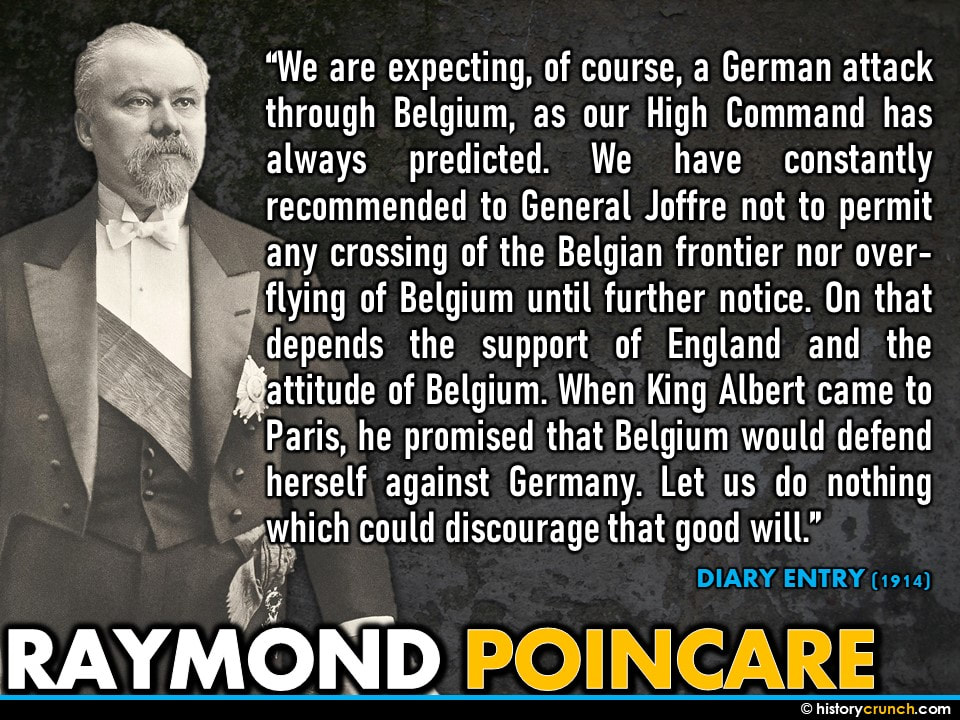
Raymond Poincaré was born on August 20th, 1860 CE in Bar-le-Duc, in the Lorraine region of northeastern France. His father was a successful engineer and the family was comfortably middle class. Poincaré was an exceptionally gifted student from a young age and excelled in his studies throughout his education. However, when he was just ten years old the Franco-Prussian War broke out and German troops advanced into Lorraine. Poincaré later recalled that he began keeping a personal journal as a young boy during this period, writing down his thoughts as he and his family fled from the advancing German forces. The experience of watching German soldiers occupy his hometown left a lasting impression on him that influenced his political views for the rest of his life.
After completing his education Poincaré studied law at the University of Paris and qualified as a lawyer in 1882 CE. He quickly established himself as a talented and successful lawyer, but his ambitions extended beyond the law. In 1887 CE he was elected as a Deputy for the Meuse region in the French parliament, beginning a political career that would last for more than four decades. He rose rapidly through the political ranks, serving in a series of cabinet positions including Minister of Education and Minister of Finance in the 1890s. For instance, he became France’s youngest ever cabinet minister when he was appointed Minister of Education in 1893 CE at the age of thirty-three. As such, Poincaré established himself early in his career as one of the most able and talented politicians in France.
Raymond Poincaré as Prime Minister
After a period away from cabinet politics in which he focused on his law career and served in the Senate, Poincaré returned to national prominence in January of 1912 CE when he was appointed Prime Minister of France. He also served simultaneously as Minister of Foreign Affairs, giving him enormous control over France’s domestic and foreign policy. This was a particularly important moment in European history, as tensions between the major powers were rising sharply and the threat of war was becoming increasingly real.
As Prime Minister, Poincaré focused intensely on strengthening France’s military and diplomatic position in the face of what he saw as the growing threat from Germany. For instance, he passed legislation extending the length of compulsory military service from two years to three years, significantly increasing the size of the French army. He also worked hard to strengthen France’s alliances with Britain and Russia, which together with France formed a defensive alliance known as the Triple Entente. The Triple Entente was an informal grouping of three major powers who agreed to support each other in the event of conflict with the opposing Triple Alliance of Germany, Austria-Hungary and Italy. Poincaré visited Russia in August of 1912 CE to reinforce the alliance between the two countries and made clear that France would stand firmly by its commitment to support Russia in a crisis. As such, his time as Prime Minister set France on a firm course of military preparedness and alliance building in the years immediately before World War I.
Raymond Poincaré as President of France
In January of 1913 CE, Poincaré was elected President of France, a move that surprised many political observers since the presidency was at that time a less powerful office than the prime ministership. However, Poincaré was determined to use the presidency more actively than his predecessors had. Unlike earlier French presidents who had largely stayed in the background, Poincaré worked hard to make the presidency a genuinely influential position in French political life. For instance, he took a close personal interest in foreign policy decisions, insisted on being kept fully informed by his ministers and used his moral authority as head of state to influence the direction of government policy.
In July of 1914 CE, as the crisis following the assassination of Archduke Franz Ferdinand of Austria-Hungary was building toward war, Poincaré was in the middle of an official visit to Russia. The assassination of Franz Ferdinand had taken place on June 28th, 1914 CE in Sarajevo, the capital of the Austro-Hungarian province of Bosnia and Herzegovina, and had set off a rapid series of events that threatened to drag all of Europe into conflict. Poincaré used his time in Russia to reinforce France’s commitment to the alliance and to discuss the developing crisis with Russian leaders. He returned to France just as the situation was spiraling toward war. When war was declared in August of 1914 CE, Poincaré made one of the most famous speeches of his presidency, calling on all French people to set aside their political differences and unite behind the war effort. He called this national unity the Union Sacrée, which means Sacred Union in French, and the phrase became one of the most famous expressions of French patriotism during the entire war.
Raymond Poincaré During World War I
Throughout the four years of World War I, Poincaré worked to maintain French unity, support the war effort and keep France’s alliances strong. In general, World War I was one of the most destructive conflicts in human history. It lasted from 1914 until 1918 and killed millions of soldiers and civilians across Europe and beyond. France bore an enormous share of the fighting, as much of the Western Front, which was the main line of battle between the Allied and German forces, ran directly through French territory. Cities and towns in northern and northeastern France were destroyed, farmland was devastated and the French army suffered catastrophic casualties in battles such as Verdun and the Somme.
Poincaré visited the front lines and military hospitals throughout the war, using his presence to boost morale among soldiers and civilians alike. For instance, in October of 1916 CE he traveled to Verdun and awarded the city the Cross of the Legion of Honour, France’s highest decoration, in recognition of the suffering its people had endured during one of the most brutal battles of the entire war. The Battle of Verdun lasted from February to December of 1916 CE and resulted in approximately 700,000 casualties on both sides, making it one of the bloodiest battles in human history.
One of the most difficult decisions of Poincaré’s presidency came in November of 1917 CE, when he appointed his longtime political rival Georges Clemenceau as Prime Minister. Poincaré personally disliked Clemenceau intensely and the two men had clashed repeatedly throughout their political careers. However, with France facing military crisis and growing war weariness among its people, Poincaré concluded that Clemenceau was the strongest and most determined leader available to take charge of the war effort. Setting aside his personal feelings, he invited Clemenceau to form a government. Clemenceau, known as the Tiger for his fierce and combative personality, proved to be an extraordinarily effective wartime leader and played a major role in France’s eventual victory in 1918 CE. As such, Poincaré’s willingness to put the interests of France ahead of his personal rivalry with Clemenceau was one of the most significant and selfless decisions of his presidency.
Raymond Poincaré and the Treaty of Versailles
World War I ended on November 11th, 1918 CE when Germany signed an armistice bringing the fighting to a stop. The following year, the leaders of the Allied nations gathered in Paris to negotiate the terms of a formal peace settlement. The result of these negotiations was the Treaty of Versailles, which was signed on June 28th, 1919 CE. The Treaty of Versailles was the main peace agreement that ended World War I. It imposed a series of harsh conditions on Germany, including the requirement to accept responsibility for causing the war, to pay large sums of money known as reparations to the Allied nations and to give up significant territories and military capabilities.
Poincaré believed that the Treaty of Versailles did not go far enough in punishing Germany or in securing France’s future safety. He felt strongly that Germany should pay very large reparations to compensate France for the enormous destruction and loss of life that the war had caused on French soil. He also wanted stronger guarantees that Germany would not be able to rebuild its military and threaten France again in the future. However, Poincaré had little direct influence over the peace negotiations, which were dominated by Clemenceau, British Prime Minister David Lloyd George and American President Woodrow Wilson. As such, the final treaty, while harsh by any standard, did not satisfy Poincaré, and he felt that France had not secured the level of protection it needed for the future.
Raymond Poincaré and the Ruhr Occupation
After his presidential term ended in January of 1920 CE, Poincaré returned to the Senate and continued to play an active role in French politics. In January of 1922 CE he was appointed Prime Minister for the second time, also taking charge of foreign affairs. His main concern at this time was enforcing the terms of the Treaty of Versailles, particularly the requirement that Germany pay reparations. Germany was struggling economically in the postwar years and was falling behind on its reparations payments. Poincaré was determined that Germany should not be allowed to avoid its obligations under the treaty.
In January of 1923 CE, after Germany failed to deliver scheduled reparations payments, Poincaré ordered French and Belgian troops to occupy the Ruhr Valley in western Germany. The Ruhr was the industrial heartland of Germany and one of the most important centers of coal and steel production in Europe. By occupying the Ruhr, Poincaré hoped to force Germany to resume its reparations payments. The German government responded by encouraging workers in the Ruhr to go on strike and passively resist the occupation, while the German government printed large amounts of money to pay the striking workers. This caused a catastrophic collapse of the German currency, known as hyperinflation, which wiped out the savings of millions of ordinary German people and created enormous social and political instability in Germany. The occupation of the Ruhr was deeply controversial and was strongly opposed by Britain and the United States, who felt that Poincaré’s approach was too aggressive and was destabilizing Europe. The occupation was eventually ended in 1924 CE after an international agreement, known as the Dawes Plan, restructured Germany’s reparations payments. As such, the Ruhr occupation was one of the most significant and controversial actions of Poincaré’s postwar career.
Raymond Poincaré’s Later Career and Legacy
Poincaré was defeated in the elections of May 1924 CE and resigned as Prime Minister, replaced by a left-wing coalition. However, he returned to the prime ministership for a third time in July of 1926 CE when France was facing a serious financial crisis. The French franc had lost much of its value and the country’s public finances were in a state of near collapse. Poincaré acted decisively to stabilize the franc, balancing the government’s budget and fixing the franc to the gold standard at a new lower value. His economic measures were highly successful and France enjoyed a period of renewed prosperity in the late 1920s. He earned the nickname the Savior of the Franc for his role in restoring the country’s financial stability. Illness forced him to resign from office in July of 1929 CE and he spent the remaining years of his life writing his memoirs, a ten-volume work titled Au Service de la France, meaning In the Service of France.
Raymond Poincaré died on October 15th, 1934 CE in Paris at the age of seventy-four. He was one of the most significant French political figures of the early twentieth century. His deep suspicion of Germany, rooted in his childhood experience of the German occupation of Lorraine, shaped his entire approach to politics and diplomacy. He worked tirelessly throughout his career to strengthen France’s military and diplomatic position, guided his country through the devastating years of World War I and fought hard in the postwar years to ensure that Germany lived up to its obligations under the Treaty of Versailles. As such, Raymond Poincaré left a complex but significant legacy as one of the most determined and patriotic leaders in French history.