James Hargreaves: A Detailed Biography

James Hargreaves
James Hargreaves invented the spinning jenny, which was an important invention in the time of the Industrial Revolution.
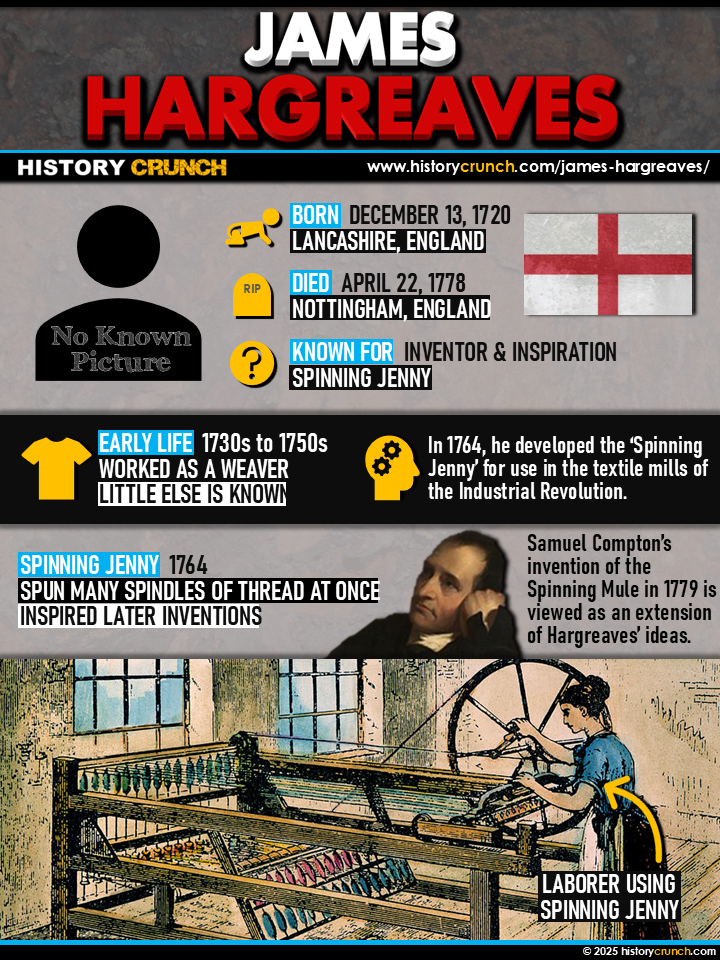
James Hargreaves was an English weaver, carpenter, and inventor who developed the spinning jenny in 1764, a multi-spindle spinning frame that significantly increased yarn production and became a key invention during the early Industrial Revolution.

Table of Contents

James Hargreaves was a significant figure in the timeframe of the Industrial Revolution and is remembered today as a noted inventor.  For example, he invented the spinning jenny, which had a profound impact on production in England and around the world during the time of the Industrial Revolution.  For instance, James Hargreaves’ spinning jenny transformed the textile industry by speeding up production.

Furthermore, other inventors used Hargreaves’ design of the spinning jenny to produce other inventions.  For example, Samuel Crompton used Hargreaves’ work to construct the spinning mule.  As such, James Hargreaves helped industrialization by inspiring other inventors.​

JAMES HARGREAVES – EARLY LIFE

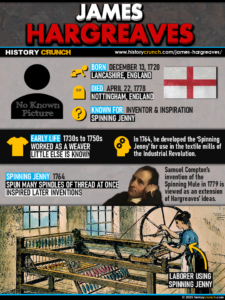
James Hargreaves was born on December 13th, 1720 in Lancashire, England.  Little is known of his early life, but he worked as a weaver, using a hand loom.  In fact, he seems to have worked as a weaver for most of his life.

JAMES HARGREAVES – INVENTION OF THE SPINNING JENNY

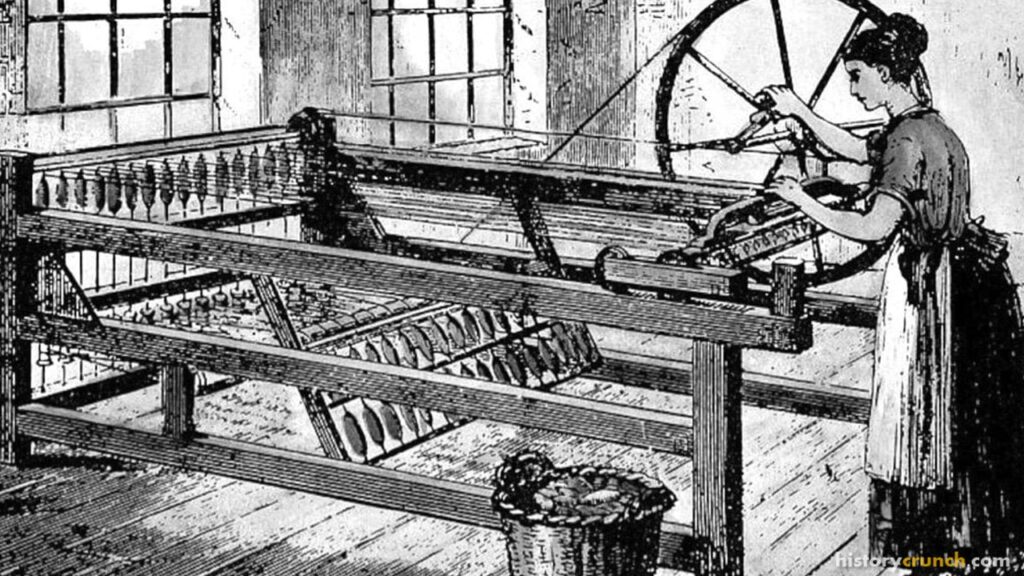
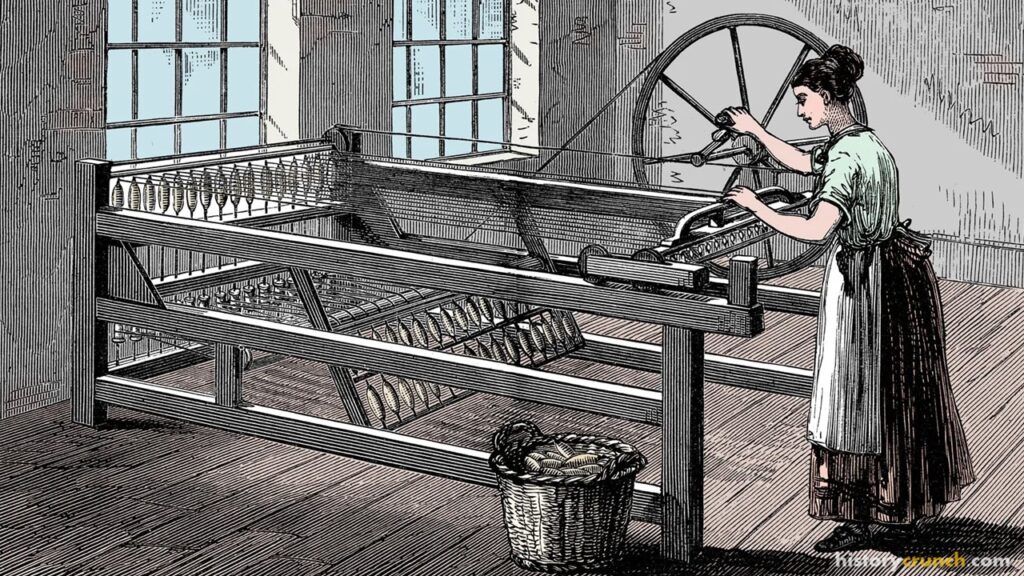
As stated above, James Hargreaves is famous for the invention of the spinning jenny in 1764.  Simply put, the spinning jenny was a machine that used a large wheel to spin many spindles of thread at once.  The invention increased the production ability of textile manufactures and was particularly important for cotton.

While Hargreaves sold his invention to several mills in the area, he made very little money from his work.  Regardless, his invention had a profound impact on the Industrial Revolution as it inspired other inventions who built off of his ideas.

For example, Richard Arkwright invented the water frame in 1759.  Arkwright’s invention was capable of producing strong yarn. The machine replaced the need for manual labour and enabled the production of inexpensive spun cotton by using the moving force of a creek or river that spun a shaft. This was important because the increased amount of energy meant that Arkwright’s water frame could produce at a higher level than Hargreaves spinning jenny.  Next, historians identify the invention of the spinning mule in 1779 by Samuel Compton, as an extension of the ideas of Hargreaves.  The spinning mule essentially allowed the fast production of yarn using a spinning machine.​

Spinning Jenny Invention in the Industrial Revolution

JAMES HARGREAVES – DEATH AND LEGACY

Hargreaves died on April 22nd, 1778, in Nottingham, England.  Today he is remembered as a significant inventor of the Industrial Revolution and furthered the process of industrialization, especially in terms of the textile industry.

JAMES HARGREAVES – INFOGRAPHIC
Facebook
X
Reddit
Pinterest
LinkedIn

We strive to produce educational content that is accurate, engaging and appropriate for all learners. If you notice any issues with our content, please contact us and let us know!

AUTHOR INFORMATION
Picture of Elias Beck

Elias Beck

I'm a passionate history and geography teacher with over 15 years of experience working with students in the middle and high school years. I have an Education Degree with a focus in World History. I have been writing articles for History Crunch since 2015 and love the challenge of creating historical content for young learners!

Augustus: A Detailed Biography

Augustus was a highly significant person and leader in the time of Ancient Rome. This article details the life and significance of Augustus, the first emperor of Rome.

Louis XIV: A Detailed Biography

Louis XIV was the King of France from 1643 to 1715 and is remembered as the most powerful example of absolute monarchy in European history. This article details the life and significance of Louis XIV.

Transcontinental Railroad Summary
Industrial Revolution

Transcontinental Railroad: A Detailed Summary

The Transcontinental Railroad, completed in 1869, was a monumental engineering feat that connected the eastern and western United States, revolutionizing transportation and commerce across the country. It was an important aspect of industrialization in the United States.

Robert E. Lee: A Detailed Biography

Robert E. Lee was the commanding general of the Confederate Army of Northern Virginia during the American Civil War, remembered as one of the most skilled military leaders of the war and the most famous symbol of the Confederate South. This article details the life and significance of Robert E. Lee.

Pope Urban II: A Detailed Biography

Pope Urban II is best known for calling the First Crusade at the Council of Clermont in 1095 CE, one of the most significant events in the history of the Middle Ages. This article details the life and significance of Pope Urban II.

Marco Polo
Age of Exploration

Marco Polo: A Detailed Biography

Marco Polo was a significant figure in the history of the Age of Exploration, the Middle Ages and the Renaissance. This article details the life and significance of Marco Polo.