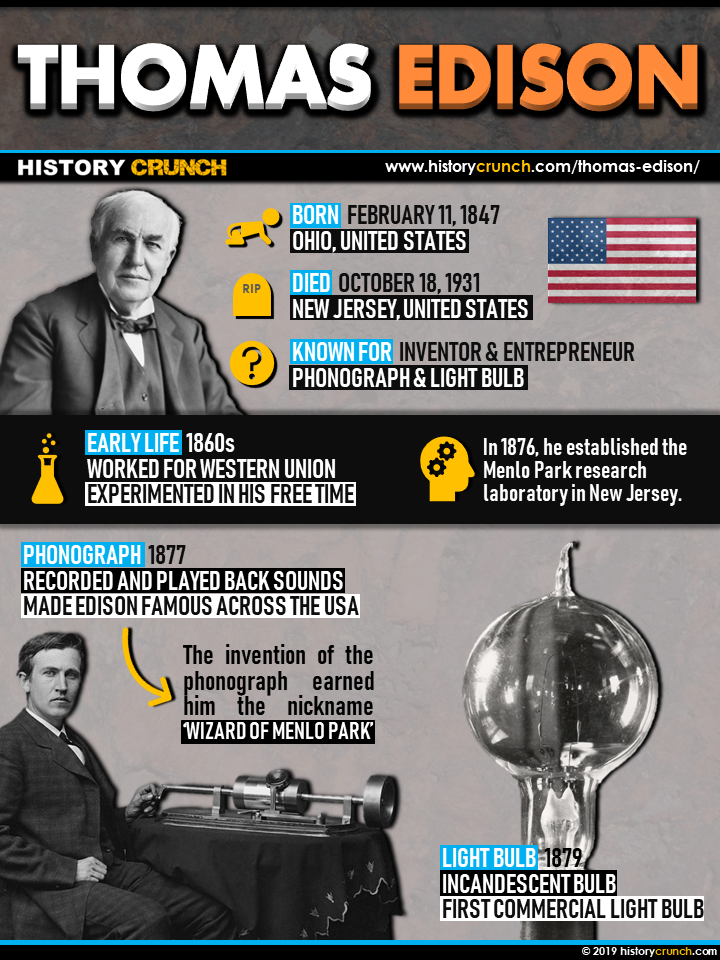
Thomas Edison was one of the most important inventors in the history of the United States. Born in Ohio in 1847, Edison is best remembered for developing the incandescent light bulb and the phonograph, two inventions that transformed daily life and industry during the late Industrial Revolution. Over the course of his lifetime he held more than 1,000 patents and founded over fourteen companies, including General Electric, which remains one of the largest publicly traded companies in the world today. This infographic was designed for students to visually summarize the key aspects of Thomas Edison’s life and significance and is based on the History Crunch article titled Thomas Edison.
Thomas Edison – Infographic
About This Infographic
This Thomas Edison infographic was created by the History Crunch team to help students and teachers quickly understand the life and significance of one of the most prolific inventors of the Industrial Revolution era. It is designed as a visual learning and study tool, summarizing the essential information covered in our full article on Thomas Edison. Teachers may use it as a classroom display, a discussion prompt, or a study aid for students preparing for assessments.
What This Infographic Covers
Thomas Edison was born on February 11th, 1847 in Ohio. He grew up in Michigan and did not attend school, instead being educated at home by his mother. As a teenager he sold candy and newspapers on trains to supplement the family income, and later worked as a telegraph operator. During his time as a telegrapher he began inventing and eventually patented his first invention, the electric vote recorder. Though none of his early inventions were particularly successful, one experiment led to a sulfuric acid spillage that got him fired, prompting him to focus on invention full time.
The infographic covers the founding of the Menlo Park Laboratory in 1876, which was one of the most important moments in Edison’s career. He built the laboratory in New Jersey using funds from the sale of his Quadruplex Telegraph, his first major commercial success. Menlo Park was not just a personal workshop but a collaborative research facility where other inventors came to train and work under Edison’s direction. Edison retained full legal ownership over all innovations produced at the lab. It was here that he developed the phonograph in 1877, the first device ever capable of recording and reproducing sound, which earned him the enduring nickname the Wizard of Menlo Park.
The centerpiece of the infographic is Edison’s invention of the incandescent light bulb. In 1878 he set out to develop a practical, long-lasting electric light that could replace the gas and oil lamps used in homes and businesses at the time. Earlier versions of the light bulb by other inventors had suffered from short lifespans and high costs. Edison obtained his patent for a carbon filament light bulb on January 27th, 1880 and made his first public demonstration on December 31st, 1879. He famously declared that he would make electricity so cheap that only the rich would burn candles. His Edison Electric Light Company began delivering electricity to customers in New York City in 1880, making it one of the first electric utility companies in the world.
The infographic also covers the competition between Edison’s Direct Current system and the Alternating Current system developed by the Westinghouse Electric Company. Edison strongly opposed the AC system but was ultimately removed from his own company by investors in 1892. His company later merged with another firm to become General Electric, one of the most significant corporations in American history.
Finally the infographic covers Edison’s death and legacy. He died on October 18th, 1931 and is remembered as one of the greatest inventors in American history. Beyond the light bulb and phonograph, his contributions extended to motion picture cameras, batteries, fluoroscopy and telegraph technology.
How to Use This Infographic in the Classroom
This infographic works well as a visual introduction to Thomas Edison before students read the full biography article or the article on the invention of the light bulb. It can also be used as a review tool before an assessment, or as a discussion prompt asking students to consider how Edison’s approach to invention, running a large research laboratory and patenting all its outputs, was different from earlier solo inventors like James Watt or John Kay. Teachers may also use it alongside related articles on the Second Industrial Revolution, the invention of the light bulb and industrialization in the United States.
Related Articles
To learn more about the topics covered in this infographic, visit the following History Crunch articles: