World War I was a conflict defined in large part by technological change. The weapons introduced and developed during the war transformed the nature of warfare in ways that the military commanders of 1914 had never anticipated, and contributed directly to the enormous scale of casualties the conflict produced. From the machine guns that made No Man’s Land nearly impossible to cross, to poison gas that brought terror to the trenches, to tanks and airplanes making their military debuts, World War I was a proving ground for modern warfare. This infographic was designed for students to visually summarize the key weapons of World War I and is based on the History Crunch articles on the Weapons of World War I.
Weapons of World War I – Infographic
About This Infographic
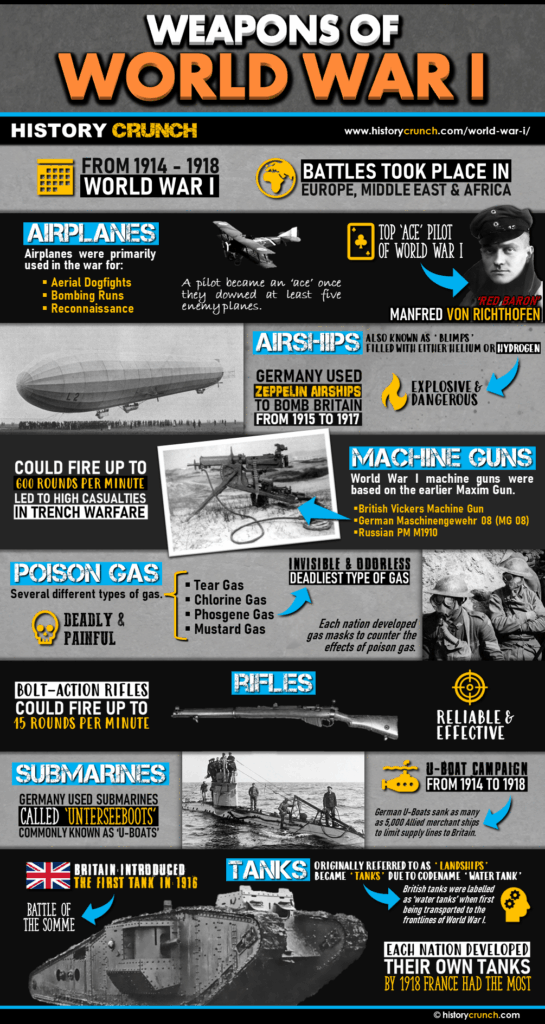
This Weapons of World War I infographic was created by the History Crunch team to help students and teachers quickly understand the role that weapons and technology played in the First World War. It is designed as a visual learning and study tool, summarizing the essential information covered in our full articles on each weapon. Teachers may use it as a classroom display, a discussion prompt, or a study aid for students preparing for assessments.
What This Infographic Covers
The infographic covers the seven main weapons of World War I.
Rifles were the standard personal weapon for infantry soldiers throughout the war. Almost every soldier on every front carried a bolt-action rifle as their primary weapon, and improvements to rifle design in the decades before the war meant that an individual infantryman could produce a rate of fire far greater than soldiers of earlier eras. Rifles were used for everything from frontline assaults to sniper duty, and were a constant feature of daily life in the trenches on all fronts.
Machine guns fundamentally changed the nature of warfare and were one of the key reasons the Western Front became a deadly stalemate. Based on the Maxim gun invented by Hiram Maxim in 1884, which could fire approximately 600 rounds per minute, machine guns gave defending forces an enormous advantage over attacking infantry. Each of the major European nations developed their own versions, including the British Vickers machine gun and the German Maschinengewehr 08. A small number of machine gunners could mow down entire waves of advancing soldiers, making the open ground of No Man’s Land extraordinarily dangerous to cross. The machine gun more than any other single weapon is responsible for the trench stalemate that defined the Western Front.
Poison gas was one of the most feared and notorious weapons of World War I, first used by Germany at the Second Battle of Ypres on April 22nd, 1915. Three main types were used during the war. Chlorine gas, the first lethal gas deployed, caused soldiers to choke and suffocate as their lungs became inflamed. Phosgene gas followed and was even more deadly, responsible for an estimated six out of every seven gas fatalities in the war, because it was colorless and its effects were sometimes not felt for up to 24 hours. Mustard gas, introduced in 1917, was less likely to kill but caused devastating injuries including severe skin blistering, eye damage and blindness. Unlike the earlier gases, mustard gas also penetrated clothing and made gas masks alone insufficient protection. Historians estimate that approximately 90,000 soldiers died from poison gas across the war. The introduction of the gas mask in 1916 reduced the overall effectiveness of gas as the war continued.
Airships, particularly the German Zeppelins, were used primarily for reconnaissance and bombing. Germany carried out 51 airship bombing raids against Britain between 1915 and 1917, killing 557 people and injuring a further 1,358. While the raids had limited military impact, they were effective in creating fear among the British civilian population. Airships were eventually replaced by airplanes, which proved more versatile and less vulnerable.
Airplanes entered the war in their most primitive form in 1914, just over a decade after the Wright Brothers’ first flight in 1903. Early aircraft were used almost entirely for reconnaissance, tracking enemy troop movements and directing artillery fire. As the war progressed, planes were fitted with machine guns and developed into dedicated fighter aircraft that engaged in aerial dogfights over the front lines. Pilots who achieved five or more aerial victories were known as aces, with Germany’s Manfred von Richthofen, the Red Baron, the most famous of the war. Bombers were also developed to strike enemy targets behind the front lines. A key technological development was the synchronization gear, first developed for Germany by Anthony Fokker, which allowed a machine gun mounted on a fighter plane to fire through the spinning propeller without destroying the blades.
Submarines, or U-boats as the German versions were known, were primarily used to attack enemy shipping in the Atlantic Ocean. Germany’s U-boat campaign aimed to cut off Britain’s supply lines by sinking merchant and transport ships. Historians estimate that as many as 5,000 ships were sunk by German U-boats during the war. Germany’s policy of unrestricted submarine warfare, which involved attacking any ship regardless of nationality, ultimately played a key role in bringing the United States into the war in 1917.
Tanks were developed by Britain specifically to break the Western Front stalemate by crossing No Man’s Land and overrunning enemy trench systems. The first British prototype, nicknamed Little Willie, was completed in 1915, and the first tank used in actual battle was the British Mark I at the Battle of the Somme in 1916. Tanks used caterpillar tracks and a rhomboidal shape to cross over trenches and were fitted with either cannons or machine guns. After Britain’s successful introduction of tanks, France and Germany developed their own versions. France produced the most tanks of any nation by the end of the war.
How to Use This Infographic in the Classroom
This infographic works well as a visual introduction to the weapons of World War I before students read the full individual articles on each weapon. It can also be used as a discussion prompt asking students to consider which weapon they think had the greatest impact on the nature and outcome of the war, or to examine how new technology creates new challenges in warfare. Teachers may also use it alongside the Life in the Trenches infographic to help students connect specific weapons with the daily trench experience of the soldiers who faced them.
Related Articles
To learn more about the topics covered in this infographic, visit the following History Crunch articles: