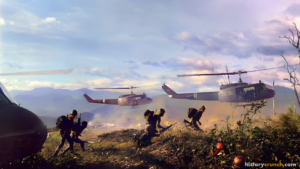
The Fall of Saigon refers to the capture of Saigon, the capital city of South Vietnam, by North Vietnamese forces on April 30th, 1975. It marked the end of the Vietnam War and the collapse of the government of South Vietnam. The event triggered a chaotic and desperate evacuation of thousands of Americans and South Vietnamese, carried out largely by helicopter in the final hours before North Vietnamese tanks crashed through the gates of the presidential palace. Vietnam was subsequently reunified under communist rule and Saigon was renamed Ho Chi Minh City. The Fall of Saigon represented a major defeat for the United States in the Cold War and had lasting consequences for American foreign policy, international relations, and the people of Vietnam.
Fall of Saigon – Background
The Vietnam War had been ongoing since the mid-1950s, when the country was divided into the communist North and the American-backed South following the end of French colonial rule. The United States gradually became more deeply involved, eventually sending over 500,000 combat troops to South Vietnam at the height of its involvement in the late 1960s. The war was enormously controversial at home, generating widespread protest and dividing American society deeply.
By the early 1970s, the United States was looking for a way to exit the conflict. The Paris Peace Accords, signed in January of 1973, provided the framework for American withdrawal. Under the agreement, the United States withdrew its combat forces while North Vietnamese forces already in South Vietnam were allowed to remain in place. The accords did not end the conflict between North and South Vietnam, and low-level fighting continued almost immediately after they were signed.
South Vietnam was left in a deeply vulnerable position. The country’s government under President Nguyen Van Thieu was corrupt and increasingly unpopular. Rampant inflation and widespread unemployment were undermining morale. The South Vietnamese army, known as the ARVN, was suffering from high desertion rates, estimated at around 24,000 troops per month by 1975. President Nixon had privately promised South Vietnam that the United States would respond with force if North Vietnam violated the peace accords, but after the Watergate scandal forced Nixon to resign in August of 1974, there was no longer any realistic prospect of renewed American military intervention. In fact, Congress had passed legislation specifically prohibiting further military action in Vietnam.
Fall of Saigon – The North Vietnamese Offensive
North Vietnam tested American resolve in December of 1974 by launching a limited attack on Phuoc Long province, north of Saigon. The province fell to North Vietnamese forces on January 6th, 1975. The United States did nothing. This confirmed to North Vietnamese leaders that American military intervention was no longer a realistic threat and emboldened them to plan a far larger offensive.
In March of 1975, North Vietnamese forces launched major attacks in the Central Highlands of South Vietnam. South Vietnamese President Thieu made the fateful decision to order a withdrawal of South Vietnamese forces from the highlands, hoping to consolidate his defenses closer to Saigon. The withdrawal turned into a catastrophic rout. Retreating soldiers and terrified civilians clogged the roads together, spreading panic and disintegrating military discipline. Major cities fell in rapid succession. Hue, the ancient imperial capital, fell on March 25th. Da Nang, South Vietnam’s second largest city, fell on March 29th. By early April, the North Vietnamese advance had accelerated far beyond what anyone had predicted. A CIA assessment issued in early March had suggested South Vietnam could hold out at least through the end of 1975. That assessment proved completely wrong.
North Vietnamese forces captured the town of Xuan Loc, the last major defensive position east of Saigon, on April 21st, 1975, after a fierce battle in which the South Vietnamese 18th Division fought courageously before being overwhelmed. On the same day, President Thieu resigned in a televised address, bitterly denouncing the United States for abandoning South Vietnam. By April 27th, approximately 100,000 North Vietnamese troops had completely encircled Saigon.
Fall of Saigon – The Evacuation
As North Vietnamese forces closed in on Saigon, the United States faced the urgent task of evacuating its remaining personnel and as many South Vietnamese allies as possible. Approximately 5,000 Americans were still in Saigon at this point, including diplomats, CIA officers, and military advisors. Tens of thousands of South Vietnamese who had worked with the Americans also desperately sought to flee.
The evacuation was initially conducted through Tan Son Nhut Air Base, with military aircraft flying people out to American ships waiting offshore in the South China Sea. On the morning of April 29th, 1975, North Vietnamese forces shelled the air base, killing two American marines and destroying aircraft on the ground. With the air base unusable, the only remaining option was a helicopter evacuation directly from the city.
The operation was code-named Operation Frequent Wind. Armed Forces Radio broadcast the coded evacuation signal, which was the playing of Bing Crosby’s White Christmas followed by the announcement that the temperature in Saigon was 105 degrees and rising. Those who recognized the signal made their way to pre-arranged pickup points across the city. Helicopters flew continuously between Saigon and the American fleet offshore through the night of April 29th and into the morning of April 30th. More than 10,000 people crowded around the American embassy, desperate to secure a place on the helicopters. The images of desperate crowds clambering over walls and pressing toward helicopter landing zones became some of the most iconic and haunting photographs of the Vietnam War.
In total, Operation Frequent Wind evacuated approximately 7,000 people, including around 5,500 South Vietnamese, in less than 24 hours. Thousands more South Vietnamese who had hoped to be evacuated were left behind when the last helicopters departed. The final American marines left the embassy roof just after dawn on April 30th, 1975.
Fall of Saigon – The Capture of Saigon
Hours after the last American helicopter departed, North Vietnamese tanks advanced on the presidential palace at the heart of Saigon. At approximately 11:30 in the morning of April 30th, 1975, a North Vietnamese tank crashed through the gates of the Independence Palace. General Duong Van Minh, who had become South Vietnam’s last president just days earlier, was waiting inside with his cabinet. He offered his unconditional surrender. A North Vietnamese officer replied that there was nothing to hand over, only surrender. The Vietnam War was over.
The Viet Cong flag was raised over the palace and the city. North Vietnamese soldiers occupied key positions throughout Saigon without significant resistance. Later that day, the city was officially renamed Ho Chi Minh City in honor of North Vietnam’s long-serving leader who had died in 1969. In 1976, North and South Vietnam were formally reunified as the Socialist Republic of Vietnam with its capital in Hanoi.
Fall of Saigon – Aftermath
The aftermath of the Fall of Saigon was deeply painful for millions of people. In the months and years that followed, the new communist government of unified Vietnam sent hundreds of thousands of people who had been associated with the South Vietnamese government or military to re-education camps, where many were held for years under harsh conditions. Political repression, economic hardship, and the disruption caused by collectivization of the economy drove enormous numbers of Vietnamese to flee the country. These refugees, many of whom escaped in overcrowded and unseaworthy boats, became known as the boat people. Hundreds of thousands of Vietnamese refugees eventually settled in the United States, France, Australia, Canada, and other countries.
Fall of Saigon – Significance
The significance of the Fall of Saigon in the history of the Cold War is considerable. For the United States it was a deeply traumatic defeat that raised urgent questions about the limits of American power and the wisdom of the country’s Cold War strategy of containing communism through military intervention. The Vietnam War had cost more than 58,000 American lives and vast amounts of money. Its failure contributed to a period of American self-doubt and reluctance to commit military forces abroad that lasted well into the 1980s.
The Fall of Saigon also had important consequences for how the Cold War was conducted more broadly. The visible American defeat emboldened the Soviet Union to support communist and revolutionary movements in Africa, Asia, and Latin America in the years that followed, contributing to a more assertive Soviet foreign policy in the late 1970s. For the people of Vietnam, the end of the war brought peace after decades of conflict but also authoritarian government, economic hardship, and for many the trauma of displacement and refugee status.
As such, the Fall of Saigon stands as one of the most consequential events of the Cold War era, a turning point that reshaped American foreign policy, altered the strategic balance of the Cold War, and profoundly affected the lives of millions of people in Vietnam and around the world.