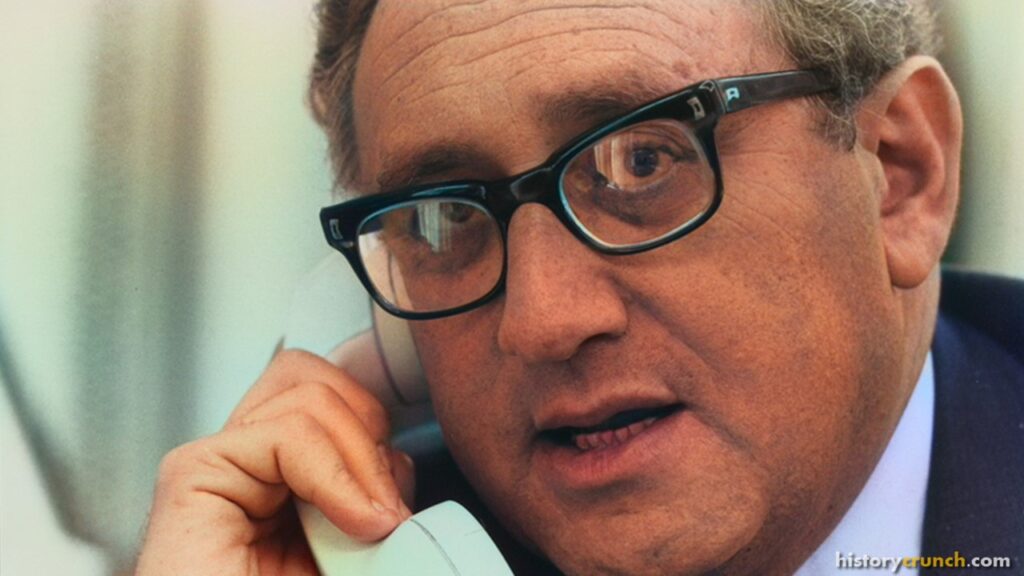
Henry Alfred Kissinger served as National Security Advisor from 1969 to 1975 and as Secretary of State from 1973 to 1977 under Presidents Richard Nixon and Gerald Ford, making him the first person to hold both positions simultaneously. He was born in Germany in 1923, fled Nazi persecution as a Jewish teenager, served in the United States Army during World War II, and rose through Harvard University to become one of America’s most influential foreign policy thinkers before entering government. His diplomatic achievements included opening relations with China, pursuing detente with the Soviet Union, and negotiating the Paris Peace Accords to end direct American involvement in Vietnam. He was awarded the Nobel Peace Prize in 1973, though the award was deeply controversial. He remains one of the most debated figures in modern American history, celebrated by some as a diplomatic genius and condemned by others for actions that critics argue caused serious harm to people in Vietnam, Cambodia, Chile, and elsewhere. He died on November 29th, 2023, at the age of 100.
Early Life of Henry Kissinger
Henry Alfred Kissinger was born on May 27th, 1923, in the small Bavarian town of Furth in Germany. He was the eldest son of Louis Kissinger, a schoolteacher, and Paula Stern. The family was Jewish, and Henry’s childhood was shaped by the rapidly deteriorating conditions for Jewish people in Germany following the rise of Adolf Hitler and the Nazi Party. The family experienced increasing discrimination and violence as Hitler’s government implemented anti-Jewish laws. In 1938, when Henry was fifteen, the family fled Germany and emigrated to the United States, settling in the Washington Heights neighborhood of New York City. The experience of being a Jewish refugee from Nazi Germany had a profound and lasting effect on Kissinger’s worldview, shaping his deep belief in the importance of stability, order, and the balance of power in international relations.
In the United States, Kissinger attended high school in New York and began studying at the City College of New York while working in a shaving brush factory to help support his family. In 1943, he was drafted into the United States Army. His intelligence and language skills quickly came to the attention of his superiors, and he was assigned to the Counter Intelligence Corps in Germany. After the war ended, he remained in Germany as part of the occupation administration, working to identify and arrest former Gestapo and SS officers. The experience gave him a firsthand understanding of the mechanics of political power and the consequences of its abuse that informed his thinking for the rest of his life.
Henry Kissinger – Rise in Politics
After his military service, Kissinger enrolled at Harvard University on the GI Bill, graduating summa cum laude in 1950 and completing his doctoral dissertation in 1954. His dissertation, later published as A World Restored, examined the Congress of Vienna and Metternich’s approach to building a stable European order after the Napoleonic Wars. The subject was not accidental. Kissinger was deeply influenced by Metternich’s concept of the balance of power and his pragmatic approach to diplomacy, and these ideas shaped his entire subsequent career in government.
Kissinger became a professor at Harvard and established himself as one of America’s leading thinkers on nuclear weapons strategy and foreign policy. His 1957 book Nuclear Weapons and Foreign Policy argued that the United States needed a more flexible approach to nuclear strategy and brought him to wide attention outside academia. He served as a consultant to government agencies and to the presidential campaigns of Nelson Rockefeller before being approached by Richard Nixon after Nixon’s election victory in November of 1968.
Nixon appointed Kissinger as his National Security Advisor in January of 1969. The appointment was surprising to many, as Kissinger had been associated with the Rockefeller wing of the Republican Party rather than with Nixon. However, both men shared a pragmatic, power-based approach to foreign policy that placed strategic interests above ideological considerations. Nixon later remarked about Kissinger that he did not trust him but could use him, capturing the complex and mutually exploitative nature of their relationship.
Henry Kissinger – National Security Advisor and the Vietnam War
As National Security Advisor, Kissinger became the dominant figure in American foreign policy alongside Nixon, often bypassing the State Department and conducting diplomacy directly through his own office. His approach was rooted in the concept of Realpolitik, meaning a foreign policy based on practical national interests and the balance of power rather than on moral or ideological principles. This approach produced both his greatest achievements and his most serious controversies.
The Vietnam War dominated Kissinger’s early years as National Security Advisor. Nixon had promised peace with honor during his 1968 campaign, and Kissinger was tasked with finding a way to extricate the United States from the conflict without a humiliating defeat. He pursued Vietnamization, the gradual transfer of military responsibility to South Vietnamese forces combined with a phased withdrawal of American troops. At the same time, in 1969 he secretly authorized the bombing of North Vietnamese supply bases in Cambodia, a neutral country, without informing Congress. The secret bombing campaign, which continued for years, contributed to the destabilization of Cambodia and the eventual rise of the Khmer Rouge, with devastating consequences for the Cambodian people, with the events of the Cambodian Genocide.
Kissinger conducted secret negotiations with North Vietnamese representative Le Duc Tho in Paris over several years, working outside the formal peace talks that had been underway since 1968. In October of 1972, he and Tho reached a draft agreement that Kissinger announced publicly with the declaration that peace is at hand. The agreement fell apart when South Vietnamese President Thieu refused to accept its terms. Nixon responded by ordering the Christmas Bombing of December 1972, one of the most intensive bombing campaigns of the entire war, against North Vietnamese targets. When talks resumed in January of 1973, the Paris Peace Accords were signed on January 27th, formally ending direct American military involvement in Vietnam. Kissinger and Le Duc Tho were awarded the Nobel Peace Prize jointly for their role in the negotiations. Tho declined the prize. The award generated enormous controversy, with critics arguing that both men had prolonged rather than ended the war.
Henry Kissinger – Opening China and Detente with the Soviet Union
While managing the Vietnam War, Kissinger simultaneously pursued two of the most significant diplomatic achievements of the Cold War era: the opening of relations with China and the policy of detente with the Soviet Union.
The opening to China was one of the most dramatic diplomatic reversals in American history. The United States had refused to recognize the People’s Republic of China since the communist revolution of 1949, treating the government of Taiwan as the legitimate government of China. Kissinger recognized that improving relations with China could give the United States a strategic advantage in its competition with the Soviet Union by playing the two communist powers off against each other.
In July of 1971, Kissinger made a secret visit to Beijing, telling the press he was ill in Pakistan while actually flying to the Chinese capital for meetings with Premier Zhou Enlai. The secret trip paved the way for President Nixon’s historic visit to China in February of 1972, the first visit by a sitting American president to the People’s Republic. The opening fundamentally shifted the dynamics of the Cold War and is widely regarded as one of the most consequential diplomatic achievements in modern American history.
On the Soviet front, Kissinger championed the policy of detente, a French word meaning relaxation of tensions, seeking to reduce the risk of direct military confrontation between the United States and the Soviet Union through negotiation, arms control agreements, and expanded trade and cultural contacts. The most important product of this policy was the Strategic Arms Limitation Treaty, known as SALT I, signed in May of 1972. SALT I placed limits on the number of intercontinental ballistic missiles and submarine-launched ballistic missiles that each side could deploy. It was the first major arms control agreement between the superpowers and represented a significant step in managing the nuclear competition at the heart of the Cold War.
Henry Kissinger – Secretary of State
In September of 1973, Nixon appointed Kissinger as Secretary of State while he retained his position as National Security Advisor, making him the most powerful figure in American foreign policy. Within weeks of his appointment, the Yom Kippur War broke out when Egypt and Syria launched a coordinated attack on Israel on October 6th, 1973. Kissinger played a central role in managing the crisis, organizing an American military airlift to resupply Israel, pressing for a ceasefire, and then conducting an intensive round of shuttle diplomacy, flying repeatedly between the capitals of Israel, Egypt, Syria, and other regional powers to negotiate disengagement agreements. His shuttle diplomacy helped stabilize the situation and eventually led to the resumption of diplomatic relations between the United States and Egypt for the first time since 1967.
Kissinger remained in office after Nixon’s resignation in August of 1974 following the Watergate scandal and continued to serve as Secretary of State under President Gerald Ford. He continued to pursue detente with the Soviet Union and managed several other international crises, though the political environment he operated in became more difficult as Congress reasserted itself in foreign policy following the Vietnam War and Watergate.
Later Years and Death of Henry Kissinger
Kissinger left government when Jimmy Carter became president in January of 1977. He returned to private life as an international consultant, author, and lecturer. He founded Kissinger Associates, a geopolitical consulting firm that advised multinational corporations and governments around the world. He continued to write prolifically, producing major books including The White House Years, Years of Upheaval, Diplomacy, and On China, which remained influential works in the field of international relations. He remained an active public commentator on foreign policy well into his nineties and was consulted by presidents and foreign leaders for decades after leaving office.
Henry Kissinger died on November 29th, 2023, at his home in Kent, Connecticut, at the age of 100. He had outlived nearly all of the other major figures of the Cold War era he had helped to shape.
Significance of Henry Kissinger
The significance of Henry Kissinger in the history of American foreign policy and the Cold War is considerable and deeply contested. His supporters point to the opening to China as a masterpiece of strategic diplomacy that reshaped the international order, to detente as a policy that reduced the risk of nuclear war during one of the most dangerous periods of the Cold War, and to his shuttle diplomacy in the Middle East as a model of sustained and patient diplomatic engagement.
His critics point to the secret bombing of Cambodia and its contribution to the rise of the Khmer Rouge, the wiretapping of journalists and his own staff members, his role in supporting the overthrow of Chilean President Salvador Allende in 1973, and his approach to the Vietnam War as evidence of a foreign policy conducted without adequate regard for human rights or democratic principles. The tension between these two assessments defines his legacy.
As such, Henry Kissinger stands as one of the most consequential and controversial figures in the history of modern American diplomacy, a man whose career embodied both the achievements and the moral costs of conducting foreign policy on the basis of pure national interest and the balance of power.