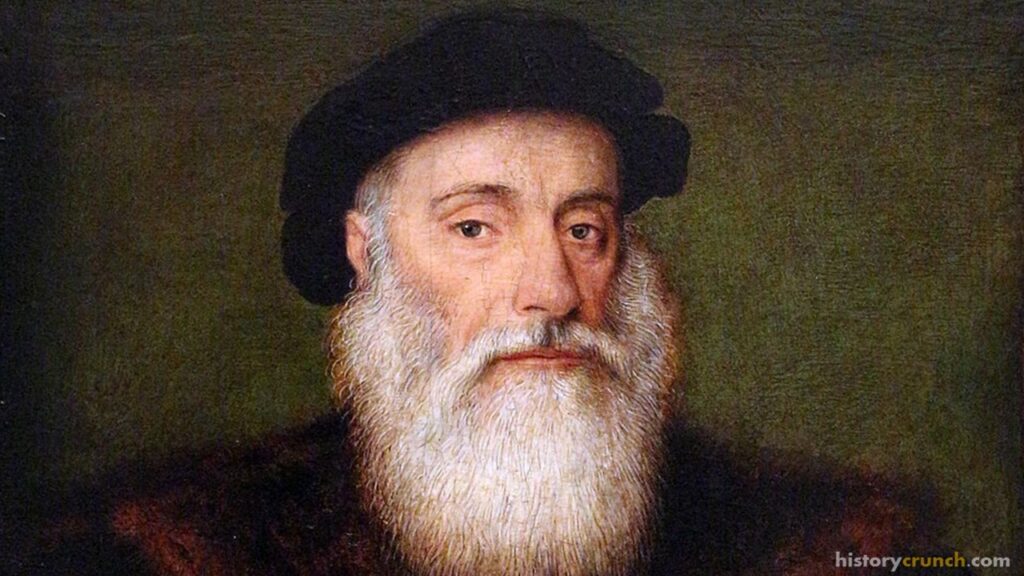
Vasco da Gama was a Portuguese explorer during the Age of Exploration. In fact, he was the first European to sail directly from Europe to India by sea, which he did by sailing around the Cape of Good Hope (South Africa). His achievements helped establish Portugal as a dominant colonial power during the Age of Exploration. His voyages had a profound impact on the course of world history.
VASCO DA GAMA – EARLY LIFE
Vasco da Gama was born in Sines, Portugal in the 1460s. However, it should be noted that the exact date of his birth is unknown. As a young man, he was likely educated in navigation, mathematics and astronomy, due to the importance of seafaring exploration for Portugal at the time. Da Gama’s father was a knight who had been a prominent figure within the Order of Santiago, and his mother, Isabel, was from a family that was well connected within Portugal, and other European countries. As such, Da Gama followed in his father’s footsteps and became a knight. In fact, Da Gama was sent on a number of expeditions as a knight. He also became a skilled sailor and navigator. For instance, Da Gama was sent on a voyage to connect Europe with the Asia via a safe route.
VASCO DA GAMA – VOYAGES IN THE AGE OF EXPLORATION
As stated above, Portugal was an important nation in the early years of the Age of Exploration. For example, Portugal, under the rule of Henry the Navigator, had already made significant progress in exploring the west coast of Africa. By the time Vasco da Gama reached adulthood, Portuguese explorers had reached along different points of the African coast, including: the equator, the Congo River and the Cape of Good Hope. The next goal for the Portuguese was to reach India by sea. This was sought after because it gave Portugal direct access to India’s spices, silks, and other luxury goods.
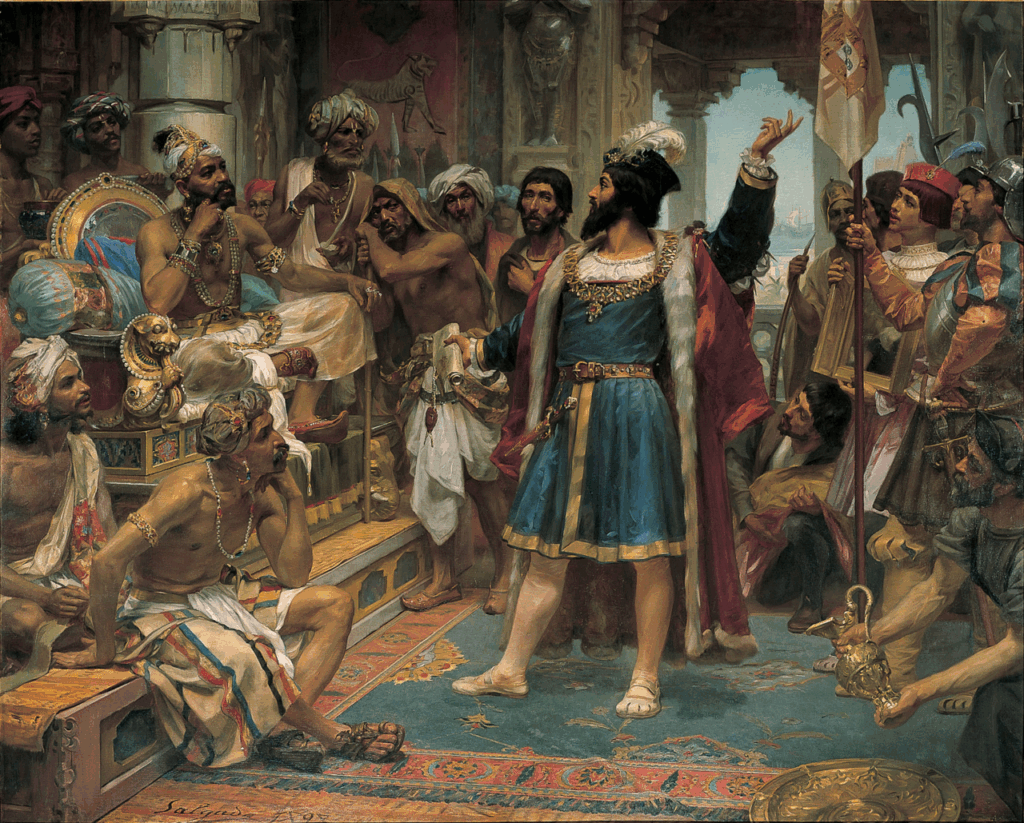
Vasco da Gama made two significant voyages to India during the Age of Exploration. He set out on the first voyage in 1497, in which he commanded four ships and about 170 men. The fleet set sail from Lisbon on July 8th, 1497, and rounded the Cape of Good Hope in southern Africa, and then sailed up the east coast of the African continent. As a result, he has been credited with being the first European to reach India by sea, and officially arrived in May of 1498. The voyage safely connected Europe and Asia, and enabled the countries to be connected for increased trade. What is more, the voyage marked the start of the age of global imperialism, and allowed the Portuguese to establish an empire in Asia. Furthermore, when he returned to Portugal in 1499, he brought back a small but valuable cargo of spices, including cinnamon and pepper.
Even after returning from India, da Gama still set sail on other expeditions. Important journeys included the trip to the Cape, the voyage to Mozambique and the trip to Mombasa which all helped to give Portugal increased power within the African nations, and helped to spread the Portuguese empire. He even went on another voyage to India, which saw him amass a large trove of rice, spices and precious metals.
Da Gama’s second voyage to India, in 1502, was a much more aggressive event. This time, he commanded a fleet of 20 heavily armed ships with the goal of increasing Portuguese dominance in the Indian Ocean. As such, the expedition focused not just on trade but on also on control over strategic regions. His military response on this second voyage was brutal and led to significant violence. For example, he bombarded Indian outposts and enforced Portuguese interests in the region through violence. By the time he returned to Portugal, da Gama had secured key trading posts and helped establish a Portuguese naval presence in the Indian Ocean, which would later evolve into a vast colonial empire stretching from East Africa to modern-day Malaysia.
VASCO DA GAMA – LATER LIFE AND DEATH
Da Gama was appointed as Governor of India in 1524 for his success as a knight, and in recognition of his monumental voyage to India. However, Da Gama died on the 24th of December 1524 in Cochin, India. He was initially buried in India, but his remains were later returned to Portugal. He remains an important figure within the history of exploration as a result of his accomplishments.
VASCO DA GAMA – SIGNIFICANCE
Vasco da Gama was a highly significant explorer during the time of the Age of Exploration. In fact, da Gama’s trip to India was a milestone in world history because the route avoided the dangerous and disputed Mediterranean Sea and Arabian Sea. As well, it enabled a safe passage for trade ships. However, the journey very long and in fact, the distance covered by da Gama’s Indian voyage was the longest expedition that had ever been made at that time. Thanks to Vasco da Gama’s successful trip, Portugal was the first European nation to reach Asia for trade, and as a result they were able to maintain control in the region for many years. In fact it took over 100 years for other European countries such as England and France to challenge Portugal’s control in this part of the world.