Religion was one of the most important aspects of life in the Aztec Empire. The Aztec were a deeply religious people who worshipped a wide pantheon of gods and expressed their beliefs through elaborate festivals, rituals, ceremonies and the construction of magnificent temples and pyramids. Their religious practices, including the controversial tradition of human sacrifice, were rooted in centuries of Mesoamerican religious history and shaped every aspect of Aztec society. This infographic was designed for students to visually summarize the key aspects of Aztec religion and is based on the History Crunch article titled Aztec Religion.
Aztec Religion – Infographic
About This Infographic
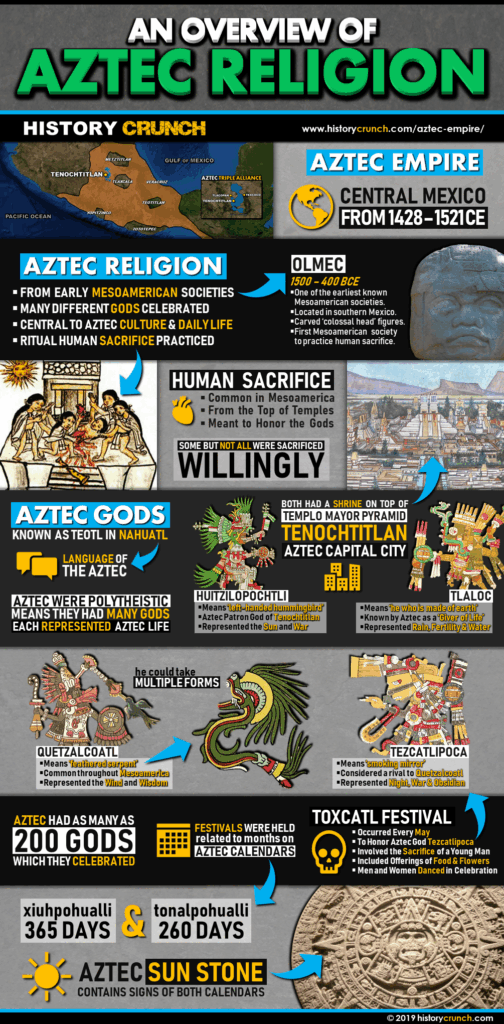
This Aztec religion infographic was created by the History Crunch team to help students and teachers quickly understand the beliefs and practices that sat at the heart of Aztec civilization. It is designed as a visual learning and study tool, summarizing the essential information covered in our full article on Aztec Religion. Teachers may use it as a classroom display, a discussion prompt, or a study aid for students preparing for assessments.
What This Infographic Covers
The infographic begins with the foundation of Aztec religious belief, which was a polytheistic system meaning the Aztec worshipped many gods. The concept of god in Aztec society is referred to as teotl in the Nahuatl language. The Aztec pantheon grew over time for two main reasons. First, the Aztec inherited many gods from the earlier Mesoamerican civilizations that preceded them, including the Olmec, Toltec and Teotihuacan. Second, as the Aztec Empire expanded and conquered rival city-states, it allowed conquered peoples to keep their own gods while requiring them to also accept Aztec gods. This meant the Aztec religious system gradually absorbed and incorporated gods from across the empire.
The infographic covers the most important gods in the Aztec pantheon. Huitzilopochtli was the god of the sun and war and was one of the most prominent gods in Aztec religion. He was closely associated with the founding of Tenochtitlan and was said to have guided the Aztec people during their long migration from the desert to the Valley of Mexico. Quetzalcoatl, the feathered serpent god, was one of the oldest and most widely worshipped deities in Mesoamerica and held great importance in Aztec religious thought. Tlaloc was the god of rain and water, vital to a civilization that depended heavily on agriculture. Tezcatlipoca, the god of the night sky and sorcery, was considered one of the most powerful gods and was often depicted as a rival to Quetzalcoatl. Mictlantecuhtli was the god of death and ruler of the underworld, reflecting the important place that death held in Aztec religious belief.
The infographic also covers the practice of human sacrifice, which is one of the most significant and controversial aspects of Aztec religion. From the perspective of the Aztec, sacrifice was not an act of cruelty but a religious necessity. In Aztec belief the world had been created through the sacrifice of the gods, and humans were therefore obligated to repay this debt through sacrifice of their own. The Aztec believed that without sacrifice the sun would stop moving, crops would fail and the universe would collapse. The most common form of sacrifice involved the removal of the heart atop a temple pyramid, most prominently the Templo Mayor in Tenochtitlan. Sacrifice was considered a great honor, as the death of the victim was understood to sustain the survival of the universe.
Finally the infographic touches on the role of temples, priests and festivals in Aztec religious life. Temples served as the physical sites of worship and sacrifice. Priests were a powerful class in Aztec society who interpreted omens, conducted ceremonies and oversaw the ritual calendar. The Aztec had a complex calendar system that organized religious festivals throughout the year, with different festivals honoring different gods through specific rituals, offerings and ceremonies.
How to Use This Infographic in the Classroom
This infographic works well as a visual introduction to Aztec religion before students read the full article. It can also be used as a review tool before an assessment, or as a discussion prompt asking students to consider how Aztec religious beliefs shaped other aspects of their society including government, warfare and daily life. Teachers may also use it alongside related articles on specific Aztec gods, human sacrifice and the Templo Mayor to help students develop a deeper understanding of the role religion played in Aztec civilization. This infographic pairs particularly well with a discussion about how the Spanish conquistadors responded to Aztec religious practices and how that shaped the events of the Spanish conquest.
Related Articles
To learn more about the topics covered in this infographic, visit the following History Crunch articles: