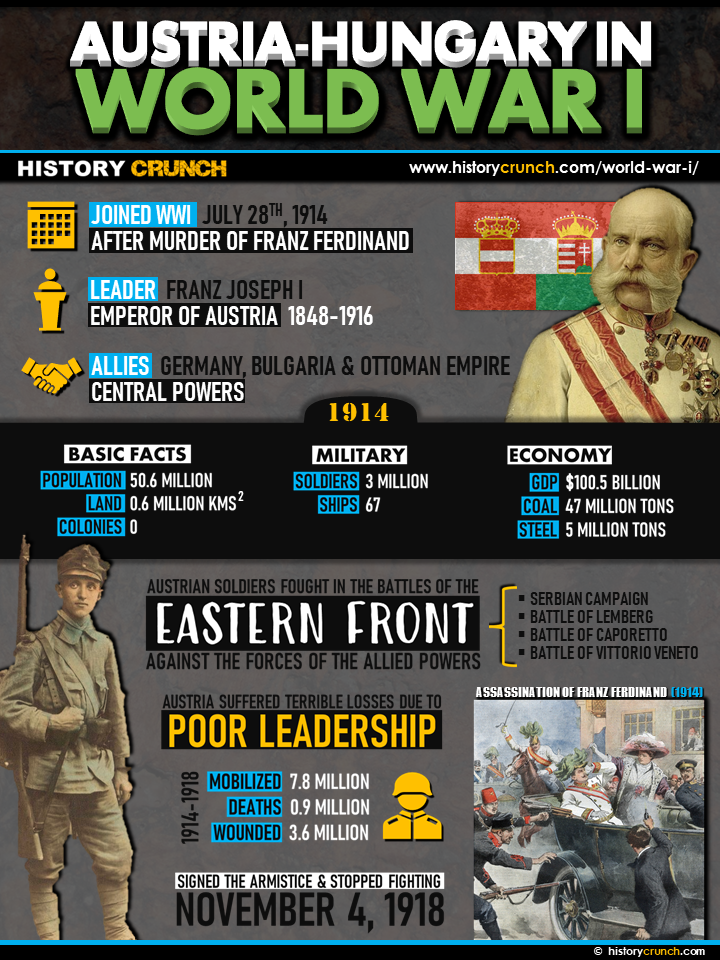
Austria-Hungary was one of the most significant nations in the history of World War I, both as the power whose actions triggered the outbreak of the conflict and as one of its main Central Powers. The assassination of Archduke Franz Ferdinand in Sarajevo on June 28th, 1914 set off the July Crisis that brought Europe to war, and it was Austria-Hungary’s declaration of war against Serbia on July 28th, 1914 that officially began World War I. Over the course of the war more than 7.8 million Austro-Hungarian soldiers served and approximately 900,000 died. The war ended with the complete dissolution of the Austro-Hungarian Empire in the fall of 1918. This infographic was designed for students to visually summarize Austria-Hungary’s role in World War I and is based on the History Crunch article titled Austria-Hungary in World War I.
Austria-Hungary in World War I – Infographic
About This Infographic
This Austria-Hungary in World War I infographic was created by the History Crunch team to help students and teachers quickly understand the significance of Austria-Hungary’s role in the First World War. It is designed as a visual learning and study tool, summarizing the essential information covered in our full article on Austria-Hungary in World War I. Teachers may use it as a classroom display, a discussion prompt, or a study aid for students preparing for assessments.
What This Infographic Covers
The infographic begins with Austria-Hungary’s role in triggering the war. On June 28th, 1914 Archduke Franz Ferdinand, the heir to the Austro-Hungarian throne, and his wife Sophie were assassinated in Sarajevo by Gavrilo Princip, a 19-year-old member of the Black Hand, a Serbian nationalist organization. Austrian authorities blamed Serbia for the assassination and issued a demanding ultimatum to the Serbian government on July 23rd, 1914. When Serbia did not fully comply, Austria-Hungary declared war on Serbia on July 28th, officially starting World War I. Russia mobilized in Serbia’s defense, Germany pledged support to Austria-Hungary, and through the alliance systems the major European powers were drawn into the conflict within weeks. Austria-Hungary entered the war as part of the Central Powers alongside Germany, Bulgaria and the Ottoman Empire.
The infographic covers the major battles Austria-Hungary fought during the war. On the Serbian Front, Austria-Hungary made three failed invasion attempts against Serbia in 1914, suffering approximately 215,000 casualties despite having a larger and more capable military. Serbia was eventually defeated in 1915 when Germany and Bulgaria joined the campaign. On the Eastern Front, Austria-Hungary faced Russia and suffered its most catastrophic defeat at the Battle of Galicia from August to September 1914, with an estimated 450,000 casualties including around 100,000 deaths. The Gorlice-Tarnow Offensive in 1915, carried out jointly with Germany, was more successful and pushed Russia back in what became known as the Great Retreat.
The Italian Front became Austria-Hungary’s primary theater after Italy joined the Allied Powers in May 1915. The 12 Battles of the Isonzo, fought along the Isonzo River from 1915 to 1917, resulted in approximately 520,000 Austro-Hungarian casualties. The twelfth and final battle, known as the Battle of Caporetto in October and November 1917, was a decisive Austro-Hungarian victory supported by German forces, pushing Italy back 93 miles and capturing nearly 275,000 Italian prisoners. However, the Battle of Vittorio Veneto in October and November 1918 reversed these gains entirely. As Austria-Hungary’s military collapsed and Hungary declared its withdrawal from the empire on October 31st, 1918, Austria-Hungary signed the Armistice of Villa Giusti on November 3rd, 1918, ending the war on the Italian Front and marking the formal dissolution of the Austro-Hungarian Empire.
The infographic also covers the Austro-Hungarian home front. The empire was a multi-ethnic state including Serbs, Poles, Ukrainians, Czechs, Slovakians and many others, all ruled by Emperor Franz Joseph I who died in November 1916 during the war and was succeeded by Charles I. Internal nationalist movements from these different ethnic groups created growing pressure from within throughout the war. The economy struggled badly with inflation estimated to have risen by as much as 1000 percent over the course of the conflict, effectively destroying people’s savings. Food rationing was imposed to prioritize supplies for soldiers, and government propaganda was used to maintain public support for the war effort.
How to Use This Infographic in the Classroom
This infographic works well as a visual introduction to Austria-Hungary in World War I before students read the full article. It can also be used as a discussion prompt asking students to consider why Austria-Hungary’s declaration of war on Serbia was so significant and how the alliance systems turned what might have been a regional Balkan conflict into a world war. Teachers may also use it alongside the WWI map and the WWI alliances map to help students understand Austria-Hungary’s geographic and strategic position at the center of the conflict.
Related Articles
To learn more about the topics covered in this infographic, visit the following History Crunch articles:
- Austria-Hungary in World War I
- Assassination of Franz Ferdinand
- July Crisis of World War I
- Central Powers of World War I
- Allied Powers of World War I
- Eastern Front of World War I
- Triple Alliance and World War I
- Causes of World War I
- World War I Overview
- Treaty of Versailles