Britain was one of the main Allied Powers of World War I and played a central role in the fighting and outcome of the conflict. Entering the war on August 4th, 1914 following Germany’s invasion of neutral Belgium, Britain brought with it not only its own forces but also the soldiers of its vast global empire, including Canada, Australia, New Zealand, South Africa and India. By the end of the war more than 6,200,000 Britons had served and approximately 800,000 had died. Britain’s contribution to the war spanned the trenches of the Western Front, the naval battles of the North Sea and Atlantic, and the politics of the peace settlement that followed. This infographic was designed for students to visually summarize Britain’s role in World War I and is based on the History Crunch article titled Britain in World War I.
Britain in World War I – Infographic
About This Infographic
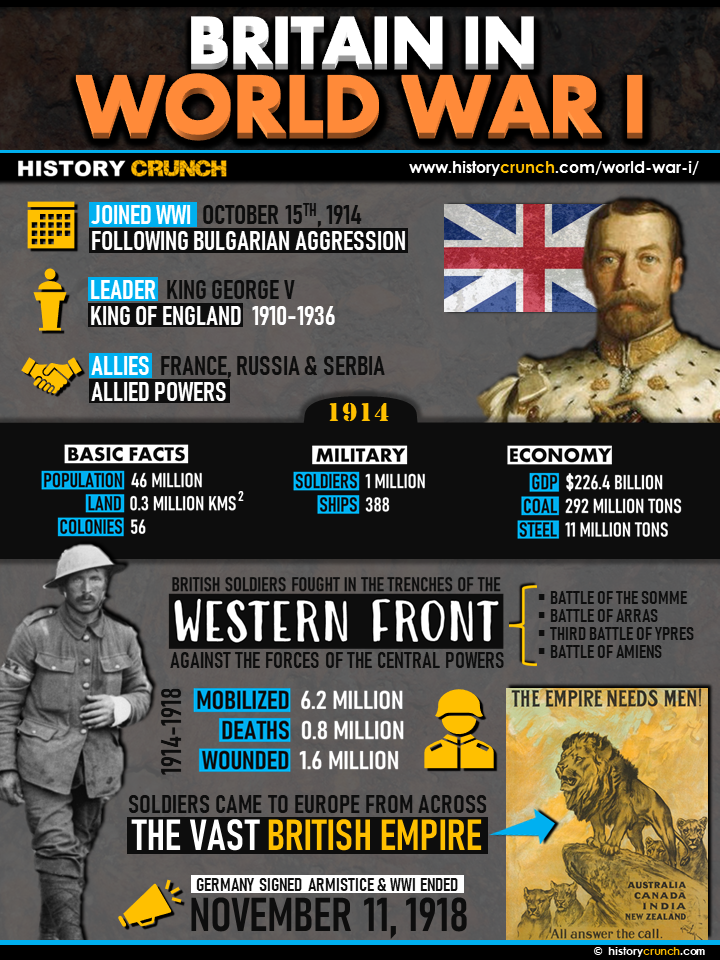
This Britain in World War I infographic was created by the History Crunch team to help students and teachers quickly understand the significance of Britain’s role in the First World War. It is designed as a visual learning and study tool, summarizing the essential information covered in our full article on Britain in World War I. Teachers may use it as a classroom display, a discussion prompt, or a study aid for students preparing for assessments.
What This Infographic Covers
The infographic begins with why Britain entered the war. Britain was a member of the Triple Entente alongside France and Russia. When Germany invaded neutral Belgium in August 1914 as part of the Schlieffen Plan, Britain was treaty-bound to protect Belgian neutrality and declared war on Germany on August 4th, 1914. Because several nations including Canada, Australia, New Zealand, South Africa and Newfoundland were Dominions of the British Empire, they were automatically drawn into the war as well, making World War I a truly global conflict.
The infographic covers Britain’s army and recruitment. At the start of the war Britain had approximately 1,000,000 soldiers, a relatively small force compared to France and Germany, and did not initially use conscription. The Regular Army and Territorial Force were combined into the British Expeditionary Force (BEF) and sent to France. A massive volunteer campaign led by Secretary of State for War Herbert Kitchener resulted in over 2.5 million British men volunteering, forming what became known as Kitchener’s Army. Conscription was eventually introduced in January 1916 and by the end of the war the British army totaled 6,200,000.
The infographic covers Britain’s navy, which was the largest in the world in 1914 with 388 ships including 29 dreadnought battleships. Britain maintained its naval dominance through the two-power standard policy, which required the Royal Navy to be larger than the next two largest navies combined. The British Navy fought the German fleet and German U-boats across the North Sea, English Channel, Atlantic and Mediterranean, protecting vital supply lines to Britain while losing an estimated 5,000 merchant and transport ships to German U-boat attacks.
The infographic covers Britain’s major battles on the Western Front, including the First and Second Battles of Ypres, the catastrophic Battle of the Somme in 1916 where the British Army suffered over 38,000 casualties on the first day alone including more than 19,000 dead, the Third Battle of Ypres (also known as Passchendaele) and the Hundred Days Offensive in 1918 that ultimately ended the war. It was at the Battle of the Somme in September 1916 that Britain also introduced tanks to the battlefield for the first time in history.
Finally the infographic covers the British home front. Women entered the workforce in large numbers for the first time, working in munitions factories and other industries, and in 1918 women over 30 were granted the right to vote through the Representation of the People Act. Food rationing was introduced, government propaganda was used extensively to maintain public support and German Zeppelin airships and bomber aircraft carried out raids on British towns and cities, killing over 1,400 people.
How to Use This Infographic in the Classroom
This infographic works well as a visual introduction to Britain in World War I before students read the full article. It can also be used as a discussion prompt asking students to consider the significance of the first day of the Battle of the Somme, or to examine how the war changed life for women and civilians on the British home front. Teachers may also use it alongside the WWI map and the Western Front map to help students understand Britain’s geographic and strategic position in the conflict.
Related Articles
To learn more about the topics covered in this infographic, visit the following History Crunch articles:
- Britain in World War I
- Western Front of World War I
- Battle of the Somme
- Trench Warfare in World War I
- Life in the Trenches
- Allied Powers of World War I
- Triple Entente and World War I
- Hundred Days Offensive
- Causes of World War I
- World War I Overview
- Australia in World War I
- Canada in World War I