A cult of personality is one of the most important concepts to understand when studying the history of dictatorships and authoritarian governments. It is a term that historians use to describe a specific type of propaganda in which the leader of a country is presented to the public in an extremely positive and often exaggerated way. In many cases, a cult of personality goes so far as to portray the leader as an almost god-like figure whose authority and greatness are beyond question. Cults of personality have appeared at various points throughout history, but they are most closely associated with the totalitarian dictatorships of the 20th century, particularly those that existed during and around the era of World War II. Understanding what a cult of personality is, and how different leaders used it, is important because it helps explain how dictators were able to maintain power over millions of people.
What is a Cult of Personality?
A cult of personality is a form of propaganda. Propaganda is any information that is designed to influence the opinions or views of a group of people, and it is a tool that has been used by governments throughout history. What makes a cult of personality unique is that it focuses specifically on the image and reputation of the leader himself. Rather than simply promoting a particular idea or policy, a cult of personality works to make the leader appear infallible, powerful, and worthy of admiration and loyalty. This is typically achieved through a combination of tools, including posters and images displayed throughout the country, newspaper coverage that only portrays the leader in a positive light, radio addresses and speeches, public ceremonies, and the use of special titles and symbols associated with the leader’s authority. In a country with a strong cult of personality, citizens are surrounded at all times by messaging that reinforces the greatness of their leader, making it very difficult for opposing ideas to take hold.
Cults of personality are closely connected to other methods that dictators use to maintain control, including censorship, indoctrination, and the use of secret police. Censorship ensures that information contradicting the leader’s image is kept from the public. Indoctrination, particularly through youth organizations and schools, helps spread the ideology of the leader to younger generations. Together, these tools work alongside the cult of personality to create a society in which the leader’s authority feels natural and unquestionable to many citizens.
Cult of Personality of Benito Mussolini
One of the earliest and most well-known examples of a cult of personality in the modern era was developed by Benito Mussolini, the fascist dictator of Italy. Mussolini seized control of the Italian government in 1922 and spent the years that followed dismantling Italy’s democratic institutions and replacing them with a totalitarian fascist state. A central part of this process was the construction of his own cult of personality.
Mussolini worked hard to present himself as a strong, commanding, and almost mythical figure to the Italian people. He was always portrayed in public in a way that emphasized his power and authority, and the image of a bold and decisive leader was carefully managed and promoted across the country. A key part of this was the title given to him during his time as dictator. He became known as “Il Duce,” which translates to “the Leader,” and this title became closely tied to his larger-than-life public image. One of the most direct tools Mussolini used to build his cult of personality was his control over the media. Italy’s main newspaper at the time was run by his own brother, and it only ever published content that was favorable towards Mussolini and his leadership. By controlling what Italians read about him, Mussolini was able to shape how he was perceived across the country. Beyond the media, Mussolini also used large public works projects and youth organizations modeled on his Blackshirt paramilitary force to promote national unity around his leadership and spread fascist values to younger generations.
Cult of Personality of Adolf Hitler
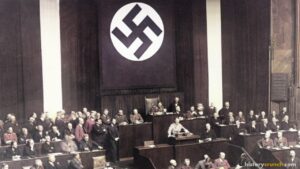
Perhaps the most powerful and far-reaching cult of personality during the World War II era was that built around Adolf Hitler, the fascist dictator of Nazi Germany. Hitler rose to power in the early 1930s and, like Mussolini before him, worked systematically to present himself as an extraordinary leader whose authority was both natural and necessary for Germany’s greatness.
Hitler was known for being a masterful public speaker. He was charismatic and deeply passionate when he spoke, and his public addresses drew enormous crowds. His speeches were a central part of his cult of personality, as they gave citizens the sense that they were in the presence of a historic and powerful figure. The Nazi Party went to great lengths to ensure that Hitler’s speeches and radio addresses could reach as many Germans as possible. For instance, the Nazi regime provided low-cost radios to German families so that Hitler’s broadcasts could be heard throughout the country. Beyond his speeches, Hitler was promoted through a massive campaign of posters, films, rallies, and other forms of propaganda. The famous Nuremberg Rallies, for example, were enormous public events designed to showcase the power of the Nazi movement and reinforce Hitler’s image as a great and unstoppable leader. His title as “Führer,” meaning “the Leader,” became a symbol of absolute authority in Germany, much like Mussolini’s “Il Duce” in Italy. In fact, Hitler had studied and admired Mussolini’s methods closely, and many of the techniques he used to build his own cult of personality were directly inspired by what Mussolini had done in Italy.
Cult of Personality of Joseph Stalin
Another prominent example of a cult of personality during this era was that of Joseph Stalin, the communist dictator of the Soviet Union. Stalin ruled the Soviet Union from 1924 until his death in 1953, and during that time he developed one of the most extensive cults of personality of any 20th-century leader.
Stalin’s cult of personality worked in a very similar way to those of Mussolini and Hitler, even though his ideology was quite different. Like them, Stalin used tight control over the media and public information to shape his image. His name “Stalin” itself was a constructed identity, as he was born Ioseb Jughashvili and adopted the name Stalin, which roughly translates to “man of steel,” as a way of projecting strength and toughness. Throughout the Soviet Union, images and statues of Stalin were displayed prominently, and he was regularly portrayed as a wise, fatherly, and all-powerful figure who had the best interests of the Soviet people at heart. This was in sharp contrast to the reality of his rule, under which millions of Soviet citizens were imprisoned in gulags, executed, or died as a result of his policies. Stalin’s cult of personality was so effective that many Soviet citizens genuinely believed in his greatness, even as his government carried out terrible acts of violence against the population.
Other Examples of Cults of Personality
While the most famous examples of cults of personality are associated with the World War II era, the concept did not begin or end with that period of history. Other notable examples have appeared at various points in the 20th and 21st centuries. In North Korea, the Kim family dynasty has maintained one of the most intense and enduring cults of personality in history. Beginning with Kim Il-sung, who founded the country, and continuing through his son Kim Jong-il and grandson Kim Jong-un, North Korean citizens have been raised in a society in which the leaders of the country are portrayed as almost divine figures. Citizens in North Korea today have very limited access to the internet or to phone communication with the outside world, which allows the government to maintain strict control over information and reinforce the cult of personality of its leader. Another modern example is that of Mao Zedong, the communist leader of China, who ruled from 1949 until his death in 1976. Like Stalin, Mao developed a powerful cult of personality in which he was portrayed as the essential and irreplaceable father of the Chinese nation.
Significance of the Cult of Personality
The cult of personality is historically significant because it reveals one of the most important ways in which dictators are able to maintain control over large populations without relying entirely on fear and violence. While all of the leaders discussed in this article also made use of secret police, censorship, and other forms of oppression, the cult of personality gave their rule a layer of popular support that pure force alone could not provide. By making themselves into admired and almost mythical figures in the minds of their citizens, these leaders were able to generate genuine loyalty and enthusiasm from at least a portion of the population. This made their regimes more stable and more difficult to challenge or overthrow.
The cult of personality also serves as an important warning for students of history. It demonstrates how powerful propaganda can be in shaping the way people think about their leaders and their governments. When citizens are given only one version of events and are surrounded by messaging that glorifies a single leader, it becomes very hard to think critically about whether that leader is truly serving the interests of the people. For these reasons, the study of the cult of personality remains one of the most important topics in understanding how dictatorships function and how they are able to cause so much harm before they are eventually brought to an end.