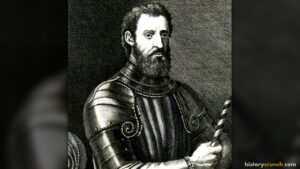
Charlemagne, also known as Charles the Great, was one of the most important rulers in the history of the Middle Ages and is often referred to as the Father of Europe. He was King of the Franks from 768 CE and went on to unite much of western Europe under his rule, becoming the first emperor to rule from the west since the fall of the Western Roman Empire centuries earlier. Charlemagne’s reign had a profound and lasting impact on the political, religious and cultural history of Europe and shaped the development of the continent throughout the Middle Ages and beyond.
Charlemagne – Early Life
Charlemagne was born on April 2nd, 748 CE, most likely in Aachen, in what is now modern-day Germany. He was the eldest son of Pepin the Short, King of the Franks, and Bertrada of Laon. Pepin the Short was an important ruler in his own right and was the first king of the Carolingian dynasty, which would go on to produce some of the most significant rulers of the Early Middle Ages. As such, Charlemagne was born into a powerful and influential family and was raised with the expectation that he would one day rule the Frankish kingdom.
When Pepin the Short died in 768 CE, he divided his kingdom between Charlemagne and his younger brother Carloman, as was the custom among the Franks. The relationship between the two brothers was difficult and tense, and the division of the kingdom created significant problems for both rulers. With that said, Carloman died unexpectedly in 771 CE, leaving Charlemagne as the sole ruler of the entire Frankish kingdom at the age of approximately twenty-three. As such, the early death of his brother was a defining moment in Charlemagne’s life and set the stage for the remarkable reign that followed.
Charlemagne – King of the Franks
As King of the Franks, Charlemagne quickly established himself as an aggressive and ambitious ruler who was determined to expand his kingdom and spread the Christian faith throughout Europe. One of his most important early military campaigns was against the Lombards, a Germanic people who controlled much of northern Italy. In 774 CE, Charlemagne invaded the Lombard kingdom and defeated its king, Desiderius, becoming King of the Lombards and significantly expanding his territory into the Italian peninsula. This conquest also strengthened his relationship with the papacy in Rome, as the Pope had long sought protection from the Lombards.
Charlemagne also waged a long and brutal series of wars against the Saxons, a Germanic people who lived in the region that is now northern Germany. The Saxon Wars lasted for approximately thirty years and were among the most difficult and violent conflicts of Charlemagne’s reign. For instance, in 782 CE, Charlemagne ordered the execution of approximately 4,500 Saxon prisoners in an event known as the Massacre of Verden, in response to a Saxon rebellion. He eventually forced the Saxons to convert to Christianity and submit to his rule, which significantly expanded the reach of both his kingdom and the Catholic faith. As well, Charlemagne conducted campaigns in other regions, including Bavaria, which he conquered in 788 CE, and parts of Spain, where he fought against Muslim forces. As such, by the height of his reign, Charlemagne controlled a vast territory that stretched from modern-day France and Germany into parts of Italy and Spain.
Charlemagne – Holy Roman Emperor
The most significant moment in Charlemagne’s reign came on Christmas Day in 800 CE, when Pope Leo III crowned him Emperor of the Romans in a ceremony at St. Peter’s Basilica in Rome. This event was one of the most important in the history of the Middle Ages and established the concept of a Christian emperor ruling over a united western Europe under the blessing of the Pope. The coronation came about in part because Pope Leo III had been attacked and driven out of Rome by his enemies and had appealed to Charlemagne for help. Charlemagne restored Leo to power and was rewarded with the imperial title.
The coronation was significant for several reasons. For instance, it symbolized the revival of the idea of a Roman Empire in the west, nearly four centuries after the fall of the Western Roman Empire in 476 CE. As well, it established a close relationship between the papacy and the secular rulers of Europe that would define the political and religious life of the Middle Ages for centuries. With that said, the coronation also created tensions with the Eastern Roman Empire, known as the Byzantine Empire, whose rulers considered themselves the rightful heirs of the Roman Empire and viewed Charlemagne’s imperial title as a challenge to their authority. As such, Charlemagne’s coronation as Holy Roman Emperor was one of the most significant political events of the Middle Ages and had lasting consequences for the history of Europe.
Charlemagne – Government and Reforms
As emperor, Charlemagne was not only a military leader but also an important administrator and reformer who worked to improve the government and organization of his vast empire. For instance, Charlemagne introduced a system of local administrators known as counts, who were appointed to govern specific regions of the empire on his behalf. He also appointed special officials known as missi dominici, which means “envoys of the lord,” who traveled throughout the empire to check on the work of local administrators and report back to Charlemagne. This system helped Charlemagne maintain control over his large and diverse empire and was an important development in the history of medieval government.
Charlemagne also worked to standardize weights, measures and currency across his empire, which helped promote trade and economic activity. As well, he introduced legal reforms and had the laws of the different peoples within his empire written down and recorded, which helped bring greater order and consistency to the administration of justice. As such, Charlemagne was not simply a conqueror but was also an effective and capable administrator whose reforms had a lasting impact on the political and economic life of medieval Europe.
Charlemagne – Carolingian Renaissance
One of the most important legacies of Charlemagne’s reign was the cultural and intellectual revival known as the Carolingian Renaissance. Charlemagne was a strong believer in the value of education and learning, even though he himself struggled to read and write and reportedly kept writing tablets under his pillow at night in order to practice. For instance, he established a palace school at Aachen, his capital, which attracted some of the greatest scholars of the time, including the English scholar Alcuin of York, who became one of Charlemagne’s most trusted advisors and helped promote education and learning throughout the empire.
Charlemagne also encouraged the establishment of schools in monasteries and cathedrals across his empire and promoted the copying and preservation of ancient texts. For instance, many of the ancient Latin manuscripts that survived the Middle Ages did so because they were copied by monks working in the monasteries that Charlemagne supported. As well, Charlemagne promoted the use of a standardized form of Latin script known as Carolingian minuscule, which made written texts much easier to read and helped spread literacy across Europe. As such, the Carolingian Renaissance was one of the most important cultural developments of the Early Middle Ages and helped preserve the knowledge of the ancient world for future generations.
Charlemagne – Later Life
In the final years of his reign, Charlemagne faced a number of difficulties. For instance, the Saxon Wars had stirred up anger among the Scandinavian kingdoms to the north, and Viking raids on the coasts of his empire began to increase in the years before his death. As well, Charlemagne’s health declined significantly in his later years, and he suffered from fevers and a limp. Despite this, he continued to govern his empire actively until the very end of his life. In 813 CE, Charlemagne crowned his son Louis, known as Louis the Pious, as co-emperor to ensure a smooth transfer of power after his death.
Charlemagne – Death and Legacy
Charlemagne died on January 28th, 814 CE, at his palace in Aachen, at the age of approximately seventy-two. He was buried at the cathedral in Aachen, which he had worked to build during his lifetime. His death was mourned across Europe and was considered a great loss by his contemporaries.
Following his death, the empire that Charlemagne had built did not survive intact for long. His son Louis the Pious proved unable to hold the empire together, and after Louis’s death in 840 CE, the empire was divided among his three sons under the Treaty of Verdun in 843 CE. This division created the foundations of what would eventually become the modern nations of France and Germany. With that said, Charlemagne’s legacy endured long after the breakup of his empire. He is remembered today as one of the most important rulers of the Middle Ages and one of the founding figures of European civilization. For instance, he is often referred to as the Father of Europe because of his role in uniting the continent and laying the political, religious and cultural foundations of medieval European society. As such, Charlemagne’s impact on the history of Europe was enormous and his influence continued to be felt throughout the Middle Ages and beyond.