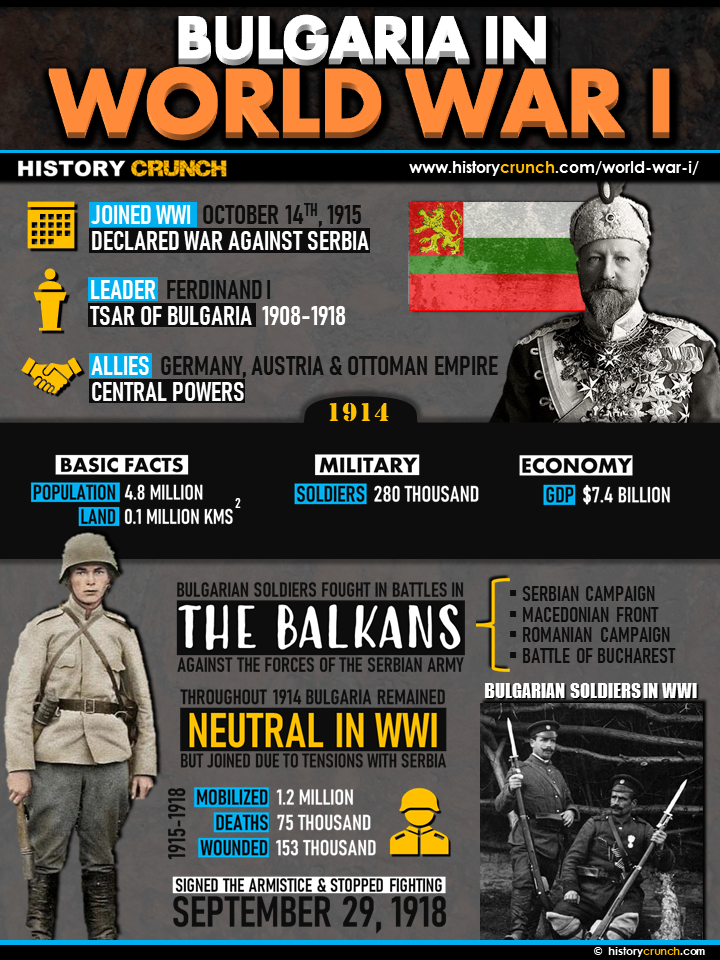
Bulgaria was the last of the four Central Powers to enter World War I, joining the conflict in October 1915 on the side of Germany, Austria-Hungary and the Ottoman Empire. Unlike the other major powers, Bulgaria remained neutral for over a year after the war began, carefully weighing its options before siding with the Central Powers in exchange for promised territorial gains in the Balkans. Over the course of the war more than 1.2 million Bulgarians served and approximately 75,000 died. Bulgaria’s participation was primarily focused on the Balkans, where its forces played a key role in defeating Serbia. This infographic was designed for students to visually summarize Bulgaria’s role in World War I and is based on the History Crunch article titled Bulgaria in World War I.
Bulgaria in World War I – Infographic
About This Infographic
This Bulgaria in World War I infographic was created by the History Crunch team to help students and teachers quickly understand the significance of Bulgaria’s role in the First World War. It is designed as a visual learning and study tool, summarizing the essential information covered in our full article on Bulgaria in World War I. Teachers may use it as a classroom display, a discussion prompt, or a study aid for students preparing for assessments.
What This Infographic Covers
The infographic begins with Bulgaria’s background and why it entered the war when it did. In the years before World War I, Bulgaria had been heavily involved in the Balkan Wars of 1912 and 1913. In the First Balkan War, Bulgaria was the strongest member of the Balkan League and fought alongside Serbia and Greece against the Ottoman Empire. However, dissatisfied with the territorial outcome, Bulgaria started the Second Balkan War against its former allies, suffering serious losses and being forced to give up territory through the treaties that ended the conflict. As a result, Bulgaria entered 1914 still recovering militarily and economically from these conflicts and declared itself neutral when World War I began in the summer of 1914.
The infographic covers Bulgaria’s decision to join the Central Powers. As the war dragged on into a stalemate in 1915, both the Allied Powers and the Central Powers competed to bring Bulgaria into the conflict on their side. Both sides offered Bulgaria territorial incentives in the Balkans. Bulgaria ultimately chose the Central Powers, partly because they offered more favorable territorial promises and partly because of existing resentments toward Serbia dating from the Second Balkan War. Bulgaria formalized its agreement with the Central Powers on September 6th, 1915 and declared war on Serbia on October 14th, 1915, formally entering World War I under the leadership of Tsar Ferdinand I and with commander-in-chief Nikola Zhekov leading its forces.
The infographic covers Bulgaria’s army and its major battles. When Bulgaria entered the war it had approximately 280,000 soldiers, expanding to over 1.2 million over the course of the conflict through a conscription system that required men to serve from age 20 until approximately age 40. However Bulgaria was a smaller and less industrialized nation, lacking the artillery ammunition, naval power and air force of the other major European powers. Bulgaria’s fighting was concentrated almost entirely in the Balkans. Its forces invaded Serbia on October 14th, 1915 alongside Germany and Austria-Hungary, and the Bulgarian First and Second Armies pushed quickly into Serbia, overrunning Serbian border defenses and capturing key towns and transportation routes. By November 24th, 1915 the Serbian Campaign was effectively over and Serbia was occupied by the Central Powers for the remainder of the war.
The infographic also covers the Bulgarian home front. With a population of approximately 4.8 million people living primarily in rural areas, Bulgaria lacked the industrial capacity of other European nations and struggled economically during the war. The country was a constitutional monarchy under Tsar Ferdinand I, who ruled throughout the war until abdicating in 1918 following Bulgaria’s defeat. The government used propaganda to maintain public support for the war effort. Bulgaria accepted defeat and signed the Armistice of Salonica on September 30th, 1918. The terms of Bulgaria’s peace settlement were finalized in the Treaty of Neuilly of 1919 and Ferdinand I was succeeded as Tsar by his son Boris III.
How to Use This Infographic in the Classroom
This infographic works well as a visual introduction to Bulgaria in World War I before students read the full article. It can also be used as a discussion prompt asking students to consider why Bulgaria delayed entering the war for over a year and what factors influenced its decision to join the Central Powers rather than the Allied Powers. Teachers may also use it alongside the WWI alliances map and the articles on the Central Powers and the Balkan Crisis to help students understand Bulgaria’s wider role in the lead-up to and events of World War I.
Related Articles
To learn more about the topics covered in this infographic, visit the following History Crunch articles: