The Central Powers of World War I included some of the most powerful nations at the time, including: Germany, Austria-Hungary, the Ottoman Empire and Bulgaria. World War I first began in 1914 from a series of important causes that included the assassination of Austrian Archduke Franz Ferdinand. The fighting continued until 1918 and saw the Central Powers face off against the Allied Powers in battlefields across Europe, Africa and the Middle East. The main nations of the Allied Powers of World War I included: France, Russia and the United Kingdom (Britain). Many of the most notable battles between the Central Powers and the Allied Powers occurred on the two fronts in Europe, which included the Western Front and the Eastern Front.
TRIPLE ALLIANCE AND THE START OF WORLD WAR I
In the years before World War I first began, Europe was divided by two different alliance systems, which included the Triple Alliance and the Triple Entente. The Triple Alliance was made up of Germany, Austria-Hungary and Italy, while the Triple Entente was made up of France, Russia and the United Kingdom. In general, the Triple Alliance was a mutual defense alliance between the member nations. This means that each nation agreed to come to the military aid and defense of the other member nations in the event that they were attacked. The Triple Alliance was first formally established by the member nations on May 20th, in 1882. The Triple Alliance was significant because it led to the creation of the Central Powers.

However, it should be noted that Italy sided with the Triple Entente as it considered Austria-Hungary to be the aggressor in the lead up to World War I. This is because, following Ferdinand’s death, Austria-Hungary began taking aggressive actions against Serbia, which was located in the Balkans. As a result, Italy declared war against Austria-Hungary as the start of World War I, and joined the Allied Powers alongside France, Britain and Russia. More specifically, Italy officially left the Triple Alliance on May 3rd in 1915. Whereas, Austria-Hungary and Germany formed the Central Powers with the Ottoman Empire and Bulgaria.
The event that sparked the creation of the Central Powers was the assassination of Austrian Archduke Franz Ferdinand on June 28th, 1914. Pro-Serbian nationalists killed Ferdinand and his wife Sophie in the city of Sarajevo. The assassination of Ferdinand obviously angered Austria-Hungary and caused them to threaten the government of Serbia. In response, Russia came to the defense of Serbia. Russia did this as part of its larger movement for Pan-Slavism. Pan-Slavism was the theory that supported the promotion of all Slavic people of which Russians and Serbians were both. As such, Russia wanted to support the Serbians against Austro-Hungarian aggression because Russia viewed Serbians as sharing a similar ethnic heritage. After Russia came to the defense of Serbia, Germany pledged its support to Austria-Hungary in the form of a ‘blank check’, meaning Germany was offering Austria-Hungary its unlimited support. This act by Germany caused an alliance between Russia and France to take effect and both France and Britain were pulled into the conflict in support of Russia. As such, the Allied Powers of World War I were established and faced off against the Central Powers in a brutal and devastating war.

CENTRAL POWERS OF WORLD WAR I OVERVIEW
As stated above, the main Central Powers of World War I was Germany, Austria-Hungary, Bulgaria and the Ottoman Empire. Each of these four nations differed greatly in terms of their resources and military capabilities. For example, Germany had some overseas colonies from which they could gather more resources, while others such as Austria-Hungary and Bulgaria had no colonies. As well, Germany had both a strong naval force and army at the outbreak of World War I in 1914. For example, what truly made Germany a strong nation-state in 1914 was its military and industrial production. The German Army boasted over 4 million soldiers and its navy included over 280 ships, including several new dreadnought-like battle ships. This massive army and navy were the result of an arms race and naval race that Germany participated in with France and Britain. Industrially, Germany excelled at producing both coal and steel. The country produced over 300 million tons of coal per year in 1914 and over 15 million tons of steel. The production of these two resources would be vital to powering Germany’s factories and weapons of war when World War I began.

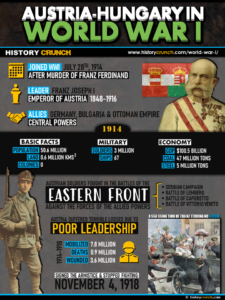
On the other hand, Austria-Hungary lagged behind most of the other European nations with a relatively smaller and weaker fighting force. At the start of war in 1914, Austria-Hungary had an army of over 800,000 soldiers and a navy of over 65 ships. The country was less industrialized that some powerful countries such as Germany, but more industrialized than others such as Russia. Regardless, Austria-Hungary struggled to maintain the industrial output of the major European powers. With that said, Austria-Hungary’s reasoning for going to war was due to the assassination of Franz Ferdinand on June 28th, 1914. Ferdinand was the Archduke of Austria-Hungary and the next in line to rule the country.
The Ottoman Empire was located in the eastern region of Europe and the Middle East. In fact, the modern country of Turkey made up much of the territory of the Ottoman Empire. In general, the Ottoman Empire struggled from disorganization and poor leadership in World War I. With that said, they were an important member of the Central Powers, and caused the Allied Powers to expand and spread think their military. For instance, throughout World War I, both Russia and Britain had to contend with fighting the Ottoman Empire.
Finally, Bulgaria was the last of the Central Power nations. Bulgaria joined the fighting of World War I in 1915 against Serbia, which was an ‘affiliate’ nation of the Allied Powers. In fact, Bulgaria made a significant contribution to the Central Power war effort in the Balkans and assisted the Ottoman Empire. However, Bulgaria was a relatively small nation and did not have the same military capabilities of the other major Central Powers.

MAJOR BATTLES OF THE CENTRAL POWERS IN WORLD WAR I
As stated previously, the Central Powers of World War I participated in many significant battles. Most of the battles were focused along the Western Front and Eastern Front, but several others also occurred in the Balkans and the Far East. The Western Front refers to a line of trenches that stretched along the eastern border of France. Along this line of trenches, several major battles were fought primarily by the Central Power of Germany. Some of the most important battles of the Western Front included:
- First Battle of the Marne
- First Battle of Ypres
- Second Battles of Ypres
- Battle of Verdun
- Battle of the Somme
- Battle of Vimy Ridge
- Third Battle of Ypres (Battle of Passchendaele)
The Eastern Front was different than the Western Front in that it involved much more movement as the armies advanced against each other. The major nations involved with the Eastern Front included Russia and Austria-Hungary. The most significant battle along the Eastern Front, included:
Besides the fighting that occurred along the Western Front and Eastern front, there were also other significant battles that occurred in other areas of Europe, the Middle East and the Far East. For instance, Italy and Austria-Hungary faced off against each other in the Alps, while Britain attacked the Ottoman Empire in the Gallipoli Campaign. The other significant battles of World War I included: