Economics

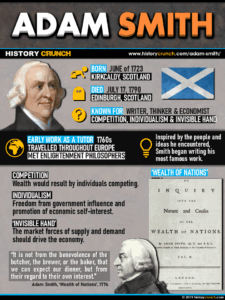
Adam Smith Infographic

Adam Smith: Infographic

This Adam Smith infographic was created by History Crunch to help students and teachers quickly understand the life, ideas and historical significance of one of the most important economic thinkers in world history. It covers his early life, his most famous work Wealth of Nations, and his lasting impact on capitalism and economic thought. Designed for students in grades 5 to 12.

Social Darwinism

Social Darwinism: A Detailed Summary

Social Darwinism is a theory that applies the concept of ‘survival of the fittest’ from Charles Darwin’s theory of natural selection to human societies, often justifying inequality, imperialism, and social hierarchy. It is most commonly seen in history in terms of economic, the Age of Imperialism and Nazi Germany.

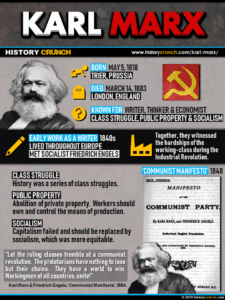
Karl Marx Infographic

Karl Marx: Infographic

This Karl Marx infographic was created by History Crunch to help students and teachers quickly understand the life, ideas and historical significance of one of the most influential political thinkers in world history. It covers his early life, his key works including The Communist Manifesto and Das Kapital, and his lasting impact on socialism, communism and workers rights movements. Designed for students in grades 5 to 12.

Economic Systems: A Detailed Summary

Economic systems are the foundation of how modern societies handle the distribution of wealth. Historians have identified several main types of economic systems, including: traditional, command, free market and mixed. This article details economic systems and highlights the main differences between them.

Communism: A Detailed Summary

The first country in the world to adopt communism was Russia during the events on the Russian Revolution in 1917. This article details the history, significance and main principles of communism.

Microeconomics: A Detailed Summary

The main principles of microeconomics focus on how individuals and businesses make choices in a world of limited resources. This article details the main principles of microeconomics in the larger economy.

Free Market Economy: A Detailed Summary

A free market economy is considered to be on the right side of the economic spectrum and is based on the principles of individualism, such as: economic freedom, self-interest, competition and private property. This article details the main principles of a free market economy.

Economics in Ancient Rome: A Detailed Summary

Economics in Ancient Rome was made up of several important aspects, including: agriculture, trade, taxation and slave labor. This article details the history and significance of economics in Ancient Rome.

Economic Individualism: A Detailed Summary

Economic individualism is centered on the idea of less government involvement or intervention in the economy. This article details the history and main principles of economic individualism.

Competition: A Detailed Summary

Competition is a key factor in economics and is a central principle in economic systems such as laissez-faire capitalism and free market economies. This article details the history and significance of competition in economics.