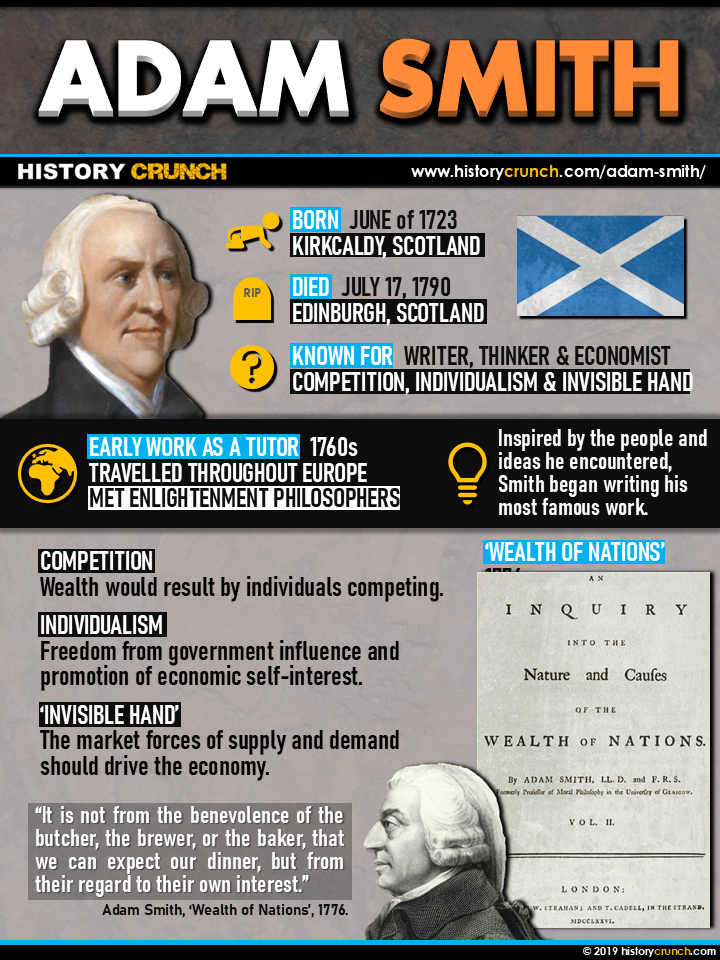
Adam Smith was one of the most significant thinkers of the Age of Enlightenment and is widely considered the father of modern economics. Born in Scotland in 1723, Smith developed ideas about free markets and capitalism that continue to shape economic systems around the world today. This infographic was designed for students to visually summarize the key aspects of Adam Smith’s life and ideas and is based on the History Crunch article titled Adam Smith.
Adam Smith – Infographic
About This Infographic
This Adam Smith infographic was created by the History Crunch team to help students and teachers quickly understand the life and ideas of one of history’s most important economic thinkers. It is designed as a visual learning and study tool, summarizing the essential information covered in our full article on Adam Smith. Teachers may use it as a classroom display, a discussion prompt, or a study aid for students preparing for assessments.
What This Infographic Covers
Adam Smith was born in Kirkcaldy, Scotland in June of 1723. He showed academic ability from an early age, attending the University of Glasgow at just 14 years old before going on to study at the University of Oxford. After leaving Oxford, he began delivering public lectures in Edinburgh and developed a close friendship with the famous Scottish philosopher David Hume. Throughout the 1750s and early 1760s Smith served as a professor of logic at the University of Glasgow, where he began developing the ideas that would later make him famous.
The infographic covers the key intellectual influences that shaped Smith’s thinking. During his travels across Europe as a tutor, Smith came into contact with some of the leading thinkers of the Enlightenment. In Geneva he met Voltaire, and in Paris he encountered the Physiocrats, a group of French economists who opposed mercantilism and argued in favour of free markets without government control. These encounters had a significant influence on Smith’s own developing ideas about economics and the role of government in society.
The centerpiece of the infographic is Smith’s most famous work, Wealth of Nations, published in 1776. The full title was An Inquiry into the Nature and Causes of the Wealth of Nations, and it became one of the most influential economic texts ever written. In it, Smith challenged the idea that governments should control the economy and instead proposed that free trade and competition were the best ways to create prosperity. He introduced the concept of the invisible hand, the idea that when individuals pursue their own economic interests, market forces of supply and demand naturally regulate the economy in a way that benefits society as a whole. These ideas laid the foundation for modern capitalism and classical liberalism.
The infographic also highlights the lasting significance of Adam Smith’s ideas. His arguments against mercantilism and government control of the economy influenced the economic policies of Britain and many other nations throughout the 1800s. His work continues to be studied and debated today, particularly in discussions about the role of government in the economy, the benefits of free trade, and the principles of capitalism.
How to Use This Infographic in the Classroom
This infographic works well as a visual introduction to Adam Smith before students read the full biography article. It can also be used as a review tool before an assessment, or as a discussion prompt asking students to consider whether Smith’s ideas about free markets and limited government involvement are still relevant in the modern world. Teachers may also use it alongside related articles on capitalism, laissez-faire economics and the Age of Enlightenment to help students understand the broader intellectual context in which Smith developed his ideas.
Related Articles
To learn more about the topics covered in this infographic, visit the following History Crunch articles: