Nicolaus Copernicus: A Detailed Biography
Nicolaus Copernicus was a Renaissance-era astronomer who proposed that the Sun, not the Earth, sat at the center of the universe. This article details the life and significance of Nicolaus Copernicus.

Nicolaus Copernicus was a Renaissance-era astronomer who proposed that the Sun, not the Earth, sat at the center of the universe. This article details the life and significance of Nicolaus Copernicus.
Galileo Galilei was an Italian astronomer and scientist who played a central role in the Scientific Revolution. This article details the life and significance of Galileo Galilei.
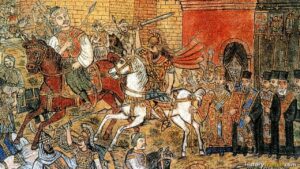
The Fall of Constantinople took place on May 29th, 1453, when the Ottoman army under Sultan Mehmed II captured the city after a 53-day siege. The fall of the city brought an end to the Byzantine Empire and is widely considered by historians to mark the end of the Middle Ages. This article details the history and significance of the Fall of Constantinople.
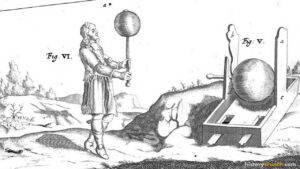
The Scientific Revolution was one of the most important events in the history of the western world and played a central role in causing the Age of Enlightenment. Taking place during the 16th and 17th centuries, it transformed the way people understood the natural world by replacing traditional beliefs with ideas based on observation, experimentation, and reason. This article details the history and significance of the Scientific Revolution.
The Age of Absolutism was a period in European history when monarchs claimed total power over their kingdoms, often justified by the divine right of kings. This article details the history and significance of the Age of Absolutism.
The Late Middle Ages was the final period of the Middle Ages, lasting from the start of the 14th century to the end of the 15th century. It was a difficult time for most people in Europe, dominated by the Black Death, the Hundred Years War, and the decline of feudalism. This article details the history and significance of the Late Middle Ages.
The Byzantine Empire was the eastern half of the Roman Empire that survived for nearly one thousand years after the western half collapsed in 476 CE. Based in the city of Constantinople, the Byzantine Empire lasted from 330 CE until 1453 CE, when it was finally conquered by the Ottoman Turks. During that time it was one of the most powerful civilizations in the world and played a major role in preserving the knowledge and culture of ancient Greece and Rome. This article details the history and significance of the Byzantine Empire.
The Renaissance was a period of significant cultural, artistic, and intellectual renewal that began in Italy in the 14th century and spread across Europe over the following two centuries. It is considered one of the most important periods in the history of Western civilization.
Italy in the Middle Ages was one of the most significant regions in medieval Europe, home to the papacy, powerful city-states and the foundations of the Renaissance. This article details the history and significance of Italy in the Middle Ages.
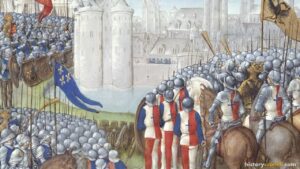
The Crusades were a significance historical event, especially in relation to the Middle Ages and the renaissance. This article details the history and significance of the Crusades.