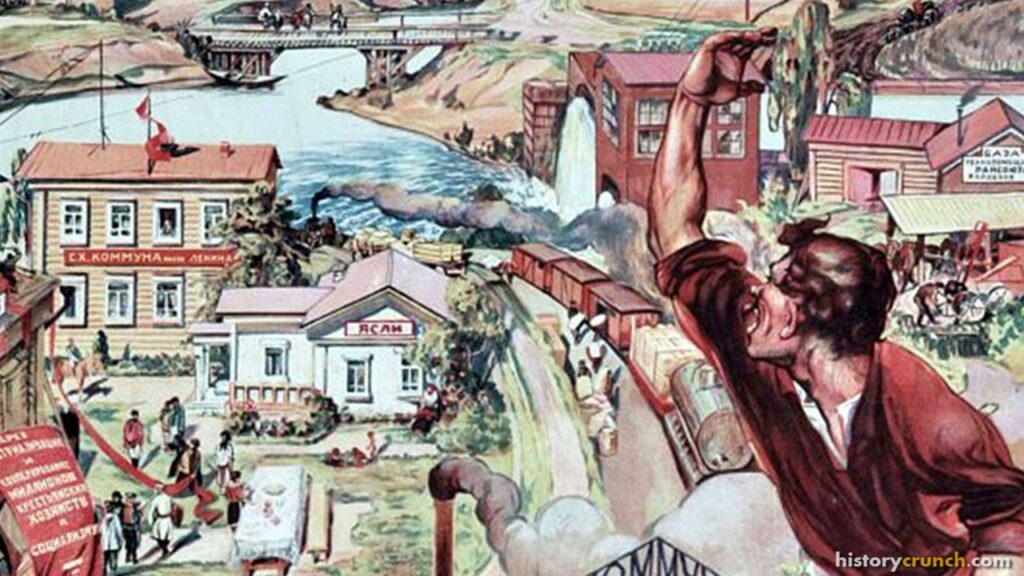
Collectivization in the Soviet Union was the process by which the government of Joseph Stalin forcibly abolished private farming and replaced it with large, state-controlled farms called collective farms, or kolkhozy. The policy was carried out most intensively between 1929 and 1933 and affected millions of people across the Soviet Union. It was closely connected to Stalin’s Five-Year Plans for industrial growth, as the grain and resources taken from the countryside were used to feed city workers and fund factories. The human cost of collectivization was enormous. Millions of people were arrested, deported, or killed, and the resulting famine took the lives of millions more, particularly in Ukraine.
WHAT WAS THE SOVIET UNION?
The Soviet Union was a communist state established in Russia following the Russian Revolution of 1917. It was governed by the Communist Party, which controlled all aspects of political and economic life. In a communist system, the state owns and directs the economy rather than allowing private individuals to do so. Collectivization was one of the most dramatic examples of this idea being put into practice. In fact, it represented Stalin’s attempt to bring the entire agricultural economy of the country under direct state control.
COLLECTIVIZATION IN THE SOVIET UNION – BACKGROUND AND CAUSES
Before collectivization, most people in the Soviet Union were peasants who farmed small private plots of land. This had been allowed under Lenin’s New Economic Policy, introduced in 1921, which permitted a degree of private farming and trade. Under this system, some peasants became relatively prosperous. In the Soviet Union, these wealthier peasants were called kulaks, a Russian word meaning fist. Stalin viewed the kulaks as a threat to communist ideals and blamed them for grain shortages that were affecting Soviet cities.
By the late 1920s, Stalin had decided that private farming had to end. He believed that large, mechanized collective farms run by the state would be far more productive than thousands of small individual farms. He also believed that collectivization would give the state direct control over grain, which could then be used to feed the growing industrial workforce in the cities and exported to earn money for buying foreign machinery. As stated above, this was closely tied to his Five-Year Plans for rapid industrialization.
Stalin also had a political motive. Private farmers, especially the kulaks, had a degree of independence that made them harder to control. By placing all of agriculture under state control, Stalin could eliminate this independence entirely and bring the rural population firmly under Communist Party authority.
COLLECTIVIZATION IN THE SOVIET UNION – HOW COLLECTIVIZATION WORKED
Collectivization began in the winter of 1929 and 1930. Peasants were ordered to give up their private land, animals, and equipment and join collective farms. On these collective farms, workers were organized and directed by Communist Party officials. They were required to hand over a set amount of grain and other produce to the state, and they received wages rather than keeping the profits of their own labor.
For many peasants, this was deeply unacceptable. Farming families had worked their land for generations and had no desire to surrender it to the state. Resistance was widespread across the Soviet Union. In fact, rather than hand their animals over to the collective, many peasants chose to slaughter them. As a result, the number of cattle in the Soviet Union fell by around 30 percent between 1929 and 1931, and the number of sheep and goats dropped by more than half. This massive loss of livestock seriously damaged agricultural productivity for years.
The government responded to resistance with brutal force. Peasants who refused to comply were arrested, beaten, or shot. Many were deported in cattle trucks to remote regions of the Soviet Union such as Siberia and the Arctic. By March of 1930, more than half of all peasant households in the Soviet Union had been forced onto collective farms.
COLLECTIVIZATION IN THE SOVIET UNION – DEKULAKIZATION
Alongside the general collectivization drive, Stalin launched a specific campaign against the kulaks known as dekulakization. On December 27th, 1929, Stalin publicly declared his intention to liquidate the kulaks as a class. The kulaks, as the more prosperous farming families, were seen as the most likely to resist collectivization and were targeted first.
In practice, the label of kulak was applied very broadly. Any farmer who resisted collectivization, even if they were not particularly wealthy, could be branded a kulak or a kulak supporter and punished accordingly. The secret police, known as the OGPU, played a central role in carrying out dekulakization. Kulaks were divided into three categories depending on how threatening the authorities considered them to be. The most dangerous were arrested and shot. Others were deported to labor camps. A third group had their property confiscated and were forced onto poor-quality land elsewhere.
The destruction of the kulak class meant the removal of the most experienced and productive farmers in the country. This had serious consequences for agricultural output, contributing directly to the famines that followed. As such, dekulakization was not just a political act but an economic catastrophe.
COLLECTIVIZATION IN THE SOVIET UNION – THE HOLODOMOR AND THE FAMINE
The most devastating consequence of collectivization was the famine of 1932 and 1933, which killed millions of people across the Soviet Union. The famine was caused by a combination of factors. The destruction of livestock and experienced farming labor had reduced agricultural output significantly. At the same time, the state continued to set unrealistically high grain quotas and seized grain from collective farms even when local people were already starving.
The famine was especially severe in Ukraine, one of the most fertile farming regions of the Soviet Union. The Ukrainian famine is known as the Holodomor, which means death by hunger in Ukrainian. Soviet authorities continued to export grain abroad and refused to allow starving rural communities to receive food aid. Whole villages were placed on blacklists that prevented residents from obtaining any food from state stores. The death toll from the Holodomor is estimated at between five and seven million people. Many countries today recognize the Holodomor as a genocide against the Ukrainian people. Furthermore, the famine caused lasting divisions between Ukrainians and the Soviet government that shaped Ukrainian history for generations.
COLLECTIVIZATION IN THE SOVIET UNION – RESULTS
By the mid-1930s, collectivization was largely complete. The vast majority of Soviet farmland had been brought under state control, and the kulak class had been effectively destroyed. However, the results for Soviet agriculture were deeply mixed. Agricultural productivity took many years to recover from the disruption caused by the forced collectivization drive and the destruction of livestock. Consumer food supplies remained poor throughout much of the 1930s.
On the other hand, the state did succeed in its primary goal of extracting enough grain and resources from the countryside to fund rapid industrialization. The workers in Stalin’s new factories were fed, albeit often poorly, and the Soviet Union’s industrial output grew rapidly during the same period. For instance, the number of industrial workers in the Soviet Union nearly tripled between 1928 and 1940. In this narrow sense, collectivization achieved what Stalin had designed it to achieve, though at a cost in human life and suffering that no economic calculation can justify.
COLLECTIVIZATION IN THE SOVIET UNION – SIGNIFICANCE
The significance of collectivization in the Soviet Union is considerable. It was one of the most extreme examples in history of a government using force to completely reorganize the economic lives of an entire population. It destroyed a way of life that had existed for centuries, eliminated an entire social class, and caused the deaths of millions of people through famine and violence.
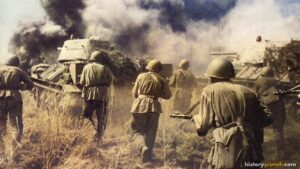
At the same time, collectivization played an important indirect role in World War II. The industrialization it helped fund gave the Soviet Union the factories and equipment needed to produce the weapons that eventually defeated Nazi Germany after the German invasion of 1941. Most historians agree that without the industrial base built during the Five-Year Plans, which collectivization helped to fund, the Soviet Union would not have been able to survive and ultimately win the war on the Eastern Front.
As such, collectivization in the Soviet Union stands as one of the most important and morally complex events in the history of the 20th century. It was a policy that achieved certain economic and military goals through methods that caused extraordinary human suffering, and its legacy continues to shape the history and identity of Ukraine and other former Soviet nations to the present day.