The Five-Year Plans were a series of national economic programs introduced by Soviet leader Joseph Stalin beginning in 1928. Each plan set specific targets for the production of key industries such as steel, coal, electricity, and heavy machinery. The goal was to rapidly transform the Soviet Union from a poor, mostly agricultural country into a powerful industrial nation. The plans had enormous consequences for the Soviet people and for the history of World War II.
WHAT WAS THE SOVIET UNION?
The Soviet Union, also known as the USSR, was a communist state established in Russia following the Russian Revolution of 1917. It was governed by the Communist Party, which controlled every aspect of political, economic, and social life. In a communist system, the economy is owned and directed by the state rather than by private individuals or businesses. The Five-Year Plans were the Soviet Union’s primary tool for putting this idea into practice, replacing the private market economy with centralized state planning that decided what was produced, how much, and by whom.
FIVE-YEAR PLANS OF THE SOVIET UNION – BACKGROUND AND CAUSES
When Stalin took control of the Soviet Union in the late 1920s, the country was overwhelmingly rural. The vast majority of people were peasants who farmed the land and lived in poverty. Industry was weak and far behind the levels seen in Western Europe and the United States. Stalin believed this made the Soviet Union dangerously vulnerable to attack from its enemies. He famously warned that the country was between fifty and one hundred years behind the advanced nations and that if it did not catch up within about ten years, it would be crushed by foreign aggressors.
Stalin also wanted to replace the mixed economy that had been in place since the early 1920s with a fully state-controlled system. Under the previous policy, known as the New Economic Policy, some private trade and farming were allowed. Stalin considered this ideologically unacceptable. He was determined to bring all economic activity under state control and use it to drive rapid industrialization.
FIVE-YEAR PLANS OF THE SOVIET UNION – THE FIRST FIVE-YEAR PLAN
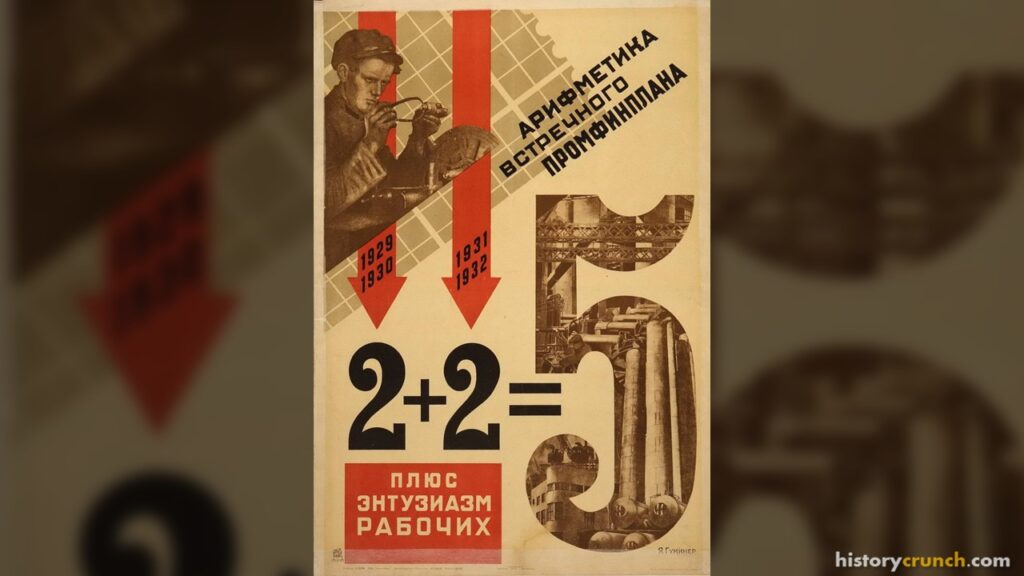
The first Five-Year Plan ran from 1928 to 1932 and focused almost entirely on heavy industry. The targets set by the plan were enormous. Total industrial output was to increase by 250 percent. Coal production was to more than triple. Steel, electricity, and machinery were all expected to grow dramatically. In fact, the party adopted the slogan “The Five-Year Plan in Four Years” to encourage even faster progress.
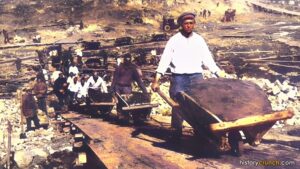
The plan was managed by a government agency called Gosplan, which set production targets for every major industry across the country. Factory managers and workers were given specific quotas to meet. Failure to meet targets could result in severe punishment, including imprisonment. Millions of workers moved from the countryside to the cities to work in the new factories. As a result, the industrial workforce nearly doubled during this period.
The plan placed almost all of its investment into heavy industry rather than consumer goods. For instance, approximately 86 percent of all industrial investment went directly toward factories, mines, and power stations. Ordinary goods such as clothing, food, and household items were neglected. This meant that while industrial production grew rapidly, the daily lives of most Soviet citizens became harder rather than better.
FIVE-YEAR PLANS OF THE SOVIET UNION – COLLECTIVIZATION OF AGRICULTURE
Running alongside the industrial program was a policy called collectivization, which was one of the most destructive parts of the entire Five-Year Plan period. Under collectivization, the Soviet government abolished private ownership of farmland. Peasants were forced to give up their individual farms and join large, state-run collective farms called kolkhozy. On these farms, workers were directed by the state and required to hand over a set portion of everything they produced.
The stated goal of collectivization was to bring agriculture under state control and to produce enough food to feed the growing industrial workforce in the cities. However, the reality was catastrophic. Many peasants strongly resisted the policy. In fact, thousands slaughtered their own animals rather than hand them over to the state. The government responded with brutal force, arresting, shooting, or deporting millions of people to forced labor camps.
A class of relatively wealthier peasants known as kulaks were specifically targeted by Stalin as enemies of the state. The destruction of the kulak class meant the loss of the most productive and experienced farmers in the country. This, combined with the state’s continued seizure of grain even when harvests were poor, led directly to a devastating famine in 1932 and 1933. The famine was especially severe in Ukraine, where it is known as the Holodomor. Millions of people died as a result of this man-made disaster, and many countries today recognize it as a genocide against the Ukrainian people.
FIVE-YEAR PLANS OF THE SOVIET UNION – THE SECOND AND THIRD FIVE-YEAR PLANS
The second Five-Year Plan ran from 1933 to 1937 and continued the work of the first. The worst disruptions of forced collectivization had passed, and the industrial economy was growing more consistently. Consumer goods received slightly more attention during this plan, though heavy industry remained the top priority. This period also overlapped with the Great Purge of 1936 to 1938, in which Stalin ordered the arrest and execution of hundreds of thousands of party members, military officers, and industrial managers. As a result, many experienced administrators and engineers were removed from their posts, which disrupted production significantly.
The third Five-Year Plan ran from 1938 to 1941 and reflected the growing threat of war in Europe. The production of weapons and military equipment became the central focus. Stalin also made an important decision to move key industries eastward, away from the western borders of the Soviet Union and deeper into the interior of the country. This decision would prove extremely important when Nazi Germany invaded in 1941.
FIVE-YEAR PLANS OF THE SOVIET UNION – RESULTS AND HUMAN COST
The results of the Five-Year Plans in purely industrial terms were remarkable. From 1928 to 1940, the number of Soviet workers in industry, construction, and transport grew from 4.6 million to 12.6 million. Factory output increased at a rate that had no equal in economic history at the time. The Soviet Union moved from being a minor industrial power to the second largest industrial economy in the world, behind only the United States.
However, the human cost of this achievement was enormous. The Holodomor famine killed millions. Millions more were sent to the Gulag, a system of forced labor camps where prisoners worked under brutal conditions. Workers in the new factories labored long hours for little pay in dangerous conditions. Cities grew so quickly that there was not nearly enough housing to shelter everyone who moved there. In short, the industrial transformation of the Soviet Union came at a terrible price paid primarily by ordinary Soviet citizens.
FIVE-YEAR PLANS OF THE SOVIET UNION – CONNECTION TO WORLD WAR II
The connection between the Five-Year Plans and World War II is direct and significant. When Nazi Germany launched its invasion of the Soviet Union in June of 1941, the initial attack was devastating. Huge areas of Soviet territory were quickly overrun, and enormous quantities of equipment and soldiers were lost. At that moment, it appeared possible that the Soviet Union might be completely defeated.
What prevented this outcome was in large part the industrial base that the Five-Year Plans had created. The Soviet Union was able to produce tanks, aircraft, artillery, and ammunition on a massive scale. In fact, Soviet industrial output eventually exceeded that of Germany, which played a crucial role in turning the tide of the war. The decision to move factories eastward during the third plan proved especially important. Many of these factories continued producing weapons even as German forces advanced deep into Soviet territory. As such, most historians agree that the Soviet Union could not have survived the German invasion without the industrialization that the Five-Year Plans had forced through in the previous decade.
FIVE-YEAR PLANS OF THE SOVIET UNION – SIGNIFICANCE
The Five-Year Plans of the Soviet Union are significant for several reasons. First, they transformed the Soviet Union from a poor, agricultural country into a major industrial and military power in little more than a decade. This industrial strength was a key factor in defeating Nazi Germany in World War II and establishing the Soviet Union as one of the two dominant superpowers of the Cold War era.
Second, the Five-Year Plans are a powerful example of the human cost of totalitarian government. The mass famine, the forced labor camps, the deportations, and the suppression of millions of people were not accidents. They were direct results of the methods Stalin chose to achieve his economic goals. The plans gave the Soviet Union industrial strength, but they did so at a price in human suffering that has few parallels in the history of peacetime government. As such, the Five-Year Plans of the Soviet Union remain one of the most important and morally complex subjects in the history of the 20th century.