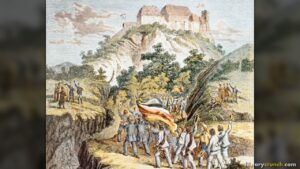
Italian Unification was one of the most important political events of the 1800s in Europe. Also known by its Italian name, the Risorgimento (which roughly translates to ‘Rising Again’ or ‘Resurgence’), it was when the many separate states and kingdoms of the Italian peninsula were gradually brought together to form a single nation. The movement took decades to complete, and was driven by a mix of nationalism, military campaigns, political deals, and the efforts of key leaders. By the time it was finished, a unified Kingdom of Italy had been established, with Rome confirmed as its capital in 1871. Historians consider the Italian Unification to be a significant event in the Age of Nationalism in Europe alongside the German Unification.
What Was Italian Unification?
Before the 1800s, the Italian peninsula was not a single country. Instead, it was divided into many separate states, including the Kingdom of the Two Sicilies in the south, the Papal States in the center, the Kingdom of Sardinia in the northwest, and various duchies and kingdoms in the north that were controlled by foreign powers, especially Austria. Each of these territories had its own rulers, laws, and traditions. The idea of a unified Italy had existed in literature and philosophy for centuries, but it was not until the 1800s that it became a serious political goal. The Risorgimento brought together a variety of groups who, despite disagreeing on many things, shared the basic goal of freeing the peninsula from foreign control and uniting it under one government.
Causes of Italian Unification
There were several important causes of Italian Unification. One of the most significant was the impact of the French Revolution and Napoleonic era. When Napoleon Bonaparte invaded and took control of large parts of Italy beginning in the 1790s, he reorganized the peninsula into a smaller number of states and abolished many of the old feudal structures. He also brought with him ideas about nationalism, legal equality, and efficient modern government. These ideas spread among Italians and helped plant the seeds of a nationalist movement, even though Napoleon himself was a foreign ruler.
After Napoleon was defeated and his empire collapsed, the major European powers gathered at the Congress of Vienna in 1814 and 1815 to reorganize Europe. Under the arrangements made at this congress, Italy was divided once again into separate states. Austria took direct control of the northern region of Lombardy-Venetia and exerted strong influence over several other Italian states. The Austrian chancellor Klemens von Metternich was determined to maintain conservative rule across Europe and actively worked to suppress any nationalist movements. For many Italian nationalists, the outcome of the Congress of Vienna was deeply unjust and became a major driving force behind the push for unification.
Another important cause was the growth of nationalist ideas and organizations throughout the Italian peninsula. Secret societies such as the Carbonari, a network of underground political clubs inspired by the ideals of the French Revolution, helped spread nationalist thinking in the 1820s and 1830s. As well, the journalist and political thinker Giuseppe Mazzini founded a movement known as ‘Young Italy’ (La Giovine Italia) in 1831, which played an important role in inspiring Italians to imagine a free and unified nation. Young Italy aimed to encourage ordinary Italians to rise up and demand national independence. Though most of Mazzini’s attempts to spark a popular uprising ended in failure, his writings and organizing helped create a generation of Italians who believed that unification was both possible and necessary. These organizations helped build a base of nationalist feeling that would fuel the unification movement in later decades.
Early Revolts and Failures
The path to unification was not smooth, and many early attempts at revolution ended in failure. For instance, the Carbonari organized uprisings against Austrian rule in the 1820s and 1830s in places such as the Kingdom of the Two Sicilies and Piedmont, but these were quickly put down with the help of Austrian military forces. Austrian power was strong enough at this point to crush these early movements before they could gain real momentum.
The Revolutions of 1848, which swept across much of Europe, gave Italian nationalists another opportunity. Uprisings broke out in Sicily, Naples, Tuscany, the Papal States, and in the Austrian-controlled north. The Milanese rose up against their Austrian rulers in what became known as the Five Days of Milan, forcing the Austrian army to temporarily retreat. King Charles Albert of Sardinia declared war on Austria, hoping to lead the push for unification. After some early successes, however, Sardinia was defeated by the Austrian army under Marshal Radetzky at the Battle of Custoza in 1848, and again at the Battle of Novara in 1849. Charles Albert gave up his throne to his son, Victor Emmanuel II, and the revolutionary republics that had briefly appeared in Rome and Venice were crushed by foreign military force. By the summer of 1849, the revolutionary phase of the Risorgimento was over.
Despite these failures, the events of 1848 taught the unification movement important lessons. The patriots realized that small Italian states could not defeat Austria on their own and that a strong monarchy, not a popular republic, offered the most realistic path forward. They also understood that winning the support of a powerful foreign ally would be essential to any future success.
Cavour, France, and the War of 1859
After the failures of 1848, the center of gravity in the unification movement shifted to the Kingdom of Sardinia under the leadership of Count Camillo di Cavour, who became Prime Minister in 1852. Cavour was a practical politician rather than a revolutionary, and he worked systematically to build Sardinia into a stronger and more modern state by improving its infrastructure, reforming its legal system, and cultivating close ties with France. He understood that unification could not be achieved through popular revolt alone and that it required careful diplomacy and military strength. For example, he brought Sardinia into the Crimean War in 1855 alongside France and Britain, which helped give the small kingdom a recognized place among the major European powers.
In 1858, Cavour met secretly with the French Emperor Napoleon III and arranged a military alliance. Under their agreement, France would support Sardinia militarily if Austria could be provoked into attacking first. In return, France would receive the regions of Nice and Savoy. In 1859, Cavour maneuvered Austria into declaring war by encouraging nationalist unrest in Austrian-controlled areas. France and Sardinia then defeated Austria at the Battles of Magenta and Solferino, forcing Austria to give up Lombardy. Napoleon III dropped out of the war earlier than expected, however, because he feared the growing strength of a unified Italy. Under the resulting armistice, Austria kept control of Venetia. Despite this disappointment, the war was a major step forward. Sardinia gained Lombardy, and popular uprisings in Tuscany, Parma, Modena, and parts of the Papal States led those regions to vote to join the expanding Kingdom of Sardinia.
Garibaldi and the Expedition of the Thousand
While Cavour focused on diplomacy and the north, the military leader Giuseppe Garibaldi turned his attention to the south. Garibaldi had spent years in exile in South America after being sentenced to death for his part in a failed uprising in Piedmont in 1834, and he returned to Italy having gained valuable experience as a guerrilla fighter. In May 1860, he gathered roughly 1,000 volunteers, known as the Redshirts or the Thousand (I Mille), and sailed from near Genoa to the western coast of Sicily. This daring campaign, called the Expedition of the Thousand, quickly gained momentum. Garibaldi defeated Bourbon forces at the Battle of Calatafimi and captured Palermo, the Sicilian capital. As he moved north through the Italian mainland, Bourbon resistance crumbled around him, and he entered Naples in early September 1860 to a warm popular welcome.
Garibaldi’s successes created a new challenge, however. If he marched on Rome, he risked a confrontation with France, which had troops there protecting the Pope. Cavour acted quickly to prevent this by sending the Sardinian army south through the Papal States. Although Garibaldi deeply resented Cavour for his role in handing Nice, his birthplace, over to France, he ultimately chose loyalty to the broader goal of Italian unity. He met King Victor Emmanuel II at Teano in October 1860 and handed over control of the south to the king. The regions that Garibaldi had conquered voted to join the Kingdom of Sardinia in a series of referendums shortly after.
Proclamation of the Kingdom of Italy
On March 17, 1861, the Italian Parliament officially proclaimed the creation of the Kingdom of Italy, with Victor Emmanuel II as its first king. The new kingdom was still incomplete, however. Venetia in the northeast remained under Austrian control, and Rome was still held by the Pope and protected by French troops.
Venetia was added to Italy in 1866 through the outcome of the Austro-Prussian War. Italy allied itself with Prussia, which was fighting Austria for dominance among the German states. Although Italian forces performed poorly in battle against the Austrians, Prussia’s victory on the northern front obliged Austria to give up Venetia. The region was formally transferred to Italy following a referendum later that year.
Rome itself was the final piece. French troops had protected the Pope and the remaining Papal States, but when the Franco-Prussian War broke out in July 1870, Napoleon III recalled his garrison from Rome to defend France against Prussia. With French protection gone, the Italian army crossed into Papal territory in September 1870. After a brief resistance, Italian forces breached the city walls at Porta Pia on September 20, 1870, and took control of Rome. The city was confirmed as the capital of the Kingdom of Italy in 1871, completing the Risorgimento.
Significance of Italian Unification
Italian Unification was a significant event in the history of both Italy and Europe. For Italy, it ended centuries of foreign domination and replaced dozens of separate governments with a single national state. Victor Emmanuel II was celebrated as the Father of the Fatherland, and the anniversary of the proclamation of the Kingdom of Italy on March 17 continues to be observed in Italy today.
The unification also had important connections to other major events in European history. For instance, the defeat of Austria by Sardinia and France in 1859 weakened Austrian power and contributed to the conditions that later led to German Unification in 1871. The Franco-Prussian War, which removed French troops from Rome and completed the Risorgimento, also shattered the French Empire and reshaped the balance of power across the continent in ways that contributed to the tensions leading up to World War I.
Not everyone celebrated Italian Unification equally, however. The new kingdom was dominated by the interests and institutions of Piedmont in the north, and many in the south felt that unification brought hardship rather than improvement. Economic differences between the industrializing north and the poorer south created lasting tensions that historians refer to as the ‘southern question’. As well, Mazzini himself died in 1872 still unhappy, believing that the monarchy had betrayed the democratic ideals of the Risorgimento. Even after 1871, many Italian speakers living in regions such as Trentino and Trieste remained outside Italy’s borders, a situation that fueled a movement known as Italian irredentism and continued to shape Italian foreign policy well into the twentieth century.