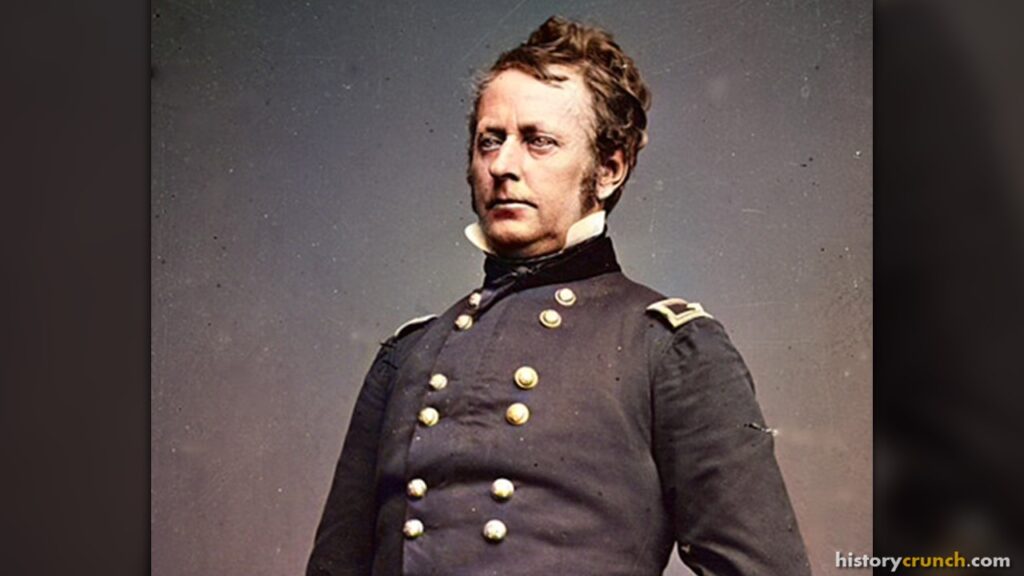
Joseph Hooker was a United States Army officer who served as a major general in the Union Army during the American Civil War. He earned the nickname Fighting Joe through a series of aggressive performances on the battlefield in 1862 and built a strong reputation as a reliable combat commander. He was appointed commander of the Army of the Potomac in January of 1863 and immediately reorganized and revitalized the demoralized Union force. However, his tenure is best remembered for his defeat at the Battle of Chancellorsville in May of 1863, in which Robert E. Lee outmaneuvered a Union army twice the size of his own. Hooker resigned command just days before the Battle of Gettysburg and went on to serve with more success in the Western Theater for the remainder of the war.
Early Life of Joseph Hooker
Joseph Hooker was born on November 13th, 1814, in Hadley, Massachusetts. He came from a New England family with a tradition of military service and secured an appointment to the United States Military Academy at West Point, entering in 1833. He graduated in 1837, finishing 29th in a class of 50. Among his classmates were several future Civil War figures including Braxton Bragg and Jubal Early, both of whom became Confederate generals. After graduation, Hooker was commissioned as a second lieutenant and began his military career in the regular army, serving in the Seminole Wars in the late 1830s and gaining practical field experience.
Joseph Hooker – Mexican-American War and Early Career
Hooker’s military reputation grew significantly during the Mexican-American War from 1846 to 1848. He served on the staffs of several generals, including Winfield Scott during the drive on Mexico City, and won three brevet promotions for gallant and meritorious conduct. The war gave him experience at the operational level of warfare alongside the most capable American commanders of his generation.
After the war, Hooker served in a series of postings during the 1850s, spending time in California. He developed a reputation during this period for hard drinking and a difficult personality. In 1853, frustrated with slow promotion, he resigned his commission and settled in California as a farmer. When the Civil War broke out in 1861, he traveled to Washington seeking a military commission but was initially refused. After watching the Union defeat at the First Battle of Bull Run as a civilian, he appealed directly to President Lincoln and was granted a commission as a brigadier general of volunteers.
Joseph Hooker – Rise to Prominence
Hooker quickly demonstrated that his reputation for aggressive and capable leadership was well-founded. He took command of a division in the Army of the Potomac and performed well throughout General George McClellan’s Peninsula Campaign in 1862, earning promotion to major general of volunteers. He continued to distinguish himself at the Second Battle of Bull Run and at the Battle of Antietam in September of 1862, where he commanded the First Corps and led the opening assault before being wounded in the foot. His performance across these engagements cemented his reputation as one of the Union’s most reliable fighting generals.
Joseph Hooker – Commander of the Army of the Potomac
Lincoln appointed Hooker to command the Army of the Potomac on January 26th, 1863, following the disastrous Union defeat at Fredericksburg under Ambrose Burnside. Hooker found the army in poor condition. Morale was extremely low, desertions were high, and the men were poorly supplied. He addressed all of these problems with impressive energy. He improved food rations, reorganized the medical system, established a proper leave system, reorganized the cavalry into a unified corps, and set up an effective intelligence operation. By the spring of 1863, the Army of the Potomac was in significantly better shape than when he had taken command.
Joseph Hooker – Battle of Chancellorsville
Hooker’s only major engagement as army commander was the Battle of Chancellorsville, fought from April 30th to May 6th, 1863, in Virginia. He developed a genuinely clever plan that used his army’s numerical superiority to flank Lee’s Confederate Army of Northern Virginia. The opening moves were executed successfully, placing the bulk of his army in a threatening position behind Lee’s lines in the Wilderness.
However, once in position, Hooker’s nerve appeared to fail him. Rather than pressing his advantage, he ordered his forces to halt and take up a defensive position, handing the initiative to Lee. Lee responded with one of the most audacious decisions of the war, dividing his already outnumbered army and sending Stonewall Jackson’s corps on a lengthy flanking march around Hooker’s exposed right flank. On the afternoon of May 2nd, Jackson’s force crashed into the Union Eleventh Corps, driving it in confusion for miles. On May 3rd, a Confederate artillery shell struck near Hooker’s headquarters and gave him a severe concussion that affected his judgment for the rest of the battle. He ordered a retreat on May 5th and 6th. The battle was a stunning Confederate victory, with Union casualties of approximately 17,000 men. Lee had defeated an army more than twice the size of his own.
Joseph Hooker – Later War Service
Following Chancellorsville, Hooker remained in command but his authority was severely undermined. When Lee launched his invasion of Pennsylvania in June of 1863, Hooker moved his army northward in parallel but came into a dispute with General-in-Chief Henry Halleck over control of the garrison at Harpers Ferry. When his request was refused, Hooker submitted his resignation. Lincoln and Halleck accepted it. On June 28th, 1863, just three days before the Battle of Gettysburg began, General George Meade replaced him.
Hooker was transferred to the Western Theater, where he performed considerably better. His forces achieved a notable success at the Battle of Lookout Mountain on November 24th, 1863, driving Confederate forces from a strong position above Chattanooga in what the press called the Battle Above the Clouds. He participated in the Atlanta Campaign under General William Tecumseh Sherman in 1864 with competence, but resigned when a younger officer was promoted over him to command the Army of the Tennessee.
Later Years and Death of Joseph Hooker
After the Civil War, Hooker remained in the regular army but suffered a stroke in 1865 that left him partially paralyzed. He retired from the army on October 15th, 1868. Joseph Hooker died on October 31st, 1879, in Garden City, New York, at the age of 64. He was buried at Spring Grove Cemetery in Cincinnati, Ohio.
Significance of Joseph Hooker
The significance of Joseph Hooker in the history of the American Civil War lies in two contrasting contributions. His reorganization of the Army of the Potomac in the winter and spring of 1863 was a genuine and important achievement that restored the morale and fighting capacity of a demoralized army. In fact, the improvements he made in food, medical care, intelligence gathering, and cavalry organization lasted well beyond his tenure in command and benefited his successors.
His defeat at Chancellorsville, however, is one of the most studied episodes in Civil War history, precisely because it illustrated so clearly the gap between meticulous planning and execution under pressure. Hooker conceived an excellent plan and then failed to implement it aggressively when the moment came, allowing Lee to seize the initiative and turn a promising Union position into a humiliating defeat. As such, Joseph Hooker stands as a general of genuine ability whose career was permanently defined by a single catastrophic failure at the moment when the most was expected of him.