The Pax Romana, which is Latin for “Roman Peace,” was a period of roughly 200 years of relative peace and stability across the Roman Empire, lasting from 27 BCE to 180 CE. The era began when Augustus became the first Roman emperor and ended with the death of Marcus Aurelius, the last of the so-called Five Good Emperors. During this time the Roman Empire reached its greatest size, its population swelled to an estimated 70 million people, trade flourished, and some of the most famous buildings and works of literature in the ancient world were produced. It is widely regarded as the golden age of Roman civilization.
WHAT WAS ANCIENT ROME?
Ancient Rome was one of the most powerful civilizations in world history. It began as a small city-state on the Italian peninsula and grew over many centuries into a vast empire that stretched from Britain in the northwest to Egypt in the southeast. At its height, the Roman Empire controlled much of Europe, North Africa, and parts of the Middle East. Roman civilization is remembered for its contributions to law, government, architecture, language, and culture. The Pax Romana was the period during which all of these achievements were most fully realized, and when the empire was at its most stable, prosperous, and influential.
PAX ROMANA – BACKGROUND AND AUGUSTUS
The Pax Romana did not arrive without a difficult beginning. In the decades before Augustus took power, Rome had been torn apart by a series of civil wars following the assassination of Julius Caesar on March 15th, 44 BCE. The political situation was chaotic, with powerful generals and politicians fighting for control of the state. Caesar’s adopted son Octavian emerged from this struggle as the victor, defeating his rivals Mark Antony and Cleopatra at the Battle of Actium on September 2nd, 31 BCE. Egypt became a new Roman province, and Octavian became the sole ruler of the Roman world.
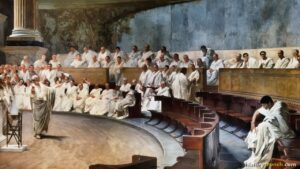
In 27 BCE, the Senate granted Octavian the honorific title of Augustus, meaning “the revered one,” and he became effectively the first Roman emperor. Augustus was careful not to call himself a king or dictator, titles that carried deeply negative associations in Roman culture after centuries of republican government. Instead he called himself the princeps, or first citizen, and maintained the outward appearance of the old Republic while holding real power firmly in his own hands. He controlled the military directly, ensuring that the legions were loyal to him personally, which eliminated the threat of further civil war.
Augustus ruled for 41 years, from 27 BCE to 14 CE, and the policies he put in place during that time laid the foundations for the two centuries of peace that followed. He reorganized the government, reformed the tax system, established a permanent professional army, and built an efficient network of provincial administrators to govern the empire’s vast territories. He also embarked on an enormous program of public building in Rome, reportedly boasting that he had found Rome a city of brick and left it a city of marble.
PAX ROMANA – THE FIVE GOOD EMPERORS
The period of the Pax Romana is most closely associated with a succession of capable rulers known as the Five Good Emperors: Nerva, Trajan, Hadrian, Antoninus Pius, and Marcus Aurelius. These emperors ruled in sequence from 96 CE to 180 CE, and their reigns were marked by relatively stable government, genuine concern for the welfare of their subjects, and the continuation of the prosperity Augustus had established.
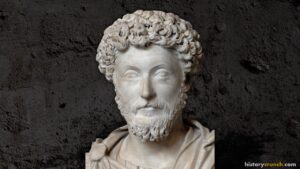
Trajan, who ruled from 98 to 117 CE, was one of the most successful military commanders among the emperors and expanded the empire to its greatest territorial extent, adding Dacia, which is modern-day Romania, and parts of the Near East. Under Trajan the empire stretched over roughly 2 million square miles (5 million square km). Hadrian, who ruled from 117 to 138 CE, took a different approach and focused on consolidating and defending existing borders rather than further expansion. He is best known for building Hadrian’s Wall across northern Britain, roughly 73 miles (117 km) long, to mark and defend the empire’s northern frontier. Antoninus Pius ruled from 138 to 161 CE and presided over one of the most peaceful and prosperous periods in Roman history. Marcus Aurelius, who ruled from 161 to 180 CE, was a philosopher-emperor who wrote the famous philosophical work Meditations and spent much of his reign fighting defensive wars against Germanic tribes pressing on the northern frontier. His death in 180 CE is traditionally used to mark the end of the Pax Romana.
PAX ROMANA – PROSPERITY AND ACHIEVEMENTS
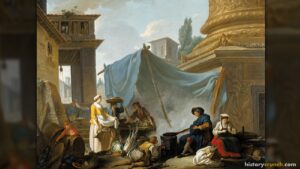
The relative peace of the Pax Romana allowed trade, culture, and building to flourish across the empire on a scale that had never been seen before. The Roman road network expanded significantly during this period, eventually stretching for over 50,000 miles (80,000 km) and connecting cities, military outposts, and ports across the entire empire. These roads made it easier to move goods, soldiers, and information quickly across vast distances.
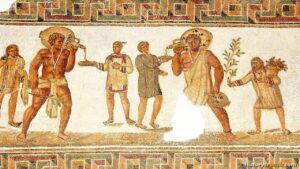
Trade thrived throughout the Mediterranean and beyond. Roman merchants conducted business with India, China, and sub-Saharan Africa, importing silk, spices, ivory, and precious stones in exchange for Roman gold, silver, glass, and manufactured goods. The stability of Roman currency and the security provided by Roman military power made long-distance commerce safer and more reliable than it had ever been.
Some of the most famous buildings in the Roman world were constructed during the Pax Romana. The Colosseum was completed in 80 CE. The Pantheon was rebuilt in its current form under Hadrian around 125 CE. Trajan’s Forum and Column were completed in 113 CE. Across the empire, cities were built or expanded with amphitheaters, baths, temples, and forums, spreading Roman urban culture from Britain to the Middle East.
Roman literature also reached its peak during the Pax Romana. Augustus personally patronized writers including Virgil, whose Aeneid told the mythological origins of Rome, Horace, Ovid, and Livy. Later in the period, the historian Tacitus and the philosopher Marcus Aurelius added to a rich literary tradition that shaped Western culture for centuries.
PAX ROMANA – LIMITS AND PROBLEMS
The Pax Romana was not entirely peaceful. Rome continued to fight wars on its frontiers throughout the period, including campaigns in Britain, the Jewish-Roman Wars in Judea that included the destruction of Jerusalem in 70 CE, Trajan’s wars in Dacia and Parthia, and Marcus Aurelius’s long defensive campaigns against Germanic tribes on the Danube frontier. Within the empire, revolts occurred periodically, and some emperors, particularly Caligula and Nero in the decades following Augustus, behaved with extreme cruelty and instability.
One of the deepest problems of the Pax Romana was that Rome never developed a reliable system for transferring power from one emperor to the next. The Five Good Emperors each chose their successor carefully and trained them well, but this depended entirely on the good judgment of the reigning emperor. When Marcus Aurelius chose to pass power to his biological son Commodus rather than a capable successor, the consequences were immediate and severe.
PAX ROMANA – END OF THE ERA
The death of Marcus Aurelius in 180 CE and the accession of his son Commodus marked the end of the Pax Romana. Commodus proved to be an erratic and brutal ruler who neglected the administration of the empire, alienated the Senate, and eventually declared himself a living god. He was assassinated in 192 CE, triggering a civil war and a rapid succession of short-lived emperors. The following century brought repeated crises including invasion, plague, economic instability, and political chaos, a period historians call the Crisis of the Third Century. The stability and prosperity of the Pax Romana were gone and would never fully return.
SIGNIFICANCE OF THE PAX ROMANA
The Pax Romana was the high point of Roman civilization. In two centuries of relative peace, the empire achieved its greatest territorial extent, its largest population, its most sophisticated urban culture, and some of its most enduring architectural and literary achievements. The roads, buildings, and institutions created during this period shaped European history for centuries after the fall of Rome.
The Pax Romana also demonstrated what strong, stable government could accomplish when it focused on building rather than fighting. The prosperity it created, the trade networks it supported, and the culture it spread across the Mediterranean world left a lasting impression on the peoples who came into contact with Rome, many of whose descendants still live in countries shaped by the Roman legacy today.