Architecture in Ancient Rome was one of the most impressive and enduring achievements of the Roman world. The Romans were master builders who developed new materials, new techniques, and new types of buildings that allowed them to construct structures on a scale the ancient world had never seen before. From enormous public baths and amphitheaters to roads, bridges, and aqueducts, Roman architecture served both practical and political purposes. It demonstrated the power of the Roman state, improved the lives of ordinary citizens, and spread a distinctive building tradition across an empire that stretched from Scotland to Syria. Many Roman buildings still stand today, and the influence of Roman architecture can be seen in government buildings, churches, and public spaces across the modern world.
WHAT WAS ANCIENT ROME?
Ancient Rome was one of the most powerful civilizations in world history. It began as a small city-state on the Italian peninsula and grew over many centuries into a vast empire that stretched from Britain in the northwest to Egypt in the southeast. At its height, the Roman Empire controlled much of Europe, North Africa, and parts of the Middle East. Roman civilization left lasting contributions to law, government, language, and culture. Among its most visible and enduring legacies is its architecture, which transformed the way buildings were designed and constructed and whose influence can still be seen in the built environment of the modern world today.
ARCHITECTURE IN ANCIENT ROME – INFLUENCES AND ORIGINS
Roman architecture drew heavily on the traditions of two earlier civilizations: the Etruscans and the Greeks. The Etruscans, who lived to the north of Rome and dominated much of central Italy before Rome’s rise to power, contributed the arch, the vault, and practical knowledge of hydraulic engineering and drainage. These structural ideas were fundamental to some of Rome’s most important architectural achievements.
Greek influence came in through two routes. The first was through the Greek colonies in southern Italy, a region the Romans called Magna Graecia, which had been building temples and civic structures in the Greek style for centuries. The second came when Rome conquered Greece directly, with the fall of Corinth in 146 BCE flooding Rome with Greek art, craftsmen, and architectural knowledge. The Greeks had developed a sophisticated system of building proportions and decorative column styles known as the architectural orders: the Doric, Ionic, and Corinthian. The Romans adopted all three and added their own variations, including the Composite order, which combined Ionic and Corinthian elements, and the Tuscan order, a simpler version of the Doric. Roman buildings often used these column styles decoratively rather than structurally, wrapping Greek-inspired detail around the concrete cores that actually held the buildings up.
What the Romans added to these inherited traditions was a focus on engineering, scale, and practicality. Where Greek architecture was primarily concerned with the exterior beauty of individual temples and public buildings, Roman architecture was equally concerned with creating large interior spaces for thousands of people, and with building the roads, bridges, and aqueducts that held an empire together.
ARCHITECTURE IN ANCIENT ROME – KEY MATERIALS AND INNOVATIONS
The single most important innovation in Roman architecture was the development and widespread use of concrete. Roman concrete, known as opus caementicium, was made by mixing a volcanic sand called pozzolana with lime and water to create a mortar, then adding chunks of stone or brick as an aggregate. The resulting material was strong, durable, and could be poured into molds of almost any shape. Roman builders began using concrete as early as the third century BCE, but it became increasingly central to construction throughout the Republic and Empire periods.
Concrete made it possible to build structures that would have been impossible using only cut stone. Vast domes, wide barrel vaults, and enormous interior spaces became achievable because concrete could be shaped to span distances that stone beams could not. The Pantheon in Rome, built by Emperor Hadrian around 125 CE, has a concrete dome 43.3 meters (142 feet) in diameter that remained the largest dome in the world for more than 1,300 years. The dome still stands intact today, a testament to the quality of Roman concrete, which some modern engineers consider more durable than many modern building materials.
Alongside concrete, the Romans made sophisticated use of brick, stone, and marble. Travertine, a white limestone quarried near Tivoli outside Rome, was used extensively for major public buildings and monuments. Marble was imported from across the empire and used for decorative surfaces, columns, and floors. The interiors of imperial buildings were often covered in thin veneers of expensive colored marble from Greece, North Africa, and the eastern Mediterranean, creating a rich visual effect while using the marble efficiently.
The arch was another defining feature of Roman architecture. The Romans had learned the arch from the Etruscans and refined it into a precise structural tool. By distributing weight outward and downward through curved stones called voussoirs, a properly built arch could span distances no horizontal stone beam could manage without support. The Romans applied the arch to bridges, aqueducts, city gates, triumphal monuments, and the multi-story facades of buildings like the Colosseum.
ARCHITECTURE IN ANCIENT ROME – PUBLIC BUILDINGS
Roman public architecture was designed to serve large numbers of people and to project the power of the Roman state. Several distinct types of public buildings became central features of every major Roman city.
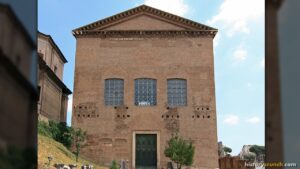
The forum was the civic heart of any Roman city. Originally a marketplace, the forum developed into a complex of temples, public buildings, law courts, and open spaces where citizens gathered for commerce, politics, and public life. The Roman Forum in Rome, which grew over many centuries, contained some of the most important buildings in the ancient world, including the Temple of Saturn, the Curia where the Senate met, and the Rostra, the speaker’s platform from which politicians addressed the public.
Basilicas were large rectangular public halls that were used for legal proceedings, business, and public gatherings. They typically featured a long central nave flanked by lower side aisles and lit by a row of windows near the roof. The basilica form proved so practical for covering large interior spaces that it was later adopted as the standard plan for early Christian churches, and it remains the basis of church architecture to this day.
Public baths, known as thermae, were among the most impressive achievements of Roman architecture. They were not simply places to wash, but large community centers that included hot rooms, warm rooms, cold plunge pools, exercise areas, libraries, gardens, and meeting spaces. The largest imperial baths were enormous buildings. The Baths of Caracalla, built in Rome between 212 and 217 CE, could accommodate around 1,600 bathers at a time in a complex covering more than 120,000 square meters. Their great vaulted halls were decorated with mosaics, marble, and statues. The engineering required to heat such large spaces, supply them with running water, and drain them efficiently was remarkable by any standard.
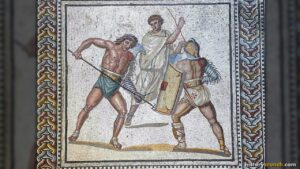
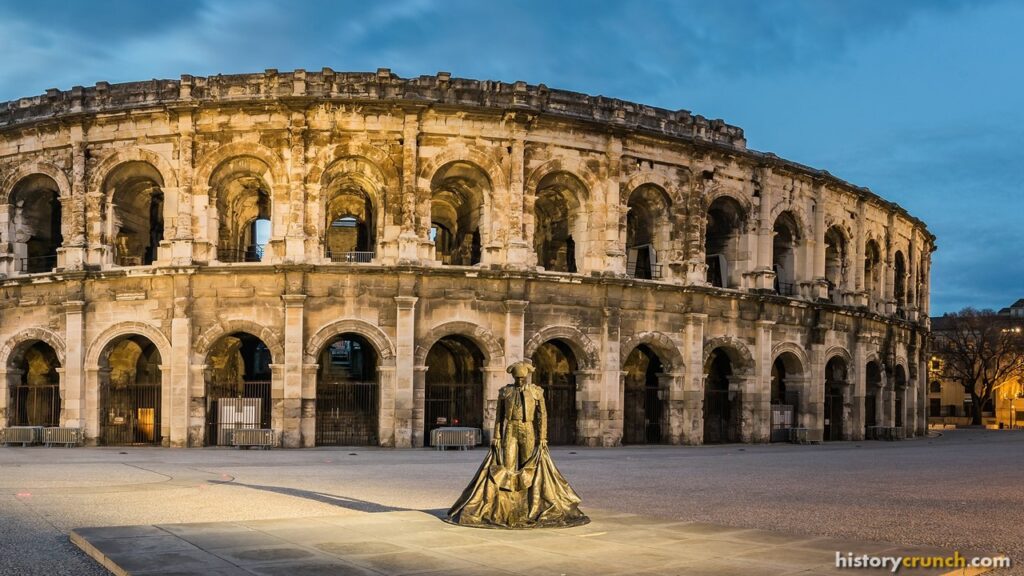
Amphitheaters were oval arenas used for gladiatorial contests, animal hunts, and public spectacles. The most famous was the Colosseum in Rome, formally known as the Flavian Amphitheater, built between 72 and 80 CE. It could hold between 50,000 and 80,000 spectators, seated according to social rank, and its exterior featured three tiers of arched openings decorated with columns in the Doric, Ionic, and Corinthian orders. Its complex system of underground passages, trapdoors, and machinery allowed animals, gladiators, and scenery to be raised dramatically into the arena. At least 250 amphitheaters were built across the Roman Empire, from Britain to North Africa.
Theaters and circuses were other key public entertainment venues. The Circus Maximus in Rome, which was used for chariot racing, could hold an estimated 150,000 to 250,000 spectators, making it the largest stadium in the ancient world.
ARCHITECTURE IN ANCIENT ROME – TEMPLES
Religion was an important part of Roman public life, and temples were among the most prominent buildings in every Roman city. Roman temples were typically raised on a high platform called a podium and approached by steps at the front. The facade was decorated with columns and a triangular pediment above the entrance. This arrangement, with the decorative front facade facing a public square and the rest of the building simpler in design, was different from Greek temples, which were designed to be seen from all sides.
The most famous surviving Roman temple is the Pantheon, originally built under Emperor Augustus and completely rebuilt under Emperor Hadrian between about 118 and 125 CE. The Pantheon was dedicated to all the gods and is remarkable for its perfectly preserved concrete dome, which features a circular opening at the top called the oculus, 8.8 meters (29 feet) in diameter, which is the sole source of light for the interior. The geometric precision of the Pantheon’s design, in which a perfect sphere would fit exactly inside the circular drum and dome, reflects the sophisticated mathematical thinking behind Roman architecture. The Pantheon has been in continuous use for nearly 2,000 years and today functions as a Catholic church.
ARCHITECTURE IN ANCIENT ROME – INFRASTRUCTURE
Some of the most important and lasting achievements of Roman architecture were practical rather than decorative. Rome’s network of roads, aqueducts, and bridges transformed the empire and remain impressive engineering achievements.
Roman roads were built to last, with a carefully layered structure of gravel, sand, and large stone paving blocks that could withstand heavy use for centuries. At the height of the empire, the Roman road network stretched for more than 80,000 kilometers (50,000 miles) across Europe, North Africa, and the Middle East, connecting cities, military forts, and ports in a system that allowed armies, traders, and officials to move quickly and reliably across vast distances.
Aqueducts were one of the great engineering achievements of the ancient world. They used gravity to carry water from distant sources, sometimes dozens of miles away, to Roman cities through a precisely calibrated system of channels, tunnels, and arched bridges. Rome itself was supplied by eleven major aqueducts. The Aqua Claudia, completed in 52 CE, stretched nearly 69 kilometers (43 miles) and delivered water to the city at a rate that some estimates put at over 180,000 cubic meters per day. Aqueducts were supported on rows of arches where they needed to cross valleys, creating the dramatic elevated viaducts that remain some of the most striking surviving Roman structures, including the Pont du Gard in southern France, which still stands to a height of nearly 49 meters (160 feet).
Roman bridges were similarly impressive. They used the arch to span rivers and valleys in a way that was both structurally sound and visually striking. Some Roman bridges are still in use today, a remarkable testament to the quality of their construction.
ARCHITECTURE IN ANCIENT ROME – TRIUMPHAL ARCHES AND COLUMNS
Roman emperors and generals used architecture to celebrate military victories and project political power. Triumphal arches were freestanding arched monuments erected to honor successful military campaigns. They were typically decorated with carved relief sculptures showing scenes from the relevant campaign and inscriptions recording the names of the honoree and their victories. The Arch of Titus, erected in Rome around 81 CE to celebrate the Roman conquest of Jerusalem, is one of the best-preserved examples and features detailed carvings of Roman soldiers carrying the sacred objects from the Temple of Jerusalem. The Arch of Constantine, completed in 315 CE, remains one of the largest and best-preserved triumphal arches in the world.
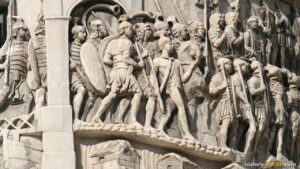
Triumphal columns served a similar purpose. Trajan’s Column, completed in 113 CE, is a 38-meter (125-foot) column covered in a continuous spiral band of carved reliefs depicting the emperor Trajan’s military campaigns against the Dacians. The level of detail and narrative skill in the carvings is extraordinary, and the column has been studied by historians and artists for centuries as a record of Roman military practices and life.
SIGNIFICANCE OF ARCHITECTURE IN ANCIENT ROME
Architecture in Ancient Rome was far more than a set of impressive buildings. It was a system through which the Roman Empire organized space, displayed power, served its citizens, and expressed its values. The roads, aqueducts, and public buildings of Rome transformed the quality of urban life across the ancient world, bringing clean water, efficient transportation, public meeting spaces, and entertainment to millions of people across a vast territory.
The lasting influence of Roman architecture on later civilizations is extraordinary. Early Christian churches adopted the basilica plan. The dome of the Pantheon influenced church builders and architects from the Renaissance to the present day. When architects in the 18th and 19th centuries wanted to give government buildings, universities, banks, and public institutions a sense of authority and permanence, they turned to Roman forms. The United States Capitol Building, the White House, and countless courthouses, libraries, and government buildings around the world reflect the enduring influence of Roman architectural ideas. In this way, the buildings the Romans constructed more than two thousand years ago continue to shape the world we live in today.