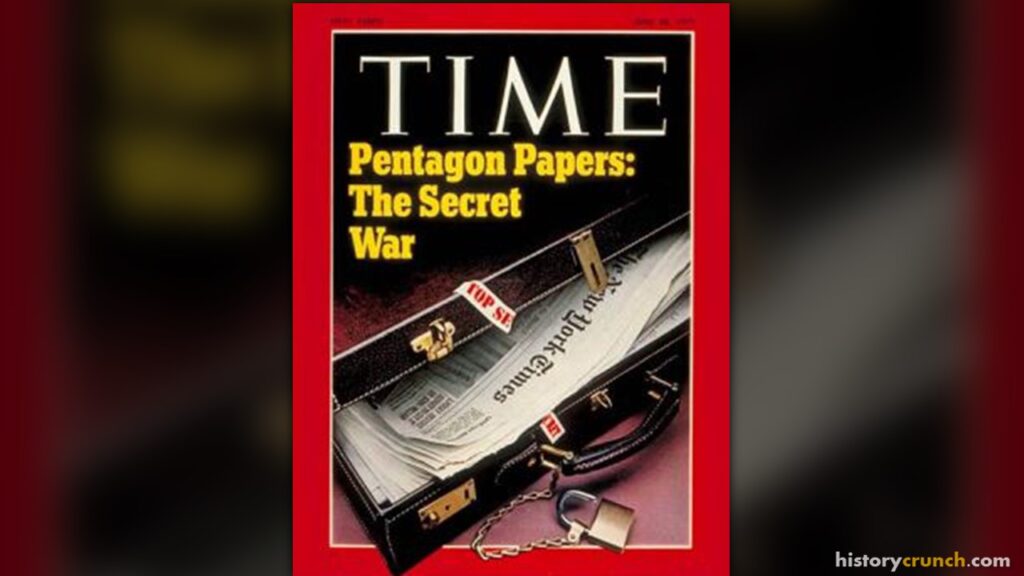
The Pentagon Papers is the popular name for a classified United States Department of Defense study officially titled History of U.S. Decision-Making in Vietnam, 1945 to 1968. The study was commissioned in 1967 by Secretary of Defense Robert McNamara and consisted of 47 volumes containing approximately 7,000 pages of documents and analysis. It was marked top secret and only 15 copies were made. In 1971, a defense analyst named Daniel Ellsberg, who had worked on the study and become deeply opposed to the Vietnam War, secretly copied large portions of it and gave them to the New York Times. The Times began publishing articles based on the study on June 13th, 1971. The Nixon administration attempted to stop publication through the courts, but the Supreme Court ruled 6 to 3 on June 30th, 1971, that the newspapers had the right to publish the documents. The Pentagon Papers revealed that the United States government had systematically deceived the American public and Congress about the nature and extent of its involvement in Vietnam, deepening the already intense public opposition to the war.
What Was the Vietnam War?
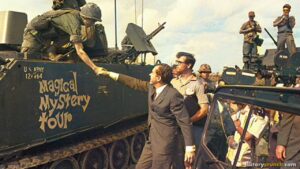
The Vietnam War was a major Cold War conflict fought between the communist government of North Vietnam, supported by the Soviet Union and China, and the non-communist government of South Vietnam, supported by the United States. The United States became deeply involved in the conflict during the 1960s, eventually sending more than 500,000 combat troops. The war was enormously controversial at home and generated widespread protest across the country. The Pentagon Papers were significant precisely because they revealed the gap between what the government had been telling the public about the war and what it actually knew and believed in private.
Pentagon Papers – Background and Commission
The study that became known as the Pentagon Papers was commissioned by Secretary of Defense Robert McNamara in June of 1967. McNamara had been one of the architects of American military strategy in Vietnam during the Kennedy and Johnson administrations, but by 1967 he had developed serious doubts about whether the war could be won. He commissioned the study partly to understand how the United States had become so deeply involved in the conflict.
A team of approximately 36 analysts, including military officers, civilian researchers, and foreign policy experts, worked on the project for 18 months. They were given access to a wide range of classified documents from across the government, though they were not permitted to conduct personal interviews with key decision-makers. The completed study covered American involvement in Vietnam from the end of World War II through May of 1968. It was finished shortly after Nixon took office and was classified top secret. Neither McNamara himself nor Nixon’s own Secretary of Defense Melvin Laird ever read it in full.
Pentagon Papers – Daniel Ellsberg
The man responsible for leaking the Pentagon Papers was Daniel Ellsberg, a defense analyst who had worked on the study and before that had served as a Pentagon official and spent two years working alongside the military in Vietnam. Ellsberg had been an early and ardent supporter of American involvement in Vietnam, but his experiences in the country and his work on the study had convinced him that the war was both unwinnable and based on systematic dishonesty by the government.
By 1969, Ellsberg had decided that the American public deserved to know the truth about how the country had become involved in Vietnam and how the war had been conducted. Over the course of several weeks in the autumn of 1969, with the help of a colleague named Anthony Russo, he secretly photocopied large portions of the study using a photocopier at an advertising agency in Los Angeles. He initially attempted to persuade members of Congress to release the documents officially, approaching several senators including William Fulbright and George McGovern, but none were willing to take the political risk. By early 1971 he had decided to go directly to the press.
In March of 1971, Ellsberg gave 43 volumes of the study to Neil Sheehan, a reporter at the New York Times who had previously covered the Vietnam War. The Times spent several months reviewing and verifying the documents before publishing its first article based on them on June 13th, 1971.
Pentagon Papers – Publication and Legal Battle
The New York Times published its first article based on the Pentagon Papers on Sunday, June 13th, 1971. After three articles had appeared, the Nixon administration obtained a federal court injunction ordering the Times to stop publishing. The Times appealed, and while the legal battle was underway Ellsberg gave copies of the documents to the Washington Post, which began its own series on June 18th. The government also sought an injunction against the Post. Within days, more than a dozen other newspapers had received copies and were publishing their own reports.
The legal battle moved with extraordinary speed through the court system. Different federal courts reached different conclusions, with some ordering publication halted and others allowing it to continue. The Supreme Court agreed to hear the case on June 26th and issued its ruling just four days later on June 30th, 1971, one of the fastest proceedings in the court’s history.
In a 6 to 3 decision in New York Times Company v. United States, the Supreme Court ruled that the government had not met the heavy burden of justification required to impose a prior restraint on the press. The majority held that the First Amendment’s protection of freedom of the press was extremely strong and that the government could not suppress publication simply by claiming national security concerns. The decision is widely regarded as one of the most important press freedom rulings in American history. Publication of the Pentagon Papers resumed immediately.
Ellsberg surrendered to federal authorities in Boston on June 28th, 1971, and was charged with conspiracy, espionage, and theft of government property, charges that carried a potential sentence of 115 years in prison. However, in May of 1973 all charges against him were dismissed by the trial judge after it emerged that the Nixon administration had conducted illegal operations against Ellsberg, including the burglary of his psychiatrist’s office by the White House Plumbers, the same covert unit that would later carry out the Watergate break-in.
Pentagon Papers – What the Papers Revealed
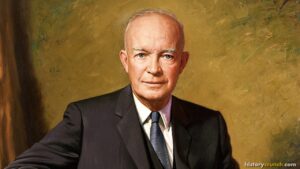
The contents of the Pentagon Papers were deeply damaging to the government’s credibility because they showed a consistent pattern of deception stretching back across multiple administrations. The study revealed that the Truman administration had become involved in supporting French colonial forces in Vietnam as early as 1950, years before most Americans were aware of any significant American interest in the region. It showed that the Eisenhower administration had made a deliberate decision in 1954 to prevent a communist takeover of South Vietnam and to undermine the government of North Vietnam, actions that contradicted public statements about America’s limited role.
Most damaging were the revelations about the Johnson administration, which was shown to have systematically misled the public and Congress about the extent of American military activities and the prospects for winning the war. In fact, a 1996 New York Times article summarizing the papers concluded that the Johnson administration had systematically lied, not only to the public but also to Congress. The study showed that the administration had ordered secret bombing raids and military operations in neighboring countries that were never reported publicly. It showed that senior officials privately doubted the war could be won even as they were making optimistic public statements about progress.
Pentagon Papers – Connection to Watergate
The Pentagon Papers had an important indirect connection to the Watergate scandal. Nixon’s obsession with stopping further leaks and with discrediting Ellsberg led directly to the creation of the White House Plumbers, the secret unit of operatives tasked with plugging information leaks and conducting covert operations against the administration’s enemies. In September of 1971, the Plumbers broke into the Beverly Hills office of Ellsberg’s psychiatrist, hoping to find damaging personal information they could use to discredit him. The same unit, under the leadership of E. Howard Hunt and G. Gordon Liddy, later carried out the Watergate break-in of June 1972. As stated above, it was the discovery of the illegal operation against Ellsberg during his trial that led to the dismissal of all charges against him, and the broader pattern of illegal White House activity that the Plumbers represented contributed directly to the Watergate crisis that ultimately brought Nixon down.
Pentagon Papers – Significance
The significance of the Pentagon Papers in the history of the Vietnam War and American democracy is considerable. The documents confirmed what many critics of the war had long suspected: that the government had been deliberately misleading the public about the war for years, understating its costs and overstating its prospects for success. This revelation deepened the already intense distrust of the government that the Vietnam War had generated and contributed to the crisis of public confidence in American institutions that characterized the early 1970s.
The Supreme Court’s decision in the Pentagon Papers case also established an important and lasting precedent for press freedom in the United States, making it much harder for the government to use prior restraint to prevent newspapers from publishing information in the public interest. This precedent has been cited in subsequent cases involving press freedom and the publication of classified information.
As such, the Pentagon Papers stand as one of the most consequential episodes in the history of American journalism and American democracy, a moment when the free press fulfilled its role as a check on government power by publishing information the government desperately wanted to suppress.