Vietnam before the Vietnam War was a period of colonial rule, revolution, division, and rising Cold War tension. From the late 1800s to the mid-1950s, Vietnam changed from part of the French colonial empire into a divided country with rival governments in the north and south, creating the conditions that later led to full-scale war.
VIETNAM BEFORE THE VIETNAM WAR – FRENCH RULE AND NATIONALISM
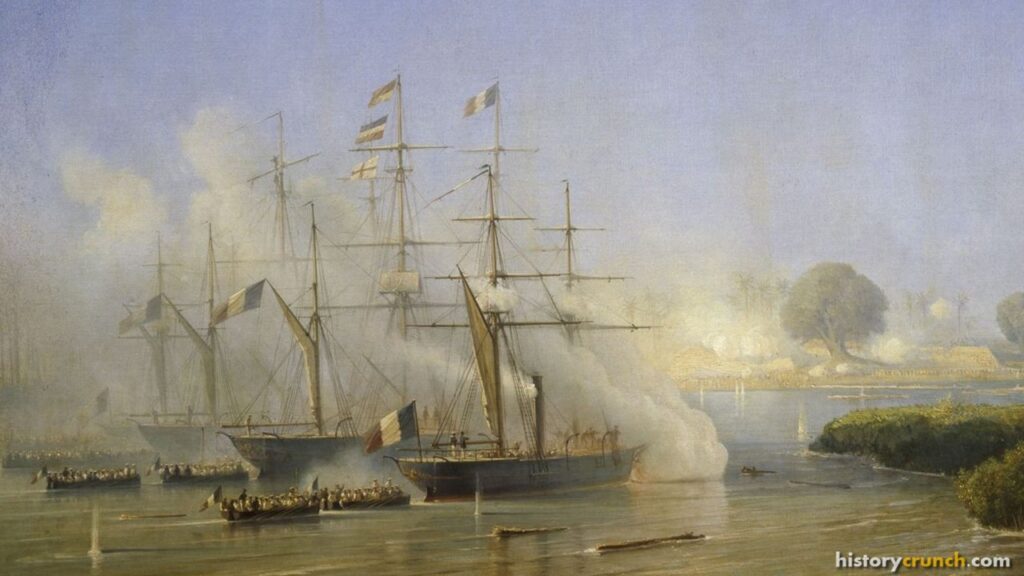
To understand Vietnam before the Vietnam War, it is necessary to begin with French imperialism. In the late 19th century, France brought Vietnam into French Indochina, and colonial rule created deep anger among many Vietnamese. Over time, that resentment helped strengthen Vietnamese nationalism and anti-colonial resistance, which became one of the most important forces in modern Vietnamese history.
By the early 20th century, Vietnamese opposition to colonial rule was growing, but it remained divided into different movements and ideologies. Some nationalists wanted independence through reform, while others wanted revolution. Historians agree that this long colonial background mattered because the later Vietnam conflict was not only a Cold War struggle. It was also rooted in decades of resistance to foreign control.
VIETNAM BEFORE THE VIETNAM WAR – WORLD WAR II AND THE VIET MINH
Vietnam changed sharply during World War II. In September of 1940, Japan invaded French Indochina after the defeat of France in Europe, and by 1941 Japan had gained full military access while the weakened French colonial administration remained in place. During this period, Ho Chi Minh, the communist leader of North Vietnam returned and helped build the Viet Minh, an independence movement that fought both foreign domination and Japanese occupation.
When Japan was defeated in August of 1945, following the atomic bombing of Hiroshima and Nagasaki, a power vacuum opened across Vietnam. On September 2nd, 1945, Ho Chi Minh declared the independence of the Democratic Republic of Vietnam in Hanoi, Vietnam. However, the situation quickly grew more complicated. Chinese Nationalist forces entered the north to accept the Japanese surrender, while British and French forces moved into the south, and French control was soon restored in Saigon, Vietnam. Therefore, Vietnamese independence was declared in 1945, but it was not securely won.
VIETNAM BEFORE THE VIETNAM WAR – FIRST INDOCHINA WAR
The next major stage before the Vietnam War was the First Indochina War. After unsuccessful negotiations, general war broke out in 1946 between French forces and the Viet Minh. The conflict lasted for years and became the main struggle over who would control Vietnam after World War II.
A decisive turning point came at Dien Bien Phu, Vietnam. On May 7th, 1954, the French-held garrison there fell after a long siege, and this defeat effectively broke French power in Vietnam. The fall of Dien Bien Phu was important because it forced France to withdraw and opened the way for an international settlement at Geneva, Switzerland.
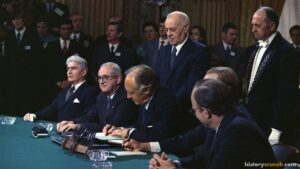
The Geneva settlement of July 21st, 1954, ended the fighting and temporarily divided Vietnam at the 17th parallel. North Vietnam came under the control of Ho Chi Minh, a Marxist-Leninist, and the Viet Minh, while the south remained under a democratic and capitalist government. The agreements treated the division as provisional rather than permanent, and they also looked toward future national elections. Regardless, the settlement did not truly solve the struggle over who would rule Vietnam.
VIETNAM BEFORE THE VIETNAM WAR – ROAD TO WAR
After 1954, Vietnam entered a new and more openly Cold War stage. In the south, Ngo Dinh Diem rose to power with strong backing from the United States. In October of 1955, Diem held a referendum that removed former emperor Bảo Đại and then established the Republic of Vietnam in Saigon, South Vietnam, with Diem as president. The vote gave Diem an overwhelming official victory, but the results were widely seen as manipulated.
The division then hardened further. Diem publicly announced in July of 1955 that he would not take part in the reunification elections that had been expected under the Geneva framework. This was a major step because it made the temporary division of Vietnam look increasingly permanent. At the same time, North Vietnam and South Vietnam developed into rival states with very different political systems, and each side claimed the right to represent the whole country.
By the late 1950s, violence inside South Vietnam was already increasing. Former Viet Minh members remained in the south, opposition to Diem’s rule grew, and communist strategy gradually shifted back toward armed struggle. Historians agree that by this stage, Vietnam had become a dangerous mix of unfinished decolonization, internal political conflict, and superpower rivalry. This meant the later war did not begin suddenly. It grew out of tensions that had been building for years.
VIETNAM BEFORE THE VIETNAM WAR – SIGNIFICANCE
The history of Vietnam before the Vietnam War was important because it explains why the later conflict became so intense and so difficult to end. The Vietnam War was rooted in French colonial rule, Japanese occupation, the rise of Vietnamese nationalism, the First Indochina War, the Geneva division, and the growing Cold War struggle between communism and capitalism.
Vietnam before the Vietnam War also shows that the later fighting was never just one simple conflict. It was at the same time a war over independence, a civil struggle over political control, and a Cold War confrontation involving outside powers.