Vietnamization was a military and political strategy introduced by President Richard Nixon in 1969, designed to gradually withdraw American combat forces from the Vietnam War while simultaneously expanding and improving the South Vietnamese military so that it could take over responsibility for fighting the war on its own. The term was coined by Secretary of Defense Melvin Laird. The policy was Nixon’s answer to the enormous pressure he faced from the American public, which had grown deeply opposed to the war after years of heavy casualties and no clear path to victory. Rather than an immediate withdrawal, which Nixon feared would be seen as a humiliating defeat, Vietnamization was intended to allow the United States to exit the war gradually and maintain what Nixon called peace with honor. Despite years of training, funding, and equipment transfers, Vietnamization ultimately failed. South Vietnam collapsed in 1975, less than two years after the last American troops withdrew.
What Was the Vietnam War?
The Vietnam War was a major Cold War conflict fought between the communist government of North Vietnam, supported by the Soviet Union and China, and the non-communist government of South Vietnam, supported by the United States. The United States became increasingly involved during the 1960s, eventually deploying more than 500,000 combat troops. The war was deeply unpopular at home and generated widespread anti-war protests. By the time Nixon took office in January of 1969, public opinion had turned strongly against continued American involvement, and pressure to find a way out of the conflict was intense.
Vietnamization – Background and Origins
When Nixon became president, the Vietnam War was at a critical and deeply troubled stage. The Tet Offensive of January 1968, in which North Vietnamese and Viet Cong forces launched simultaneous attacks on more than 100 cities and towns across South Vietnam, had shocked the American public and shattered the government’s claims that the war was being won. Although American and South Vietnamese forces had repelled the offensive militarily, the political damage in the United States was enormous. Public support for the war collapsed and President Lyndon Johnson, recognizing that he could not win re-election, chose not to run again.
Nixon had campaigned for president in 1968 with the promise of a secret plan to end the war, and once in office he faced the challenge of delivering on that promise without appearing to simply abandon South Vietnam. He was deeply opposed to immediate withdrawal, believing it would undermine American credibility around the world and encourage communist aggression elsewhere. At the same time, he recognized that the American public would not accept continued large-scale casualties indefinitely.
Nixon’s solution was Vietnamization. The core idea was simple. The United States would gradually reduce its combat role while pouring resources into building up the South Vietnamese military, known as the Army of the Republic of Vietnam or ARVN. As South Vietnamese forces became stronger, American troops could be withdrawn in stages. In this way the United States could leave Vietnam without appearing to have simply given up.
Vietnamization – Implementation
Nixon announced Vietnamization to the American public in a nationally televised speech on November 3rd, 1969. He described the policy as a plan to end the war and win the peace by strengthening South Vietnam’s ability to defend itself. He promised a phased and gradual withdrawal of American troops tied to improvements in South Vietnamese military capability.
The troop withdrawals began almost immediately. In June of 1969, Nixon announced the withdrawal of 25,000 American troops. Further withdrawals followed in the autumn of 1969. By March of 1970, he was announcing the phased withdrawal of 150,000 troops over the coming year. American troop levels fell from a peak of approximately 549,000 in 1969 to around 69,000 by 1972. The last American combat troops were withdrawn in March of 1973, following the Paris Peace Accords.
At the same time, the United States poured enormous resources into expanding and improving the South Vietnamese military. The ARVN grew from approximately 427,000 troops in late 1968 to around 516,000 by 1971. Territorial defense forces and civilian militias were expanded similarly, giving South Vietnam more than one million men in uniform by 1970. American military advisors trained South Vietnamese forces in tactics, logistics, and the use of modern weapons. The United States transferred large quantities of aircraft, artillery, vehicles, and other equipment to the South Vietnamese military.
Vietnamization – Complications
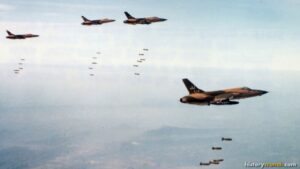
Vietnamization was complicated from the beginning by several major difficulties. The most fundamental was that the ARVN, despite its growing size and improved equipment, continued to suffer from serious problems of morale, leadership, and motivation. Corruption was widespread among South Vietnamese officers. Desertion rates remained high. Many units performed poorly in combat when not supported by American air power. The Easter Offensive of March 1972, in which North Vietnam launched a massive conventional military assault across South Vietnam, exposed these weaknesses dramatically. South Vietnamese ground forces struggled badly and were only able to halt the offensive with massive American air support, including B-52 bombing raids.
Vietnamization was also complicated by Nixon’s decision to expand the air war and carry out military operations in neighboring countries. In April of 1970, Nixon ordered American and South Vietnamese forces to invade Cambodia to destroy North Vietnamese supply bases there. The Cambodian incursion provoked enormous protests in the United States, including the Kent State University shootings in which four students were killed by National Guard troops during a protest on May 4th, 1970. Rather than demonstrating American strength, the episode deepened the domestic political crisis over the war. In 1971, South Vietnamese forces attempted an invasion of Laos to cut the Ho Chi Minh Trail, North Vietnam’s main supply route into the South. The operation, known as Lam Son 719, ended in a disastrous South Vietnamese retreat and cast serious doubt on the ARVN’s ability to operate effectively without American ground support.
Vietnamization – Results and Failure
The Paris Peace Accords of January 1973 provided the formal conclusion of American military involvement in Vietnam. Under the agreement, the remaining American forces withdrew within 60 days. Vietnamization had achieved its narrow political goal of allowing the United States to exit the war. However, it had not achieved its broader military goal of leaving behind a South Vietnam capable of defending itself.
The fundamental weaknesses that had plagued the South Vietnamese military throughout the war were not solved by training and equipment transfers alone. When North Vietnam launched its final offensive in March of 1975, the South Vietnamese government and military collapsed with shocking speed. Major cities fell in rapid succession. President Nguyen Van Thieu resigned on April 21st, 1975, and South Vietnam surrendered unconditionally on April 30th, 1975. Saigon was renamed Ho Chi Minh City. Vietnam was reunified under communist rule. The outcome that Vietnamization had been designed to prevent had come about anyway, just two years after the last American troops left.
Vietnamization – Significance
The significance of Vietnamization in the history of the Vietnam War is considerable. It was the policy that allowed the United States to disengage from its most divisive and damaging foreign policy commitment, reducing American casualties significantly and eventually bringing American prisoners of war home. In this limited sense it achieved what Nixon intended.
However, Vietnamization’s failure to produce a South Vietnam capable of surviving without American support raises important questions about the limits of what military training and equipment can accomplish. The ARVN’s weaknesses, including poor leadership, low morale, and corruption, were deeply rooted in the political and social failures of the South Vietnamese government, and no amount of American military assistance could fix problems that were ultimately political rather than military in nature.
In fact, Vietnamization established a model of military assistance and gradual disengagement that the United States has returned to in subsequent conflicts, including in Iraq and Afghanistan, with similarly mixed results. As such, Vietnamization stands as one of the most consequential and instructive strategies of the Cold War era, a policy that succeeded in ending American involvement in the Vietnam War without resolving the conflict itself.