Propaganda in Nazi Germany was one of the most important tools used by Adolf Hitler and the Nazi Party to control German society. Nazi Germany began on January 30th, 1933, when Hitler became Chancellor of Germany, and it lasted until May of 1945, when Nazi rule collapsed at the end of World War II. During that period, propaganda shaped what many Germans read in newspapers, heard on the radio, watched in films, and saw in posters, parades, schools and rallies. This is significant because propaganda helped the Nazis spread their ideas far beyond government offices and into the everyday lives of ordinary people.
WHAT WAS NAZI GERMANY?
To understand propaganda in Nazi Germany, it is first necessary to understand Nazi Germany itself. Nazi Germany was the dictatorship created by Hitler and the Nazi Party after democracy was destroyed in Germany in 1933. After the Reichstag Fire on February 27th, 1933, the Nazis used fear of communism to gain more power. Then, on March 23rd, 1933, the Enabling Act gave Hitler the ability to make laws without the normal approval of parliament. This is significant because it allowed Hitler to build a dictatorship and remove many of the limits that had existed in the Weimar Republic.
Once the Nazis had gained control, they moved quickly to reshape public life. Rival political parties were banned, critics were silenced, and the government worked to bring culture, education, and media under Nazi influence. This is important because propaganda became much more powerful in a state where opposition voices were being removed.
WHAT WAS PROPAGANDA?
Propaganda is information used to influence how people think and feel, especially for political purposes. In general, propaganda does not simply provide neutral facts. Instead, it selects information, repeats certain messages, appeals to emotions, and presents events in ways that support a particular goal. This is significant because propaganda can shape public opinion even when the information being presented is incomplete, exaggerated or false.
In Nazi Germany, propaganda was used to strengthen support for the regime and weaken resistance to it. The Nazis wanted Germans to admire Hitler, trust the government, fear supposed enemies, and accept Nazi policies as necessary and patriotic. This is important because propaganda in Nazi Germany was one of the main ways the dictatorship of Adolf Hitler and the Nazi Party maintained power.
PROPAGANDA IN NAZI GERMANY – JOSEPH GOEBBELS
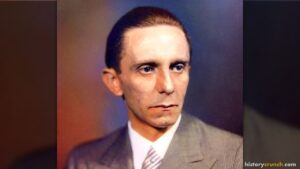
The most important figure in Nazi propaganda was Joseph Goebbels. On March 13th, 1933, Hitler appointed Goebbels as Minister of Public Enlightenment and Propaganda. As a result, Goebbels became one of the most powerful men in Nazi Germany because he was responsible for shaping the ideas and messages spread through the media, the arts and public events. This is significant because propaganda became far more effective once it was organized by the state under a single determined leader.
Goebbels understood that propaganda had to be simple, emotional and repeated often. He wanted Nazi messages to appear everywhere, so that Germans would hear the same ideas again and again in different forms. Hitler was presented as a heroic leader, Germany was presented as a nation rising again after humiliation, and the enemies of the Nazis were presented as threats to the country. This is important because repetition made propaganda feel normal and familiar, which helped the regime influence the everyday thinking of the German people.
PROPAGANDA IN NAZI GERMANY – ADOLF HITLER
One of the main goals of propaganda in Nazi Germany was to build a cult of personality around Adolf Hitler. Nazi posters, speeches, films, and rallies presented Hitler as a strong, wise, and almost heroic leader who could restore Germany’s greatness. He was often shown as calm, disciplined and deeply connected to the German people. This is significant because it encouraged loyalty not just to the Nazi Party, but to Hitler himself.
This image was especially important in the years after World War I, when many Germans felt anger, humiliation, and uncertainty. Nazi propaganda presented Hitler as the man who could reverse the damage caused by the Treaty of Versailles, defeat communism, rebuild the economy and restore national pride. Therefore many Germans were willing to accept dictatorship if they believed Hitler could solve Germany’s problems.
Large rallies also played a major role in this process. The Nuremberg rallies, held in the 1930s, were massive Nazi gatherings filled with banners, uniforms, speeches, and carefully staged displays of unity. These events were designed to impress both participants and viewers. This is significant because the rallies turned propaganda into a dramatic experience and made Nazi power appear overwhelming.
PROPAGANDA IN NAZI GERMANY – TYPES OF PROPAGANDA
Historians have identified several different types of propaganda used by the Nazi regime in the years before and during the events of World War II. Fort instance, the most common types included: radio, films, newspapers, posters and public rallies.
The Nazis used many forms of media, but radio was one of the most effective. The government encouraged German families to buy cheap radios, often called the ‘People’s Receiver’, so that Nazi speeches and broadcasts could be heard in homes across the country. In fact, by 1938, millions of these radios had been produced and distributed to the people of Nazi Germany. This is important because radio allowed the Nazi regime to speak directly to the population in a fast and powerful way.
Film was also used to spread Nazi ideas. Goebbels understood that film could entertain people while also delivering political messages. Some films directly attacked Jews and other supposed enemies of the regime, while others promoted loyalty, sacrifice, and national pride more indirectly. This is significant because propaganda worked best when it did not always look like propaganda. Sometimes it was most effective when it was mixed with entertainment.
Newspapers were another major tool. Nazi officials took control of the press and censored criticism of the government. Editors were expected to follow official guidance, and newspapers increasingly reflected Nazi priorities and language.
Propaganda in Nazi Germany worked closely with censorship. The regime did not simply promote its own ideas. It also worked to remove books, music, films, and opinions that did not fit Nazi values. One famous example came with the book burning rallies of May 10th, 1933, when books considered ‘un-German’ were burned publicly. As a result, artists, writers, journalists and teachers faced growing pressure to conform. Some were dismissed from their positions, while others went into exile or remained silent.
PROPAGANDA IN NAZI GERMANY – WHY WAS IT EFFECTIVE?
Propaganda in Nazi Germany was effective for several reasons. First, it was repeated constantly through many different forms of media and public life. Second, it connected itself to real fears and frustrations that many Germans already felt after World War I and during the Great Depression. Third, it was supported by censorship, surveillance and repression, which made open disagreement dangerous. This is important because propaganda rarely works through words alone. It becomes stronger when it is backed by state power and the use of terror and repression.
PROPAGANDA IN NAZI GERMANY – SIGNIFICANCE
Propaganda in Nazi Germany was significant because it shows how a dictatorship can try to control an entire society through ideas, symbols and emotion. The Nazis used propaganda to glorify Hitler, spread anti-Semitism, manipulate public opinion, and shape the values of children and adults alike. This is important because it reveals that authoritarian power often depends on controlling how people see the world.
Propaganda in Nazi Germany is also significant because it helped prepare the ground for persecution, war, and mass violence. The regime did not rely only on police power and terror. It also worked to make its beliefs seem normal, patriotic, and necessary. Overall, propaganda in Nazi Germany was one of the central tools that allowed the Nazis to build, strengthen and sustain their dictatorship. For this reason , historians consider propaganda in Nazi Germany as significant to the developments of World War II and the Holocaust.