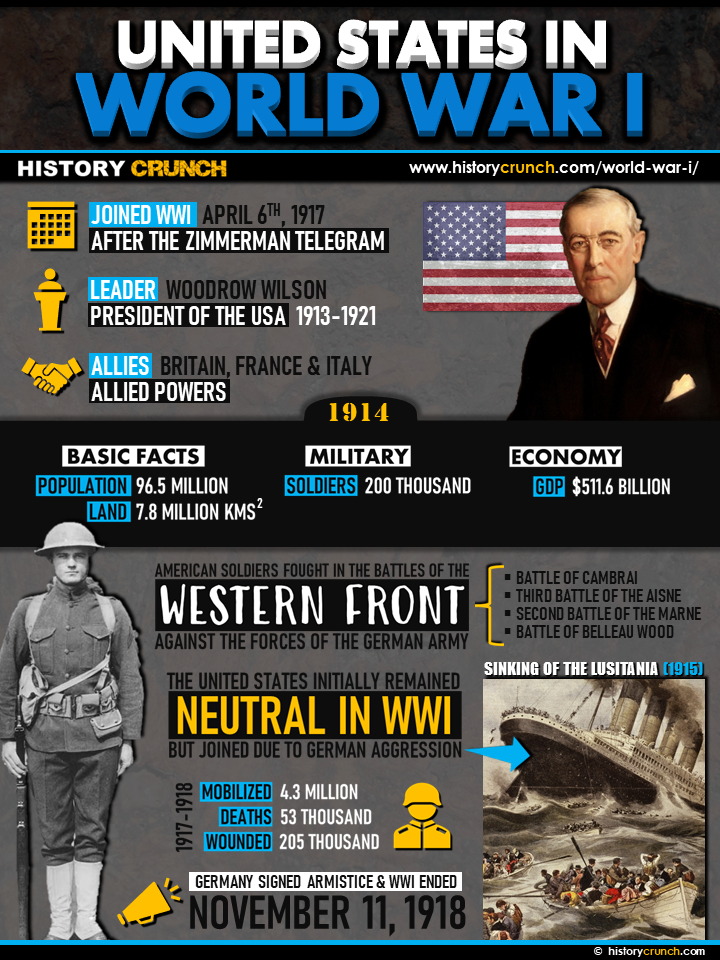
The United States entered World War I on April 6th, 1917 after nearly three years of neutrality, fundamentally changing the balance of the conflict in favor of the Allied Powers. President Woodrow Wilson had won reelection in 1916 partly on the slogan He Kept Us Out of War, but a combination of German submarine warfare and the discovery of the Zimmermann Telegram made American neutrality impossible to maintain. The fresh troops and resources that the United States brought to the Western Front played a crucial role in the final Allied offensives that ended the war on November 11th, 1918. This infographic was designed for students to visually summarize the United States’ role in World War I and is based on the History Crunch articles on the United States in World War I.
United States in World War I – Infographic
About This Infographic
This United States in World War I infographic was created by the History Crunch team to help students and teachers quickly understand the significance of America’s role in the First World War. It is designed as a visual learning and study tool, summarizing the essential information covered in our full articles on the United States in World War I. Teachers may use it as a classroom display, a discussion prompt, or a study aid for students preparing for assessments.
What This Infographic Covers
The infographic begins with why the United States remained neutral for nearly three years and what ultimately forced it into the war. When World War I began in 1914, most Americans wanted to stay out of the conflict and President Wilson pursued a policy of strict neutrality. However, Germany’s unrestricted submarine warfare in the Atlantic created growing tension. The most significant early incident was the sinking of the British ocean liner RMS Lusitania in May 1915, which killed 1,198 people including 128 American citizens. Germany temporarily suspended unrestricted submarine warfare following American pressure, but resumed it in February 1917.
The second major trigger was the Zimmermann Telegram. In January 1917 German Foreign Secretary Arthur Zimmermann sent a secret message to the German ambassador in Mexico proposing a military alliance between Germany and Mexico. Germany promised to help Mexico recover territory it had lost to the United States including Texas, New Mexico and Arizona if Mexico would join the war against the United States. British intelligence intercepted and decoded the telegram and shared it with the American government in February 1917. When its contents were published in American newspapers on March 1st, 1917, public outrage against Germany surged. Combined with Germany’s resumption of unrestricted submarine warfare and the sinking of American ships, it became impossible for Wilson to maintain neutrality. On April 2nd, 1917 President Wilson asked Congress for a declaration of war against Germany and Congress voted in favor on April 4th, 1917.
The infographic covers the American Expeditionary Force (AEF) and its major battles on the Western Front under the command of General John J. Pershing. American forces participated in several significant battles in 1918. The Battle of Chateau-Thierry on May 31st, 1918 saw American forces help stop a German advance that had pushed to within 50 miles of Paris. The Battle of Belleau Wood from June 1st to 26th, 1918 saw American Marines fight a fierce battle against five German divisions in northern France, suffering over 7,900 casualties including over 1,800 deaths. The Battle of Saint-Mihiel from September 12th to 15th, 1918 saw the American First Army successfully capture a German-held salient in a rapid four-day operation that demonstrated the growing effectiveness of American forces.
The largest and most significant American engagement was the Meuse-Argonne Offensive from September 26th to November 11th, 1918, which historians consider the most important American battle of World War I. Fought in northeastern France as part of the larger Hundred Days Offensive, the battle saw American and French forces push through the Argonne Forest against determined German resistance. The United States suffered over 122,000 casualties including over 26,000 deaths, making it the second deadliest campaign in American military history. The final phase of the offensive advanced deep into German territory until the armistice on November 11th, 1918 ended the war.
How to Use This Infographic in the Classroom
This infographic works well as a visual introduction to the United States in World War I before students read the full articles. It can also be used as a discussion prompt asking students to consider why the United States waited nearly three years before entering the war, and whether the Zimmermann Telegram or German submarine warfare was the more important factor in changing American public opinion. Teachers may also use it alongside the Zimmermann Telegram article and the Western Front map to give students a complete picture of America’s path to and participation in the war.
Related Articles
To learn more about the topics covered in this infographic, visit the following History Crunch articles: