This Eli Whitney infographic was created by History Crunch to help students and teachers quickly understand the life, inventions and historical significance of one of the most important American inventors of the Industrial Revolution. It covers his early life, his invention of the cotton gin, his development of interchangeable parts and his lasting impact on American industry. Designed for students in grades 5 to 12.
Eli Whitney – Infographic
About This Infographic
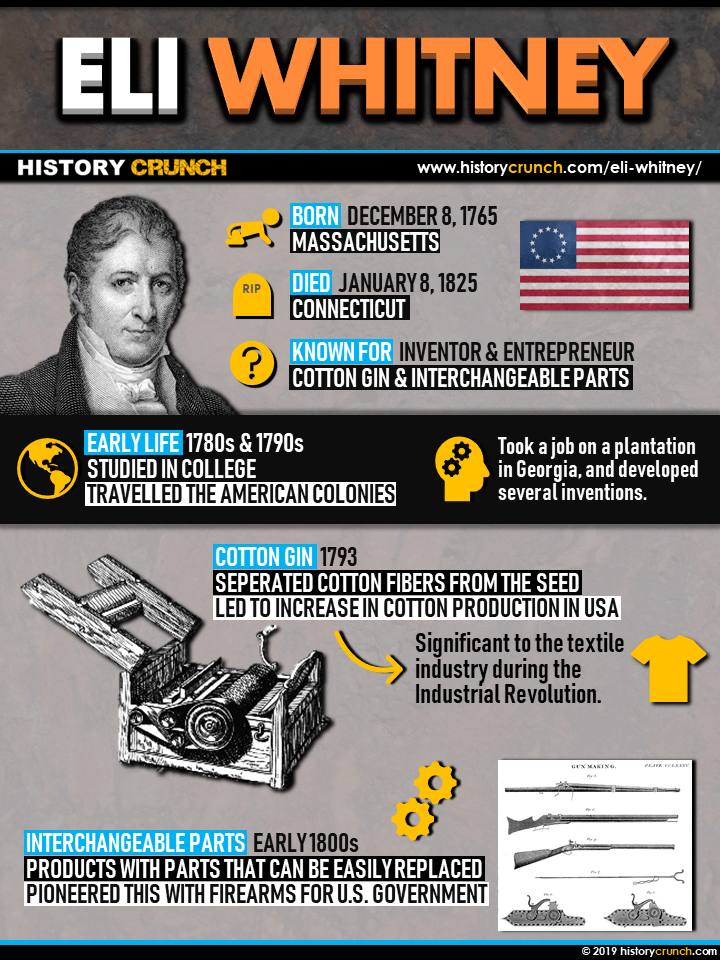
This Eli Whitney infographic was created by the History Crunch team to help students and teachers quickly understand the life and significance of one of the most important inventors in American history. It is designed as a visual learning and study tool, summarizing the essential information covered in our full article on Eli Whitney. Teachers may use it as a classroom display, a discussion prompt, or a study aid for students preparing for assessments.
What This Infographic Covers
Eli Whitney was born on December 8th, 1765 in Massachusetts. His father was a successful farmer and Whitney showed an early aptitude for practical problem-solving. When his mother died in 1777, he was put in charge of a nail manufacturing operation, giving him hands-on experience with early industrial processes from a young age. This early exposure to manufacturing helped shape the inventive mind that would go on to change American industry.
The infographic covers Whitney’s most famous invention, the cotton gin, which he developed in 1793 after visiting cotton plantations and recognizing the need for a faster method of processing cotton. Before the cotton gin, separating cotton fibers from their seeds was an extremely slow and labor-intensive process done entirely by hand. Whitney’s machine could perform this task quickly and efficiently, dramatically increasing the speed and scale of cotton production. The cotton gin made cotton into a highly profitable crop, strengthened the agricultural economy of the Southern United States and significantly boosted the American textile industry. However, the infographic also notes the troubling consequence of this invention: by making cotton production so much more profitable, the cotton gin also greatly increased the demand for enslaved labor on plantations, strengthening the institution of slavery in the United States at a critical moment in its history.
The infographic also highlights Whitney’s second major contribution to industrial history, his pioneering of interchangeable parts. After the cotton gin, Whitney developed a relationship with the United States Army and was granted a contract to manufacture firearms in the early 1800s. To fulfill this contract efficiently, his company developed a system in which firearms were built from standardized, easily replaceable parts. This meant that when a single component broke or needed repair, only that part needed to be replaced rather than the entire item. This concept of interchangeable parts became one of the most important innovations in the history of manufacturing and is a cornerstone of modern mass production methods used in industries around the world today.
Eli Whitney died on January 8th, 1825 in Connecticut. He is remembered today as one of the key inventors of the Industrial Revolution, particularly in the context of American industrialization.
How to Use This Infographic in the Classroom
This infographic works well as a visual introduction to Eli Whitney before students read the full biography article. It can also be used as a review tool before an assessment, or as a discussion prompt exploring the unintended consequences of invention, specifically how the cotton gin increased cotton production while also strengthening slavery in the American South. Teachers may also use it alongside related articles on the cotton gin, interchangeable parts and the broader story of American industrialization to help students understand Whitney’s place in industrial history.
Related Articles
To learn more about the topics covered in this infographic, visit the following History Crunch articles:
- Eli Whitney
- Cotton Gin Invention in the Industrial Revolution
- Interchangeable Parts Manufacturing in the Industrial Revolution
- Industrial Revolution Overview
- Inventions and Inventors of the Industrial Revolution
- Textile Manufacturing in the Industrial Revolution
- Slavery in the United States
- Factory System in the Industrial Revolution