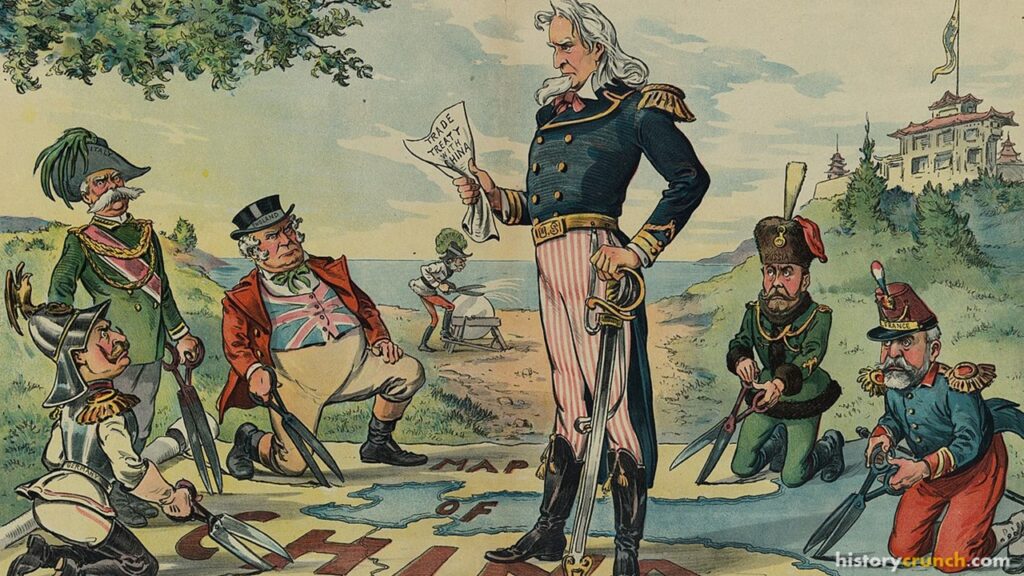
The ‘Open Door Policy’ was a term used in relation to trade and other economic interests in China during the Age of Imperialism. For instance, in the late 19th century and early 20th century, the major western powers (Britain, France, Germany, Russia, and Japan) exerted a great deal of influence in China. More specifically, the western powers used their colonial empires to carve up ‘spheres of influence’ in China. However, the United States did not have its own sphere of influence in China and instead called for an ‘Open Door Policy’, which guaranteed it equal access to Chinese markets. As such, the term ‘Open Door Policy’ is most closely linked with American interests in China during the period of western imperialism.
OPEN DOOR POLICY – BACKGROUND HISTORY
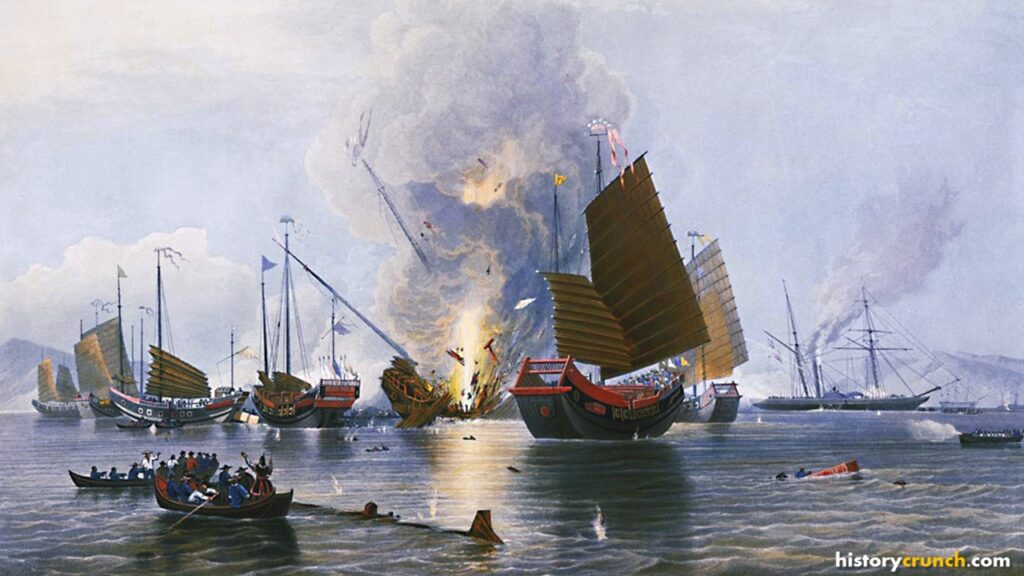
Following its loss of the two Opium Wars (First Opium War and Second Opium War), China entered a period where foreign imperial powers developed spheres of influence within its borders. Each of the following nations developed and established spheres of influence in China after the mid-1800s: France, Britain, Germany, Russia and Japan. For example, in 1860, Russia captured a large portion on Northern China and controlled it as its own ‘sphere of influence’.
Japan also took advantage of China in its weakened state. For example, it worked to increase its influence in Korea, a country that China had formerly dominated. The two countries eventually erupted into war over control of Korea in the form of the First Sino-Japanese War, which took place from 1894 to 1895. Similar to the previous Opium Wars, the First Sino-Japanese War proved to be another crushing defeat for the Qing Dynasty and China. As a result, China was forced to give control of Korea, the island of Taiwan and the Liaodong Peninsula to Japan. As well, Japan began to establish its own sphere of influence on the eastern coast of China.
OPEN DOOR POLICY – ROLE OF THE UNITED STATES
For its part, the United States did not establish its own sphere of influence within China but the United States government argued that it should receive the same commercial and trading rights as the other western powers. More specifically, the United States sought to establish an ‘Open Door Policy’ in China meaning it wanted equal access to trade in China for all nations. The policy was meant to prevent foreign powers from carving up China into colonies, thus denying the United States access to lucrative trade markets.
The United States took matters in Asia more seriously after the Spanish-American War, when they took control of the Philippines. In 1898, United States President William McKinley stated his desire for the creation of an ‘open door’ that would allow all foreign nations access to the Chinese market for the purposes of trade. The following year, United States Secretary of State John Hay addressed letters to the foreign powers in China, which historians refer to as the ‘Open Door Note’. In these letters, the United States called on these countries to allow free trade in their spheres of influence. As well, it called for Chinese political unity, meaning the country should not be carved up into colonies. Again, the United States called for these measures as a means of protecting its economic interests in China, as it was afraid that it might be locked out of the region.
While none of the western powers formally agreed to John Hay’s policy as stated in his letters, it helped maintain an open door to trade in China. With that said, the ‘Open Door Policy’ that the United States called for did not prevent China from being dominated by the western powers.

OPEN DOOR POLICY – CHALLENGES
Challenges to the Open Door Policy occurred several times in the years that followed. First, the Boxer Rebellion of 1900 saw Chinese nationalists fight in an attempt to end foreign occupation of their country. Second, Japan issued the ‘21 Demands’ on China in 1915. These were special privileges requested by Japan that would occur within China. Regardless, the Open Door Policy was an important historical event, especially in relation to the period of western imperialism in China.