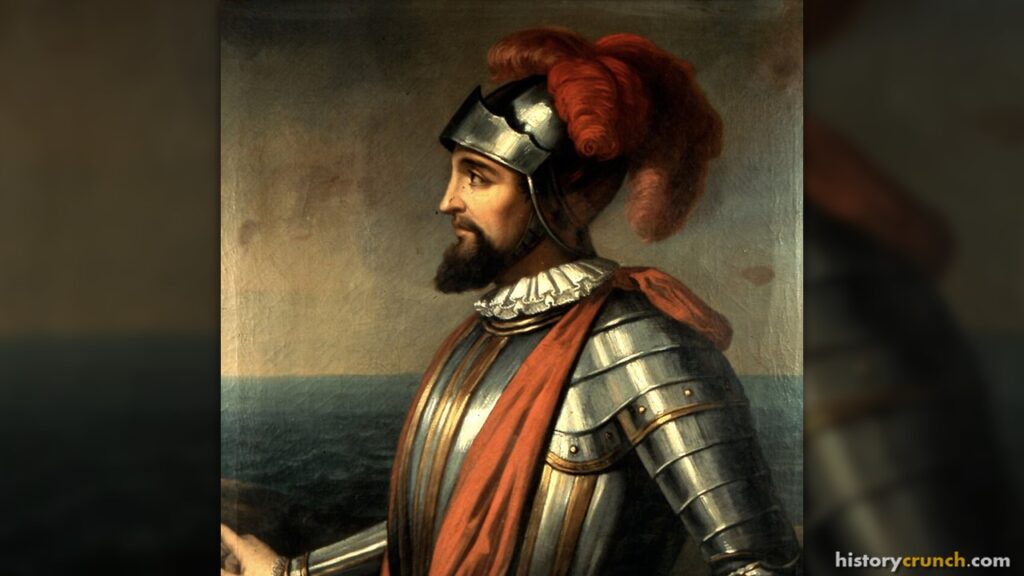
Vasco Núñez de Balboa was a Spanish explorer and conquistador who became the first European to see the Pacific Ocean from the shores of the Americas. In 1513 he led an expedition across the Isthmus of Panama and reached the Pacific coast, claiming the ocean and all lands it touched for the Spanish Crown. His achievement was one of the most significant geographical discoveries of the entire Age of Exploration and opened up European understanding of the true size and shape of the Americas.
Vasco Núñez de Balboa – Early Life
Vasco Núñez de Balboa was born around 1475 in Jerez de los Caballeros, Spain, the same region that later produced Hernando de Soto. He came from a family of lesser nobility, meaning his family had some social standing but little wealth. Like many ambitious young Spaniards of his generation, Balboa was drawn to the opportunities for fame and fortune that Spanish exploration of the New World was beginning to offer. In 1500 he sailed to the Americas for the first time, arriving in the region of present-day Colombia and Venezuela as part of an early Spanish expedition to the northern coast of South America.
After this first voyage, Balboa settled on the island of Hispaniola, which is the island today shared by the Dominican Republic and Haiti, and attempted to establish himself as a farmer and pig breeder. However, he accumulated significant debts during his time there and struggled to make a success of his life on the island. By 1510, creditors were closing in and Balboa was desperate for a way out. He reportedly stowed away or otherwise secured passage on a supply ship headed for a Spanish settlement on the mainland of South America, escaping Hispaniola and the debts he had accumulated. This somewhat unpromising beginning set the stage for the remarkable achievements that followed.
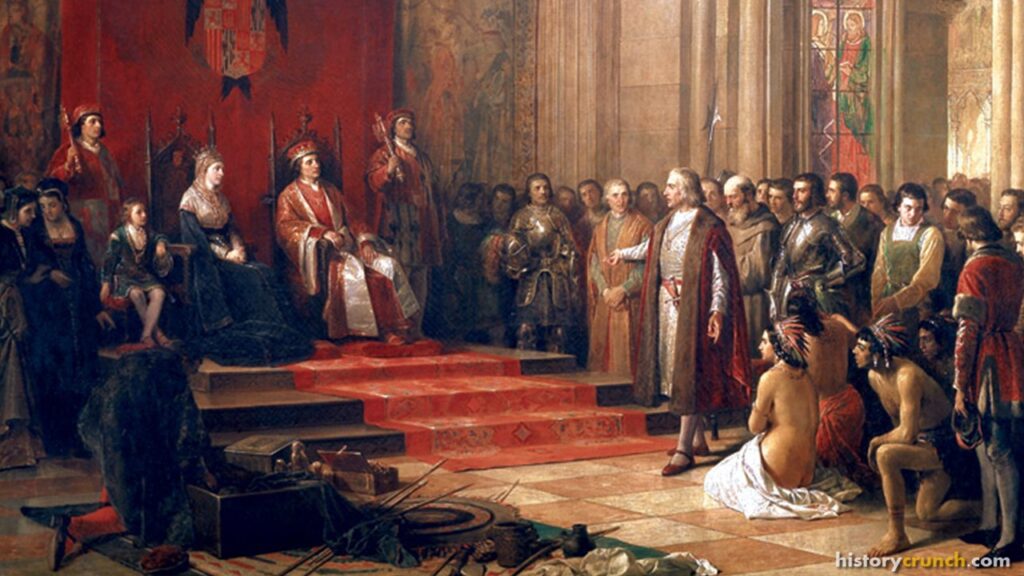
Vasco Núñez de Balboa – Voyages in the Age of Exploration
As stated above, Balboa was an important explorer during the time of the Age of Exploration and carried out significant explorations to the New World. In fact, after making his way to the mainland of Central America, Balboa quickly established himself as a capable leader among the Spanish settlers in the region. The Spanish settlement at Darién, located on the eastern coast of the Isthmus of Panama, was struggling under poor leadership, and Balboa used his intelligence and force of personality to effectively take control of the colony, removing its ineffective governor in a move that was technically a mutiny but was largely accepted by the settlers who preferred his leadership.
As governor of Darién, Balboa worked to establish productive relationships with some of the local indigenous peoples, using a combination of diplomacy, trade, and force. Through these contacts, he began to hear persistent stories about a great sea to the south and a land rich in gold that lay beyond the mountains of the interior. Different indigenous leaders described a vast ocean to the south and spoke of a wealthy civilization in that direction. These accounts referred to what Europeans would later identify as the Pacific Ocean and the Inca Empire of South America. For Balboa, these stories represented an enormous opportunity and he became determined to find this southern sea.
In September of 1513, Balboa set out from Darién with a force of approximately 190 Spanish soldiers and several hundred indigenous guides and allies. The expedition crossed the Isthmus of Panama through dense jungle, steep mountains, and extremely difficult terrain. The crossing took approximately 25 days and was an extraordinarily demanding journey in the tropical heat with limited supplies. On September 25th, 1513, Balboa climbed a peak in the mountains of Panama and became the first European to see the Pacific Ocean from the Americas. He stood at the summit and looked out over the vast body of water stretching to the horizon before him.
Four days later, on September 29th, 1513, Balboa led his men down to the shore of the Pacific. He waded into the water in full armor and, holding a sword in one hand and a banner bearing an image of the Virgin Mary in the other, formally claimed the ocean and all lands bordering it for the King of Spain. He named the body of water the Mar del Sur, meaning the South Sea, because he had approached it from the north. The name Pacific Ocean was later given to the same body of water by Ferdinand Magellan. Balboa spent several weeks exploring the coastline around the Gulf of Panama before returning to Darién with pearls, gold, and the extraordinary news of his discovery.
Vasco Núñez de Balboa – Later Life and Death
Despite the importance of his achievement, Balboa’s later years were marked by political conflict and ultimately a tragic end. While he had been away on his expedition to the Pacific, a new governor named Pedro Arias Davila, commonly known as Pedrarias, had been appointed to govern the region by the Spanish Crown. Pedrarias was a jealous and suspicious man who resented Balboa’s fame and popularity and feared that Balboa’s ambitions and achievements might threaten his own authority. The relationship between the two men was tense and difficult from the beginning, and Balboa was forced to navigate carefully to avoid the hostility of the new governor.
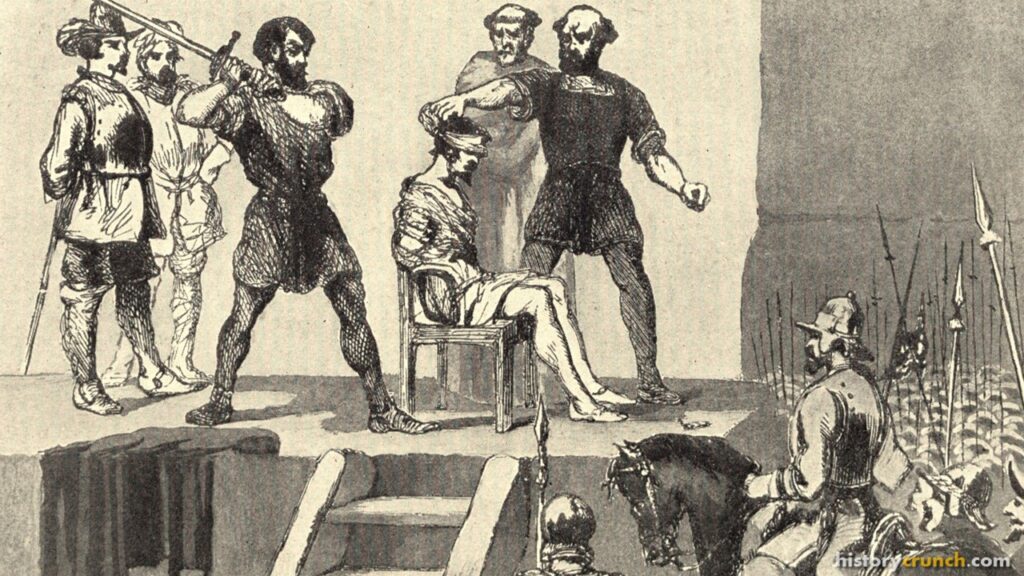
Balboa continued to make plans for further exploration, particularly for an expedition to explore and colonize the Pacific coast of South America. He supervised the construction of ships on the Pacific coast of Panama, working toward the goal of launching a major southern expedition. However, before he could set sail, Pedrarias moved against him. In 1519, Pedrarias had Balboa arrested on charges of treason, accusing him of plotting to overthrow Spanish authority in the region. The charges were widely believed to be politically motivated and unjust. Balboa was given a hasty trial, found guilty, and beheaded along with four of his companions in January of 1519. He was approximately 44 years old at the time of his death. Pedrarias watched the execution personally to ensure it was carried out.
Vasco Núñez de Balboa – Significance
Vasco Núñez de Balboa was a highly significant figure in the history of the Age of Exploration. His crossing of the Isthmus of Panama and his sighting of the Pacific Ocean in 1513 was one of the most important geographical discoveries of the entire era. By demonstrating that a vast ocean lay to the west of the Americas, Balboa fundamentally changed European understanding of world geography. His discovery made clear that the Americas were not part of Asia, as Christopher Columbus had believed, but rather a separate and enormous landmass standing between Europe and the Far East. This knowledge directly shaped the subsequent voyages of explorers like Ferdinand Magellan, whose circumnavigation of the globe in 1519 to 1522 was made possible in part by the geographic understanding that Balboa’s discovery had contributed.
Balboa’s achievement also had enormous strategic and economic consequences for Spain. His claim of the Pacific Ocean and all lands bordering it in the name of the Spanish Crown extended Spanish territorial ambitions far beyond the Caribbean and opened up the possibility of reaching Asia by sailing west from the Americas, which had been one of the original goals of Spanish exploration. His discovery helped set the stage for the later Spanish conquest of Peru and the Inca Empire under Francisco Pizarro, as indigenous accounts of a wealthy civilization to the south that Balboa had heard during his time in Panama pointed directly toward the Inca. As such, Vasco Núñez de Balboa remains one of the most significant and consequential explorers of the Age of Exploration, even though his life was cut short before he could fully pursue the opportunities his own discovery had created.