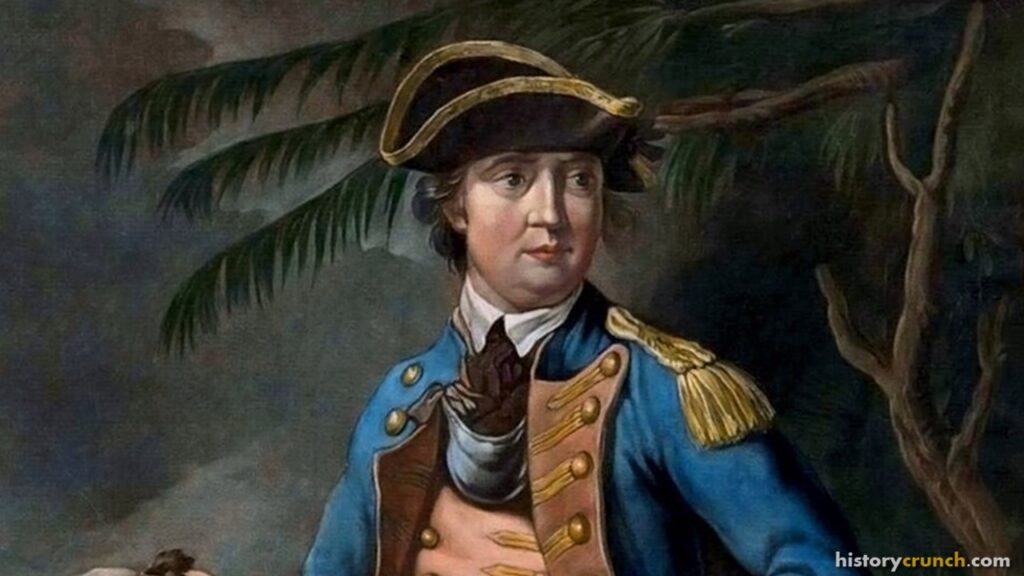
Benedict Arnold was an American military officer who became one of the most celebrated generals of the Revolutionary War before committing the most infamous act of treason in American history. Born on January 14th, 1741, in Norwich, Connecticut, Arnold fought with extraordinary courage and skill on behalf of the Patriot cause for the first five years of the war, playing decisive roles at Fort Ticonderoga, the invasion of Canada, Lake Champlain, and the Battle of Saratoga. In 1779, driven by resentment, debt, and personal grievance, he secretly began working for the British and plotted to hand over the key American fortification at West Point. His name has since become synonymous with the word traitor in the United States.
Benedict Arnold – Early Life
Benedict Arnold was born on January 14th, 1741, in Norwich, Connecticut. He came from a family of some social standing. His great-grandfather had served as governor of Rhode Island, but the family’s fortune declined significantly during Arnold’s childhood. His father became an alcoholic after the deaths of most of Arnold’s siblings from yellow fever, and the family fell into poverty. When Arnold’s parents both died by the time he was 21, he was largely on his own.
Arnold moved to New Haven, Connecticut, where he established himself as an apothecary and merchant. He proved to be a talented businessman, operating ships that traded between the Caribbean and Canada, and he built a comfortable fortune through hard work and commercial skill. In 1767 he married Margaret Mansfield, with whom he had three sons. His first wife died in 1775, leaving Arnold a widower with young children in the middle of a war.
Benedict Arnold – Military Service in the Revolutionary War
When news of the battles at Lexington and Concord reached Connecticut in April of 1775, Arnold immediately raised a company of militia and marched to join the fight. He quickly identified Fort Ticonderoga in upstate New York as a strategic prize, recognizing that the British artillery stored there could be used to break the siege of Boston. Arnold secured a commission from the Massachusetts Provincial Congress to capture the fort and marched north. He arrived to find Ethan Allen already planning an attack with the Green Mountain Boys. After a tense dispute over who held command, the two men led the assault together on May 10th, 1775, capturing the fort without a single casualty. The artillery seized at Ticonderoga was later dragged to Boston by Henry Knox and used to force the British out of the city.
Later that year, Arnold led one of the most punishing military marches of the entire war. He commanded roughly 1,100 men on an overland expedition through the wilderness of Maine in the autumn of 1775, aimed at capturing Quebec. The march covered hundreds of miles through swamps, rivers, and dense forest in worsening autumn weather, and nearly half the men died or turned back before reaching Canada. Arnold’s force linked up with General Richard Montgomery outside Quebec and attacked the city on December 31st, 1775. The assault failed, Montgomery was killed, and Arnold was shot through the leg. Despite his wound, he refused to retreat and was promoted to brigadier general for his courage.
In 1776, Arnold demonstrated remarkable military ingenuity on Lake Champlain, where he organized and commanded a small American fleet of hastily built gunboats against a far superior British naval force. In the Battle of Valcour Island in October of 1776, his fleet was destroyed, but the fighting delayed the British advance long enough to prevent an invasion of New York that autumn. Most historians regard his action on Lake Champlain as one of the most important strategic contributions of the entire war, buying the Americans the time they needed to prepare the defenses that would eventually defeat Burgoyne at Saratoga.
Arnold’s finest hour came at the Battle of Saratoga in the autumn of 1777. Though General Horatio Gates kept him at arm’s length after a bitter personal dispute, Arnold played a central role in both engagements. He led the American advance at the first Battle of Saratoga on September 19th, and at the second battle on October 7th, he rode onto the field without orders after being officially relieved of command, rallying troops and leading the attack on the Breymann Redoubt. During the assault his horse was shot and fell on his leg, badly wounding the same leg that had been injured at Quebec two years earlier. Arnold was carried from the field. The victory at Saratoga proved decisive, convincing France to enter the war as an American ally. Many historians believe Arnold’s battlefield contribution on October 7th was the single most important act of military leadership at Saratoga.
Benedict Arnold – Growing Resentment and the Road to Treason
Despite his remarkable record, Arnold accumulated grievances throughout his service that steadily poisoned his relationship with the Patriot cause. In 1777, Congress promoted five officers of lesser rank to major general, passing Arnold over entirely. Washington interceded and eventually secured Arnold’s promotion, but the slight cut deeply. Arnold attempted to resign his commission in protest on more than one occasion, only to be persuaded to stay.
After his wounds at Saratoga left him unable to take a field command, Washington appointed him military commander of Philadelphia in the spring of 1778. It was a disastrous posting for Arnold’s character. He socialized with wealthy Loyalist families, lived extravagantly beyond his means, and used his position to pursue business dealings that were at best questionable. Pennsylvania’s governing council filed charges of misconduct against him, and he was court-martialed in late 1779. He was largely cleared of the most serious charges but was reprimanded by Washington, who described his conduct as “imprudent and improper.”
During his time in Philadelphia, Arnold began a courtship of Peggy Shippen, the daughter of a wealthy Loyalist sympathizer. They married in April of 1779. Peggy had connections to British officers in the city, including Major John Andre, a British intelligence officer. Arnold’s marriage placed him firmly within Loyalist social circles at the same moment that his resentment of Congress and his fellow officers was reaching its peak. By May of 1779, he had made his first secret overture to the British.
Benedict Arnold – The West Point Plot
Arnold’s contact on the British side was Major John Andre, a charming and intelligent officer who served as adjutant general to British commander Sir Henry Clinton. Beginning in mid-1779, Arnold passed increasingly valuable military intelligence to the British, receiving money in return. He shared information about American troop dispositions, the French alliance’s military plans, and details of Washington’s strategy. In return he received roughly £5,000, though he had hoped for much more.
In the summer of 1780, Arnold secured command of West Point, the strategically vital American fortification on the Hudson River in New York. He then offered to hand West Point and its 3,000-man garrison over to the British in exchange for £20,000 and a commission as a brigadier general in the British Army. The capture of West Point would have cut New England off from the rest of the colonies and could have changed the course of the war.
On September 21st, 1780, Arnold met secretly with Andre near the Hudson River to finalize the details of the plot. Andre carried the incriminating papers tucked inside his stockings. On his return journey to British lines, Andre was stopped by three American militiamen at Tarrytown, New York, on September 23rd. The papers were discovered and Andre was taken prisoner. Word of his capture reached West Point on September 25th, 1780, just as Washington and his staff were arriving for an inspection visit. Arnold was warned moments before Washington arrived and fled by boat down the Hudson River to a British ship. He escaped to New York City, where the British received him and gave him his promised commission.
Washington’s reaction upon receiving the evidence of Arnold’s treason was stunned disbelief. “Arnold has betrayed me,” he reportedly said. “Whom can we trust now?” Andre was tried by a military tribunal, convicted as a spy, and hanged at Tappan, New York, on October 2nd, 1780. Washington considered attempting to exchange Andre for Arnold, but the British refused.
Benedict Arnold – Service with the British
Arnold received a brigadier general’s commission in the British Army, though he never received the full £20,000 he had been promised and the British never fully trusted him. In December of 1780, he led a British raiding force into Virginia, capturing Richmond and burning military supplies across the region. He also led a particularly brutal raid on New London, Connecticut, in September of 1781, the colony of his birth, in which a nearby fort was captured and the town burned. The raid killed a number of American soldiers after they had surrendered, an action that intensified the contempt in which he was already held.
After the British defeat at Yorktown and the end of the war, Arnold moved to England with Peggy and their children. He later relocated to Saint John, New Brunswick, in Canada, where he attempted to rebuild his merchant business. He was never warmly received. In England and Canada alike, he was treated with suspicion and distrust. His property in Saint John was burned by a mob. He returned to England permanently and spent his final years there in relative obscurity, pursuing various unsuccessful business ventures. He died in London on June 14th, 1801, at the age of 60.
Significance of Benedict Arnold
Benedict Arnold presents one of the most complex and troubling portraits in American history. In the first half of his military career, he was arguably the most gifted combat commander on either side of the Revolutionary War. His actions at Ticonderoga, Quebec, Lake Champlain, and Saratoga were each decisive contributions to the American cause, and had he died at Saratoga, he would almost certainly be remembered as one of the great heroes of the Revolution. A monument near the Saratoga battlefield commemorates his contribution in an unusual way: it depicts only his wounded leg, without his name or face, honoring the sacrifice while refusing to honor the man.
The treason that followed has erased nearly all of that from popular memory. The name Benedict Arnold became, and remains, a byword for betrayal in the United States. At West Point, his name was removed from the monuments honoring the generals of the Revolutionary War. Whether his treason grew from genuine political conviction, personal resentment, financial desperation, the influence of his Loyalist wife, or some combination of all of these is a question historians have debated ever since. What is beyond dispute is that his story serves as a reminder that heroism and betrayal are not always found in different people, and that the choices made at moments of personal grievance can define a life more completely than any battlefield courage.