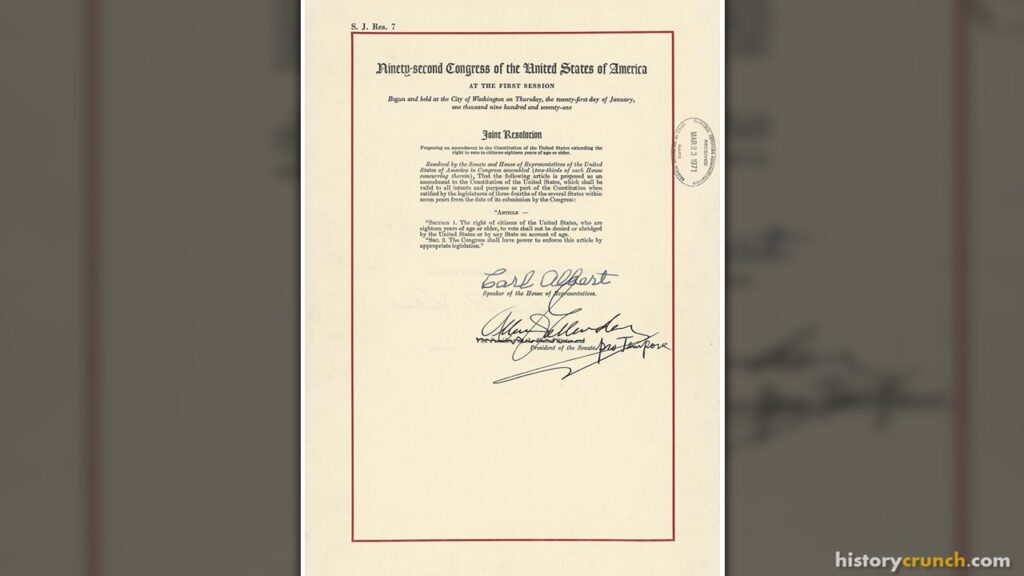
The 26th Amendment to the United States Constitution was ratified on July 1st, 1971, and lowered the minimum voting age in the United States from 21 to 18. The official text of the amendment states that the right of citizens of the United States who are eighteen years of age or older to vote shall not be denied or abridged by the United States or by any state on account of age. The amendment was passed with remarkable speed, driven primarily by the argument that young men who were old enough to be drafted and sent to fight in the Vietnam War should also be old enough to vote in the elections that determined the country’s political direction. It was ratified by the required three-quarters of state legislatures in just 100 days, faster than any other constitutional amendment in American history, and immediately created approximately 11 million new voters.
What Was the Vietnam War?
The Vietnam War was a major Cold War conflict fought between the communist government of North Vietnam and the non-communist government of South Vietnam, with the United States providing military support to the South. The United States became deeply involved during the 1960s, drafting young men as young as 18 into military service and sending them to fight in a war that was deeply unpopular at home. The draft system, which required young men to register for military service at 18 but denied them the right to vote until 21, created a powerful and widely felt sense of injustice that became the primary driver of the movement to lower the voting age.
26th Amendment – Background and Origins
The debate over lowering the voting age in the United States did not begin with the Vietnam War. Its roots stretched back to World War II. In November of 1942, with the United States needing to expand its military rapidly after entering the war, Congress lowered the minimum draft age from 21 to 18. Almost immediately, people began to question why a young man could be required to fight and die for his country at 18 but was not considered old enough to vote until 21. The slogan old enough to fight, old enough to vote emerged from this contradiction and would be repeated throughout the following three decades.
In 1942, West Virginia Congressman Jennings Randolph introduced the first of what would eventually be eleven bills he sponsored over his career to lower the voting age to 18. None succeeded at the time, though the idea gained some early support. In 1943, Georgia became the first state to lower its voting age for state and local elections to 18, with Kentucky following in 1955. In his 1954 State of the Union address, President Dwight D. Eisenhower became the first president to publicly call for a constitutional amendment to lower the voting age, telling Congress that young people who had been summoned to fight for America in time of peril should also participate in the political process that produced that fateful summons.
Despite this support, the movement gained little legislative momentum throughout the 1950s. It was the Vietnam War that changed everything.
26th Amendment – The Vietnam War and the Push for the Amendment
By the mid-1960s, with American involvement in Vietnam escalating rapidly and the draft sending tens of thousands of young men to fight in Southeast Asia, the injustice of the situation became impossible to ignore. Young men between 18 and 21 could be conscripted into military service, sent into combat, and killed, but they had no voice in choosing the leaders who made those decisions. The slogan old enough to fight, old enough to vote became a rallying cry for the anti-war movement and for a broader youth voting rights movement that gained enormous momentum across the country.
By 1969, no fewer than 60 resolutions had been introduced in Congress to lower the minimum voting age, but none had passed. The following year, Congress took a different approach. In the Voting Rights Act of 1970, it included a provision lowering the voting age to 18 in all federal, state, and local elections. President Nixon, while personally supporting the idea of lowering the voting age, believed this approach was unconstitutional and that only a constitutional amendment could properly make the change. He signed the bill but publicly stated his doubts about its validity.
Nixon’s doubts proved well-founded. In the Supreme Court case Oregon v. Mitchell, decided in December of 1970, the court ruled 5 to 4 that Congress had the authority to lower the voting age for federal elections but not for state and local elections. This created a highly impractical situation in which different voting rolls would have to be maintained for different levels of elections. The obvious solution was a constitutional amendment that would apply uniformly to all elections. In fact, the confusion and cost involved in administering separate electoral rolls gave Congress a powerful practical reason to act quickly.
26th Amendment – Passage and Ratification
Congress moved with unusual speed. On March 10th, 1971, the United States Senate voted 94 to 0 in favor of a proposed constitutional amendment to lower the voting age to 18. On March 23rd, 1971, the House of Representatives voted 401 to 19 in favor. The proposed amendment was then sent to the state legislatures for ratification, which required approval from three-quarters of all states, or 38 of the 50 states.
The response from the states was equally swift. The ratification process normally takes years. On this occasion, the necessary 38 states ratified the 26th Amendment in just over two months. Ratification was completed on July 1st, 1971, 100 days after the amendment passed Congress, the fastest ratification of any constitutional amendment in American history. President Nixon certified the amendment on July 5th, 1971, in a ceremony in the East Room of the White House.
26th Amendment – Impact and the 1972 Election
The immediate impact of the 26th Amendment was enormous. At a stroke, it created approximately 11 million new voters between the ages of 18 and 21 who were eligible to vote in American elections for the first time. The first major election in which these new voters could participate was the presidential election of November of 1972, in which Nixon defeated Democratic candidate George McGovern.
The 1972 election was significant for the youth vote for several reasons. Many young voters were deeply engaged by issues including the ongoing Vietnam War, civil rights, and the emerging women’s liberation movement. In fact, despite the enormous expansion of the eligible electorate that the 26th Amendment produced, the 1972 election demonstrated that young voters did not vote as a single block and held a range of political views. Youth voter turnout has varied considerably in different elections since 1972, generally running lower than turnout among older voters, though it has increased significantly in some recent elections.
26th Amendment – Significance
The significance of the 26th Amendment to the United States Constitution is considerable. It was the third constitutional amendment in just over a century to expand the right to vote to a previously excluded group of Americans, following the 15th Amendment of 1870, which gave African American men the right to vote, and the 19th Amendment of 1920, which gave women the right to vote.
The amendment directly addressed one of the most widely felt injustices of the Vietnam War era. The argument that young people who were old enough to die for their country should be old enough to choose their country’s leaders was both simple and powerful, and the speed with which Congress and the states acted demonstrated that it was almost universally accepted. In this sense, the 26th Amendment was a direct product of the Vietnam War and a permanent change to American democracy shaped by one of the most controversial conflicts in American history.
For students of American history, the 26th Amendment also stands as an important example of how social and political movements can produce lasting constitutional change. The decades-long campaign to lower the voting age, driven first by World War II and then by the Vietnam War, resulted in one of the most broadly supported and rapidly ratified amendments in the history of the Constitution. As such, the 26th Amendment to the United States Constitution remains one of the most significant democratic reforms of the 20th century.