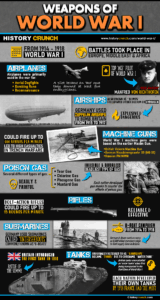
Machine guns were one of the most important weapons of World War I. In particular, the First World War was primarily a defensive war in that countries established defensive trench systems where they stopped enemy advances. The machine gun was vitally important to this defensive strategy, and gave the defending army a large advantage. World War I was a deadly conflict as shown by the millions of military and civil casualties it caused. The large number of casualties was the result, in part, of the development and use of weaponry that took place during the war. In all, the machine gun was one of the most significant weapons of World War I alongside other important weapons, such as: airplanes, airships, poison gas, rifles, submarines and tanks.
INVENTION OF THE MACHINE GUN BEFORE WORLD WAR I
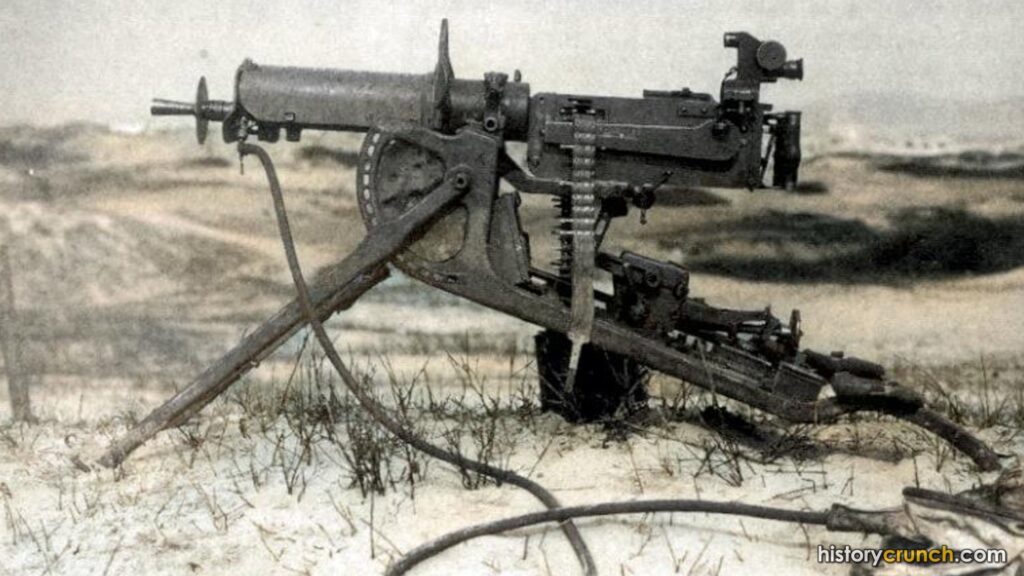
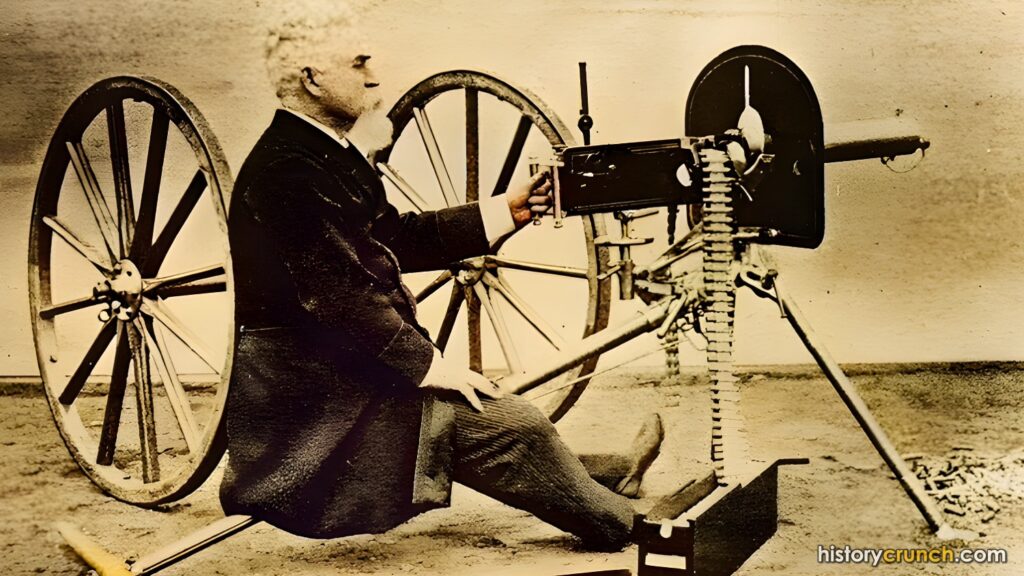
As stated above, the machine gun played a vital role in the events of World War I. In fact, the machine gun transformed warfare in World War I upon its introduction into the war effort. Hiram Maxim created the first machine gun 30 years before the start of World War I in 1884. Hiram Maxim was a British inventor, and is best remembered today for his invention of the Maxim gun. He also carried out inventions in the fields of flight and electricity. Regardless, the significance of the Maxim gun was that it used the force from the recoil of the gun to allow it to automatically fire. For this reason, it is referred to as a recoil-operated machine gun. In fact, it was the first recoil-operated machine gun in history that was produced on a wide scale. The mechanism of the Maxim gun allowed it to operate much more efficiently and reliably than earlier machine guns. For instance, it did not need as many men to operate and was much easier to use in the field of battle. In all, it is believed that the Maxim gun could fire as many as 600 rounds per minute, which made it a devastating weapon.
With that said, the Maxim gun had several shortcomings. For instance, the Maxim gun was water-cooled. Rapid-fire machine guns of the time needed a form of cooling, due to the heat generated by the firing of so many rounds in such a short period of time. However, almost all machine guns at the time, used air cooling methods. The water-cooling method of the Maxim gun allowed it to fire longer and at a faster rate, but also meant that the gun required a supply of clean water. This wasn’t always possible in the heat of battle. As well, while a single person could easily fire the Maxim gun, it required a team of four to six soldiers to reasonably operate. These soldiers were needed to load, reload, cool, and move the weapon when needed. Regardless of its shortcomings, the Maxim gun was a formidable weapon and helped European armies dominate battlefields throughout the late 1800s and early 1900s. In fact, it is often considered to be one of the main factors of European dominance in the Scramble for Africa and the Age of Imperialism.
IMPORTANCE OF THE MACHINE GUN IN WORLD WAR I
The Maxim gun was not only an important weapon in the Scramble for Africa, but also proved a valuable asset for the first few decades of the 20th century. For instance, the Maxim gun was widely used in the First World War.
More specifically, each of the major European nations created their own version of the Maxim gun with different advancements and improvements. For example, the British developed the Vickers machine gun, which was essentially a more advanced Maxim gun. The Vickers machine gun was introduced in 1912 and became popular in the British Army across the battlefields of World War I. For instance, versions of the Vickers machine gun were even used on airplanes in World War I. The Vickers machine gun remained in operation until the 1960s. As stated above, other nations had their own versions of the Maxim gun such as: Germany with the Maschinengewehr 08 (MG 08) and Russia with the PM M1910. These machine guns all played a significant role in World War I and contributed to the massive death tolls and casualty numbers that the war is remembered for. It also gained mass use among most of the main nations involved in the events of World War I. For example, in 1912, the United States Army only issued four machine guns per regiment but by 1919 the number increased to 336 machine guns per regiment. As such, historians consider the machine gun to be one of the most significant weapons of World War I.
In all, the machine gun was a devastating weapon that was a major contributor to the casualties produced by World War I. The war led to the machine gun being developed and used in the battlefield in a number of new and deadly ways. All of the major countries involved in World War I would come to develop their own versions of the machine gun.