The ‘Holy Land’ in the Crusades is a term that refers to a region in the Middle East and is best associated with the historical events of the Middle Ages. The Crusades are one of the most significant events in the history of Europe and the Middle East. They were a series of religious wars carried out by Christian crusaders from Europe during the timeframe of the Middle Ages. Beginning in 1096 CE, the Crusades saw European knights and noblemen travel to the Middle East in an attempt to capture the Holy Land away from Muslim people that had controlled the region for the previous centuries. The term crusade means ‘cross’. Therefore, the Europeans that became crusaders viewed themselves as ‘taking up the cross’. In fact, many of the crusaders wore crosses on their clothing and armor as they made their pilgrimage to the Holy Land.
HOLY LAND IN THE CRUSADES – SUMMARY
As stated above, the ‘Holy Land’ was the main goal of the European crusaders and saw much of the back and forth fighting the nine main Crusades. As such, the Crusades involved European Christians journeying to the Holy Land in order to protect Christian sites and prevent Muslim control of the region. In short, the ‘Holy Land’ refers to large sections of modern-day Israel, Palestine, Jordan and parts of both Lebanon and Syria.
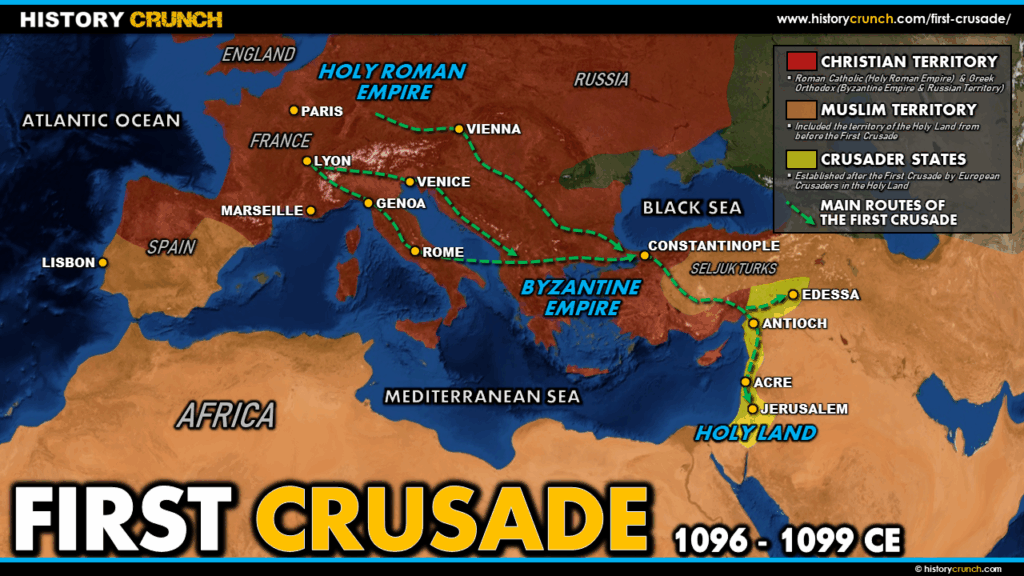
Before the start of the Crusades, this region was controlled by Muslim civilizations, but Christian leaders in the Roman Catholic Church sought to gain control over the Holy Land. This essentially caused the Crusades and led to the outbreak of the First Crusade in 1096 CE. What followed was a series of nine Crusades which altered history for people throughout both Europe and the Middle East.
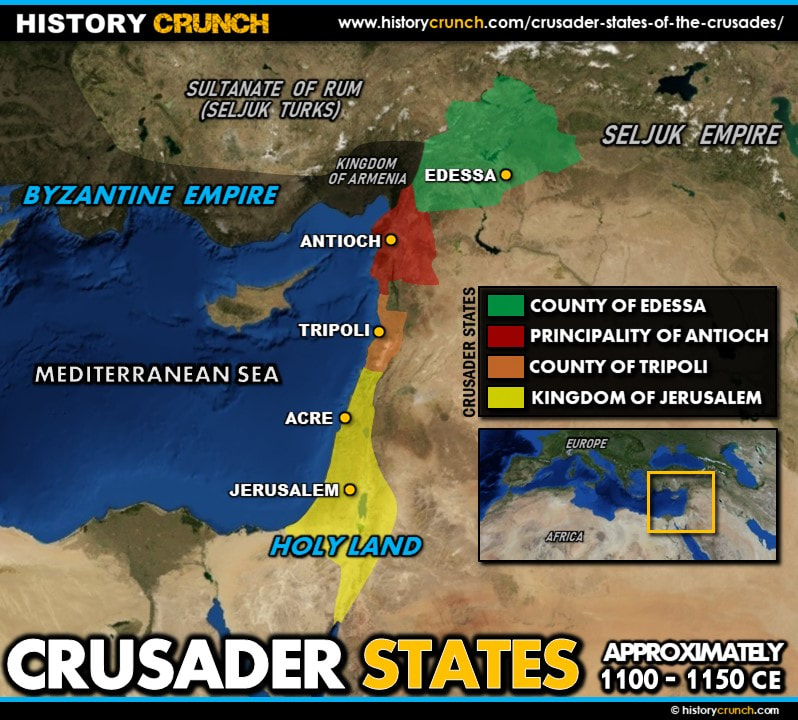
During the First Crusade, the crusaders captured several key territories which they later turned into ‘Crusader States’. These states were controlled by the crusaders for their benefit and used as a way of carrying out further attacks in the Middle East. The main crusader states established at the time were: the County of Edessa, the Principality of Antioch, the Kingdom of Jerusalem and the County of Tripoli. All of these states are in the area of the Eastern Mediterranean and were vital routes towards the Holy Land for European crusaders.
HOLY LAND IN THE CRUSADES – CITY OF JERUSALEM
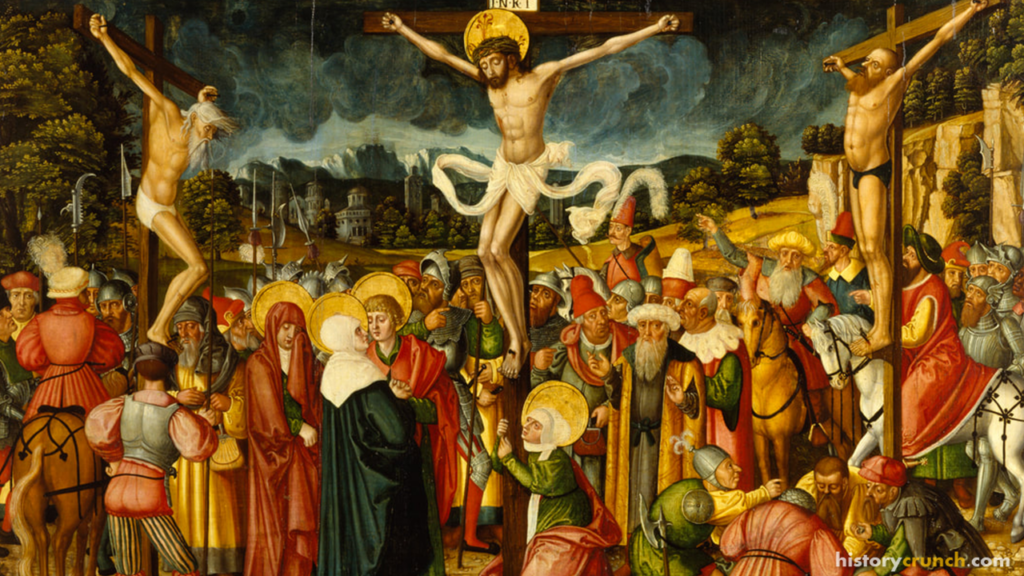
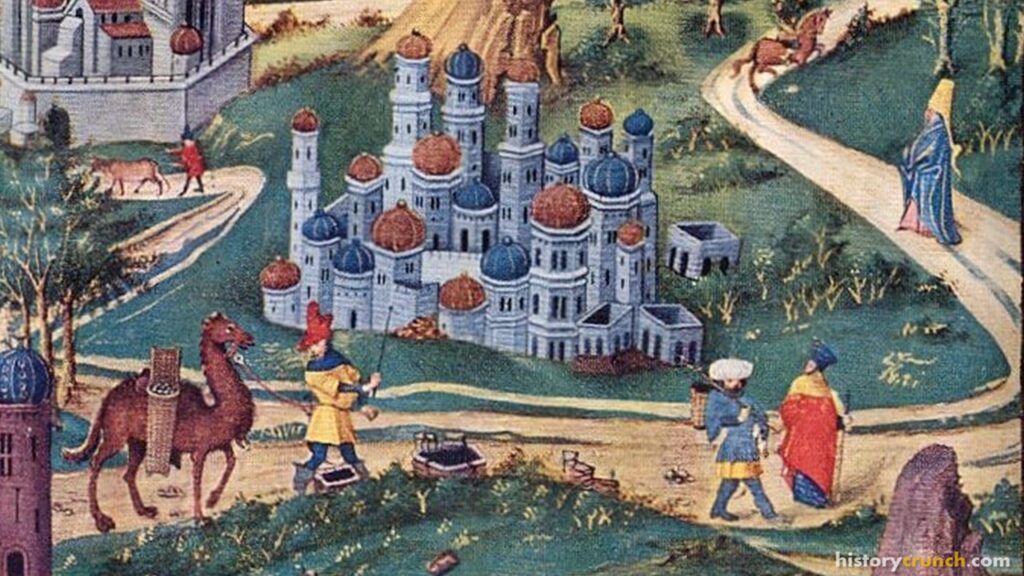
The Holy Land, which is where the Crusader States were located was a vitally important region to all three of the major religions: Christianity, Islam and Judaism. This was especially true in the city of Jerusalem. The city was centrally located in the Holy Land between the Mediterranean Sea and the Dead Sea. While the history of the city itself goes back much further, it was a significant site in the Crusades because of the importance it holds in the three main religions of the region: Christianity, Islam and Judaism. For Christians, Jerusalem was the site of Jesus Christ’s crucifixion and resurrection. As such, the city was vitally important to their understanding of the teachings and history of Jesus. For Muslims, the city was the land guaranteed by Abraham and the place where the prophet Muhammed ascended into heaven to meet Allah (God). For Jewish people Jerusalem was important because it was the land guaranteed to them by Abraham. All three religions had (and still have) important religious sites in the city including temples, churches, mosques and synagogues. As a result, all three religions wanted access to the city which led to clashes and disagreements over time.