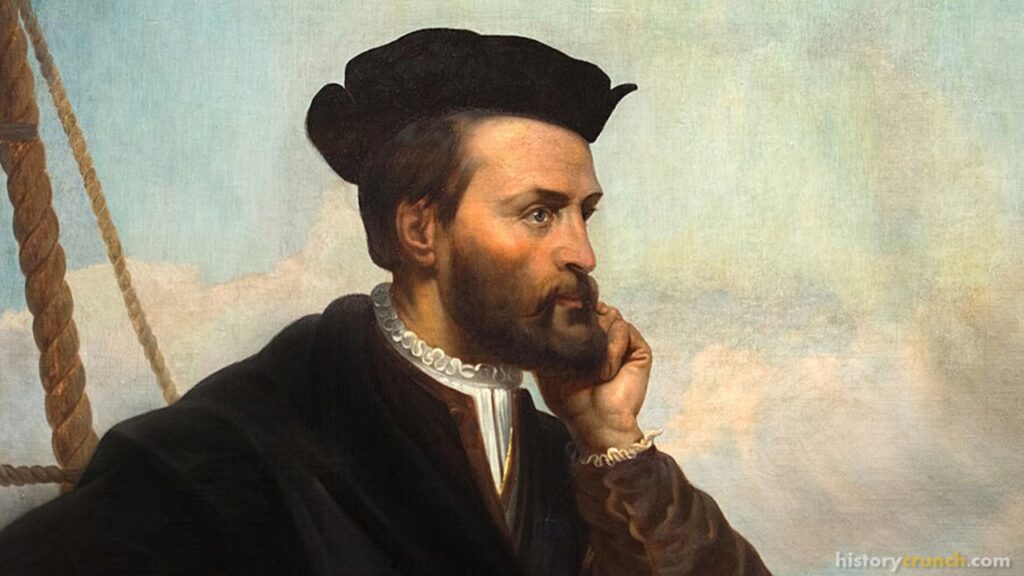
Jacques Cartier was a French explorer who was important in the early European exploration of North America. Today, he is best known for his voyages to regions that are now in modern Canada. As well, he is also remembered a the first European to map and name the St. Lawrence River, which is a major waterway into the interior of Canada. Cartier’s expeditions laid the foundation for France’s later colonization of North America. As such, he is considered to be an important figure in the history of the Age of Exploration.
JACQUES CARTIER – EARLY LIFE
Jacques Cartier was born in Saint-Malo, Brittany, on the 31st of December in 1491. Little is known about his early years, but he was likely involved in navigation and trade as a young man. He married Mary Catherine des Granches, which improved his social status and provided him with increased wealth. This ultimately allowed him to become an explorer. In fact, by the 1530s, Cartier had gained a reputation as a skilled navigator and sailor, which caught the attention of King Francis I of France.
At the time, France was looking to catch up with Spain and Portugal, who had already established profitable colonies and trade routes through explorations in the Age of Exploration. Inspired by the rush for gold, new lands, and a potential passage to Asia, Francis I hired Cartier to explore lands to the west. In fact, Francis I was hoping Cartier would find riches and the Northwest Passage to Asia.
JACQUES CARTIER – VOYAGES IN THE AGE OF EXPLORATION
Jacques Cartier undertook several main voyages during the time of the Age of Exploration. Cartier’s first voyage as an explorer set sail on the 20th of April in 1534. He had been hired by the king to discover a western passage for trade between Europe and Asia. The king was particularly interested in discovering gold and spices. Jacques Cartier and his crew, which consisted of two ships and about 60 men, took 20 days to cross the Atlantic. Upon arriving in the New World, he and his crew and explored parts of modern Newfoundland and the Gulf of St. Lawrence. He encountered Indigenous peoples, including the Mi’kmaq and Iroquoians, with whom he engaged in initial trade and interaction. During this voyage, Cartier symbolically claimed the land for France. Though he did not venture far inland, the journey was considered a success and raised French hopes for further exploration and possible colonization. Irregardless, he and his crew set sail after only a couple of months, and returned to France in September of 1534 with two captives from the voyage.
Cartier’s second voyage set sail in 1535, and lasted one year. The fleet included three ships and over 110 crew members. The crew sailed to the New World, and explored the land of modern day Canada. For instance, he sailed deeper into the continent, navigating the St. Lawrence River, which was an important waterway that became key to France’s ambitions in the New World. Furthermore, Cartier reached the regions of modern-day Quebec City and Montreal, which today are two prominent cities in the province of Quebec. Cartier did come into some difficulties on his expeditions around the land because of unforeseen river rapids and thick ice, which he and his fleet could not sail through. However, he was the first European to describe and map the Gulf of St. Lawrence and the St. Lawrence River. Cartier and his men spent the harsh winter in Stadacona, which was an Iroquois village near the modern Quebec City. During the winter, Cartier and his men suffered from scurvy, which is a deadly vitamin deficiency that was relatively common among European explorers during the Age of Exploration. Cartier and his crew were saved, in part, by Indigenous knowledge on ways to counter the effects of scurvy. Cartier eventually kidnapped several Indigenous leaders, the Iroquois leader of Stadacona, Chief Donnacona, and his two sons. Cartier returned to France in 1536, hoping the captives would impress the French court and provide useful information about inland riches.
Jacques Cartier’s third and final voyage set sail in 1541 and again lasted for one year. He had been ordered to return to the New World to help with colonization efforts and to establish a permanent settlement. During this voyage he claimed the land of modern day Canada for France and planted crops to aid colonization. Furthermore, he also established a colony called ‘Charlesbourg-Royal’, but it quickly faced challenges, such as: harsh weather, poor supplies, resistance from local Indigenous groups, and low morale among the settlers. Regardless, Cartier thought he had discovered valuable deposits of gold and diamonds in the New World, but upon returning to France, they were revealed to be worthless iron pyrite and quartz. This failure, combined with internal political struggles in France and ongoing wars in Europe, ended French efforts to settle the region for several decades. In fact, Cartier and his fleet returned to France in 1542. It was not until 1609 that a colony actually appeared on Canada’s shores.
JACQUES CARTIER – DEATH AND SIGNIFICANCE
After his final voyage Cartier stayed in Saint-Malo, Brittany, France where he worked occasionally as a Portuguese interpreter. Cartier died on September 1st, 1557 at the age of 65. Historians disagree on his exact cause of death, but it is believed to have been from a typhus outbreak.
Although Jacques Cartier never achieved his goals of finding gold or a passage to Asia, his contributions to the Age of Exploration were still incredibly significant. For example, Cartier was the first European to map and describe the St. Lawrence River. His detailed accounts and maps were used for decades and helped establish France’s claim to vast inland territories in modern-day Canada. In fact, Cartier’s voyages were key to the development of New France, which was the French colonial empire in North America. Though colonization wouldn’t take hold until Samuel de Champlain’s time in the early 1600s, Cartier’s expeditions provided the geographic knowledge for later French claims in the New World.