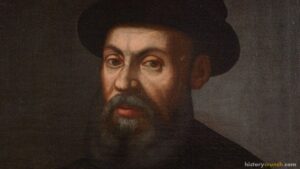
Richard the Lionheart was one of the most celebrated rulers of the Middle Ages and one of the most famous kings in the history of England. Known for his remarkable courage and skill as a military commander, Richard led the Third Crusade from 1189 to 1192 CE and became one of the most recognizable figures of the medieval period. His nickname, the Lionheart, was a reference to his bravery and fierce leadership in battle and has followed him through the centuries as one of the most enduring images of medieval kingship.
Richard the Lionheart – Early Life
Richard the Lionheart was born on September 8th, 1157 CE in Oxford, England. He was the third son of King Henry II of England and Eleanor of Aquitaine, one of the most powerful and influential women of the Middle Ages. His family, known as the Plantagenets, controlled a vast territory that stretched from the Scottish border in the north to the Pyrenees mountains in the south, encompassing England and large portions of France. As such, Richard was born into one of the most powerful royal families in medieval Europe.
As a young boy, Richard was given a thorough education in both academic subjects and the arts of war. He grew up largely in France, where his mother Eleanor governed the duchy of Aquitaine, and absorbed the troubadour culture of southern France from an early age. For instance, he developed a love of music and poetry that stayed with him throughout his life and he later composed his own songs and verses. At the age of eleven, Richard was appointed Count of Poitou, and at the age of fourteen he was invested as Duke of Aquitaine, his mother’s duchy. As such, Richard took on significant political and military responsibilities from a very young age and quickly developed a reputation as a capable and determined ruler.
Richard the Lionheart – Conflict with Henry II
Like his brothers, Richard had a difficult and often hostile relationship with his father King Henry II. In 1173 CE, Richard, along with his brothers Henry the Young King and Geoffrey, rebelled against their father in a conflict that lasted approximately eighteen months before Henry II fought them to a standstill. Richard was just seventeen years old at the time. Although he and his brothers were reconciled with their father after the rebellion, tensions within the family continued for many years.
Following the deaths of his older brothers Henry the Young King in 1183 CE and Geoffrey in 1186 CE, Richard became the heir to the English throne. With that said, the relationship between Richard and his father remained difficult. For instance, Richard allied himself with King Philip II of France in a campaign against Henry II that proved successful, and Henry II was forced to accept humiliating peace terms shortly before his death. Henry II died on July 6th, 1189 CE, and Richard succeeded him as King of England. As such, the conflict between Richard and his father defined much of his early adult life and shaped the path by which he came to the throne.
Richard the Lionheart – King of England
Richard was crowned King of England at Westminster Abbey on September 3rd, 1189 CE. From the very beginning of his reign, Richard’s attention was focused almost entirely on the Third Crusade rather than on the governance of England. The Crusades were a series of religious wars carried out by Christian crusaders from Europe during the timeframe of the Middle Ages, in which European knights and noblemen traveled to the Middle East in an attempt to capture the Holy Land from Muslim control. Richard had taken a crusading vow even before he became king and saw participation in the Third Crusade as the central mission of his reign.
To fund his crusade, Richard raised enormous sums of money through taxation and the sale of offices, titles and lands. For instance, he reportedly said that he would have sold London itself if he could have found a buyer. Richard spent very little time in England during his reign, which lasted from 1189 to 1199 CE. In fact, historians estimate that he spent as little as six months of his entire reign in England, leaving the country largely in the hands of trusted administrators. As such, Richard was a king whose ambitions and interests lay primarily in France and the Holy Land rather than in England itself.
Richard the Lionheart – The Third Crusade
The most significant event of Richard’s reign was his leadership of the Third Crusade, which took place from 1189 to 1192 CE. The Third Crusade was launched in response to the capture of Jerusalem by the Muslim leader Saladin in 1187 CE, which had shocked the Christian world and prompted Pope Gregory VIII to call for a new crusade. Richard joined the crusade alongside Philip II of France and the Holy Roman Emperor Frederick Barbarossa of Germany, though Barbarossa drowned in June of 1190 CE while crossing a river on horseback, which caused many of his crusaders to abandon the campaign.
Richard met with Philip II of France at Vezelay in France on July 4th, 1190 CE and the two kings set out together toward the Holy Land. Richard and the English crusaders marched to Sicily, where they met the English fleet, and then sailed toward the Holy Land. Along the way, Richard conquered the island of Cyprus in May of 1191 CE after its ruler mistreated shipwrecked English crusaders. Richard arrived near the city of Acre in June of 1191 CE and combined his forces with the French crusaders already there. Together, the crusaders captured Acre on July 12th, 1191 CE, which was one of the most important victories of the Third Crusade. However, following the fall of Acre, Richard ordered the execution of approximately 2,500 to 3,000 Muslim prisoners, which was one of the most controversial acts of his campaign.
Following the victory at Acre, Richard led the crusader forces south along the coast of the Holy Land toward the city of Jaffa. Along the way, Richard’s forces met the army of Saladin at the Battle of Arsuf on September 7th, 1191 CE and won a decisive victory, forcing Saladin’s forces to retreat. This gave the crusaders an important foothold from which to launch an attack on Jerusalem, which was the main goal of the crusade. With that said, despite twice leading his forces to within sight of Jerusalem, Richard ultimately decided not to attempt a direct assault on the city, as he feared that even if the crusaders captured it, they would be unable to hold it against a Muslim counterattack. As such, the crusaders never retook Jerusalem, which was considered the main failure of the Third Crusade.
The Third Crusade ended with the Treaty of Jaffa, signed on September 2nd, 1192 CE between Richard and Saladin. Under the terms of the treaty, Jerusalem remained under Muslim control, but Christian pilgrims were granted the right to visit the city freely. The treaty also secured several coastal cities for the crusaders. As such, the Third Crusade was a mixture of significant military successes and the failure to achieve its main goal of retaking Jerusalem. Richard was heavily criticized for his failure to capture Jerusalem, though his military achievements during the campaign had been remarkable.
Richard the Lionheart – Captivity and Ransom
On his way home from the Holy Land in late 1192 CE, Richard ran into serious trouble. He chose to travel through the Holy Roman Empire rather than France because of the hostility of King Philip II of France. However, he was recognized and captured near Vienna in December of 1192 CE by Duke Leopold of Austria, whom he had publicly humiliated during the siege of Acre. Leopold handed Richard over to the Holy Roman Emperor Henry VI, who held him prisoner in various imperial castles.
The capture of Richard caused a crisis in England. His brother John took advantage of Richard’s absence to plot against the throne, and King Philip II of France used the opportunity to try to seize Richard’s French territories. Richard’s mother Eleanor of Aquitaine took firm action to defend her son’s interests, strengthening garrisons and demanding renewed oaths of loyalty to the king. Eventually, a ransom of 150,000 marks of silver was raised, an enormous sum that required heavy taxation across England, and Richard was released in February of 1194 CE. For instance, to put this sum in context, it amounted to approximately three times the annual income of the English crown. As such, Richard’s captivity was a significant setback for both him and his kingdom and placed an enormous financial burden on the people of England.
Richard the Lionheart – Later Reign and Death
Following his release in 1194 CE, Richard returned briefly to England, where he was crowned for a second time at Winchester, before crossing the Channel to France to defend his territories against Philip II. He spent the last five years of his life largely in France, engaged in a series of military campaigns against the French king. During this period Richard proved himself once again to be a highly capable military commander and had recovered most of his lost French territories by the time of his death.
Richard the Lionheart died on April 6th, 1199 CE at the age of forty-one from a crossbow wound sustained during a siege of the castle of Chalus-Chabrol in the Duchy of Aquitaine. The castle was held by a minor lord who had refused to hand over a treasure discovered on his lands. Richard was struck by a crossbow bolt while inspecting the castle’s defenses and the wound became infected. He died eleven days later and was buried at Fontevraud Abbey in France, where his tomb effigy can still be seen today. Richard left no legitimate children and was succeeded by his brother John, who became King John of England.
Richard the Lionheart – Legacy
Richard the Lionheart is remembered as one of the most celebrated rulers of the Middle Ages and one of the greatest military commanders of his time. His courage, his leadership of the Third Crusade and his romantic image as the ideal medieval knight made him a legendary figure even during his own lifetime. For instance, stories connecting Richard to the legend of Robin Hood began circulating in the medieval period, reflecting the popular image of Richard as a heroic and just king. As well, his coat of arms featuring three golden lions remains part of the royal arms of England to the present day.
With that said, historians have also noted that Richard’s neglect of England in favor of his crusading ambitions and his wars in France placed enormous financial burdens on his subjects and left the kingdom in a difficult position at the time of his death. As such, the legacy of Richard the Lionheart is a complex one that combines genuine military brilliance with the limitations of a king who rarely governed the kingdom he was supposed to rule. Regardless, his place as one of the most significant and celebrated figures of the Middle Ages is secure.