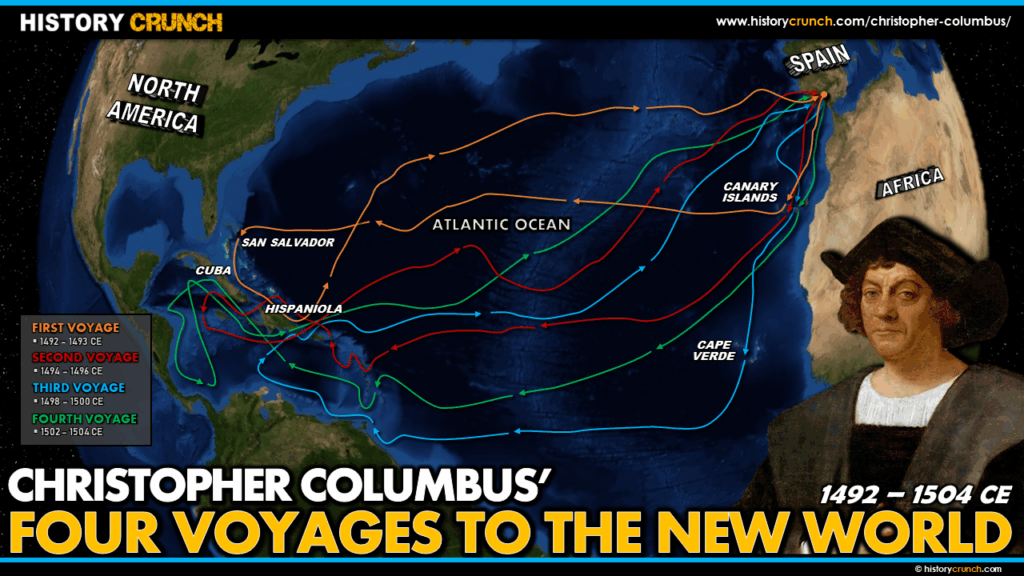
Christopher Columbus‘ quest to reach Asia was the driving factor behind his four famous voyages to the New World. This article details the history and significance behind the quest to reach Asia.
CHRISTOPHER COLUMBUS’ FOUR VOYAGES TO THE NEW WORLD
Christopher Columbus is one of the most significant figures in all of World History and is particularly important to major world events such as the Age of Exploration and Renaissance. His four famous journeys to the New World in the late 15th century and early 16th century altered the history of the world and led to a mass migration of people from the Old World to the New World. Today, he is best remembered as a famous European navigator, explorer and colonizer.
QUEST TO REACH ASIA – REASONS FOR EUROPEAN DISCOVERY
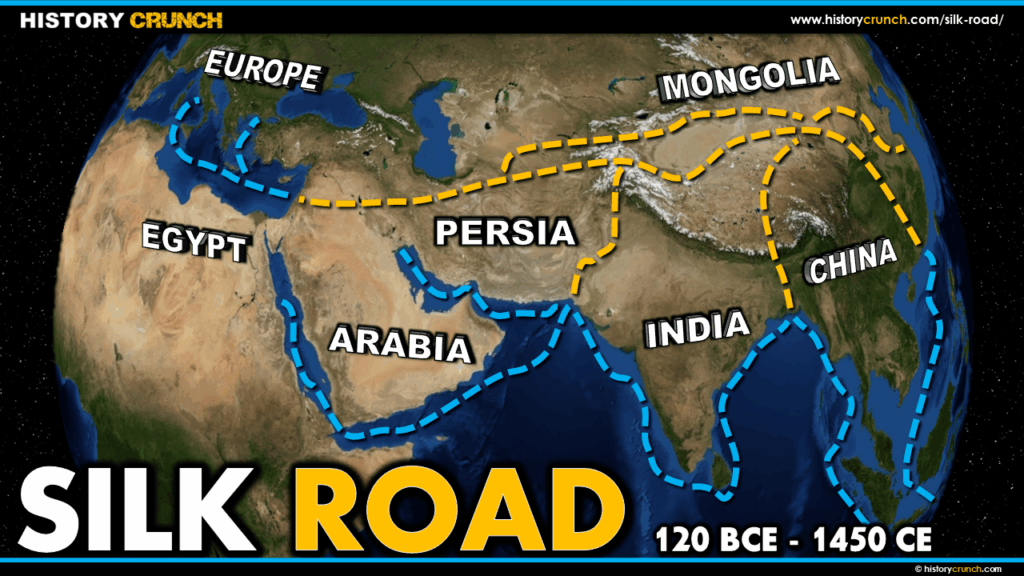
The desire to reach Asia by a sea route was an important factor in Europe in the late Renaissance and led directly to the events of the Age of Exploration. In the previous centuries (during the timeframe of the Middle Ages) most long distance trade between Europe and Asia occurred along the network of trade routes referred to as the Silk Road. It is perhaps one of the earliest and largest trade networks in human history, and played a vital role to many different civilizations throughout Eurasia from approximately 120 BCE to 1450 CE. At its height, the Silk Road stretched from Japan and China in the east to the Mediterranean area including Italy in the west, which was a span of over 4000 miles. Along the way, it travelled through many different regions including: India, Persia, the Middle East, Africa and Eastern Europe. However, the fall of Constantinople to Ottoman Turks in 1453 created issues for European trade along the Silk Road. As such, many in Europe were anxious to find a sea route that could be used to expand and quicken the long-distance trade of the time.
Famous Florentine mathematician and astronomer, Paolo dal Pozzo Toscanelli, suggested in the 1470s that it may be possible to sail to East Asia by heading west from Europe. He recorded this idea in a letter and map that he sent to a friend who lived in Portugal. Eventually, Toscanelli’s idea reached Portuguese King Alfonso V. Although Alfonso V rejected Toscanelli’s idea, it helped spark later journeys westward by European navigators and explorers such as Christopher Columbus. Supposedly, Toscanelli made a copy of the letter and map for Christopher Columbus, who then took it with him on his first voyage to the New World in 1492.

QUEST TO REACH ASIA – AROUND AFRICA
However, Alfonso V rejected the idea of a westerly route in favor of one that travelled around the southern tip of Africa. Portugal was the first European country to explore different sea routes to Asia. For example, at the outset of the Age of Exploration Portuguese navigators had begun sailing south along the western coast of Africa. In the process, they established many different trading posts that helped them finally develop the route around the southern tip of the continent. For instance, in 1488, famous Portuguese explorer Bartolomeu Dias reached the Cape of Good Hope, which is located in modern-day South Africa. He was the first explorer to do this at the time, and paved the way for the route to Asia around Africa. This discovery by Dias caused Portugal to abandon the idea of a westerly route across the Atlantic Ocean (at the time it was referred to as the ‘Ocean Sea’), which led to Alfonso V rejecting Toscanelli’s proposal. However, the sea route around Africa was long and caused many at the time to suggest that a straight westerly route, across the Atlantic Ocean, may be quicker.
CHRISTOPHER COLUMBUS – QUEST TO REACH ASIA
Christopher Columbus approached King John II of Portugal in 1485 in regards to his plans of carrying out a westward voyage to Asia. At the time, European monarchs were the best source of financial support for explorers who wished to carry out voyages as part of the Age of Exploration. As part of his plans, Columbus requested three ships and one year to cross the Atlantic Ocean and return to Europe.
Ultimately, John II rejected Columbus on the belief that a crossing of the Atlantic Ocean was impossible. Columbus returned in 1488, to again ask for financial support of a voyage from John II. However, the Portuguese king again rejected Columbus’ plan. In part, the king’s decision was based on the recent voyage of Portuguese explorer Bartolomeu Dias, who was the first to make the trip around the southern tip of Africa in 1488.
At the same time that he had been proposing his westerly route idea to John II in Portugal, Columbus was also seeking financial support from other monarchs in both England and Spain. While Henry VII of England rejected him as well, he gained some support from the monarchs Ferdinand and Isabella of Spain. Columbus first proposed his idea to them in 1486, but a deal wasn’t reached until January of 1492 when they granted him financial support for his journey.
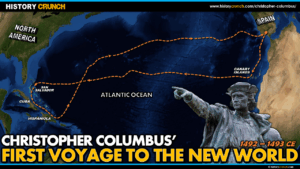
As a part of the deal reached with the Spanish crown, Columbus was guaranteed a few things. First, Columbus was promised that if the voyage was successful then he would be given the rank of Admiral of the Ocean Sea and appointed Viceroy and Governor of all the new lands he claimed for Spain. Second, Columbus had the right to nominate three persons, from whom the Spanish monarchy would choose one, for any office in the new lands. Third, Columbus would be entitled to 10 percent of all the revenues from the new lands forever. As such, Columbus embarked on his westerly route across the Atlantic Ocean in the summer of 1492 in search of a shorter and more direct route to Asia.