Aztec warriors played an important role in the development and expansion of the Aztec Empire. The Aztec Empire was a civilization in central Mexico that thrived in the time before the arrival of European explorers during the Age of Exploration. Throughout its history as a civilization the Aztec Empire expanded across much of central Mexico and other surrounding areas, to become the most dominant and powerful people in the region. Tenochtitlan, the main Aztec city (or altepetl), was the center of this vast empire.
Throughout much of their history, the Aztec were a militaristic people who focused on the expansion of their empire. Following the Aztec’s founding and construction of Tenochtitlan in the Valley of Mexico in 1325, they quickly established their authority across the other societies in the valley. Aztec warriors were critical to the dominance of the Aztec Empire and warriors were honored and celebrated figures in Aztec society.
AZTEC WARRIORS – EDUCATION AND TRAINING
As stated above, warfare was a central component of Aztec culture and Aztec warriors played an important role in Aztec society.
Aztec boys were first identified as warriors with a birth ritual. The ritual involved a shield and an arrow. The shield was placed in the boy’s left hand, while the arrow was placed in his right hand. This was meant to symbolize the boy’s life as a warrior for his people. As well, the birth ritual highlighted the importance of warriors to Aztec society.
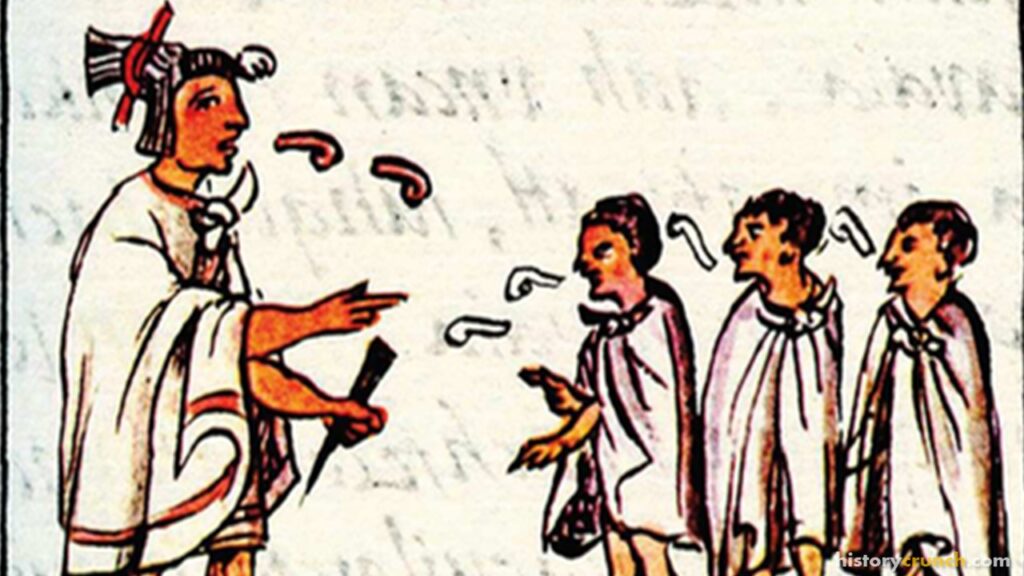
As they grew up, Aztec boys received an education that ultimately prepared them for battle and service in the Aztec military. For instance, boys between the ages of ten and twenty were required to attend school. Boys of the lower classes attended schools called Telpochcalli. While the boys from the nobility attended schools called Calmecac. The Telpochcalli schools focused on preparing the boys for warfare and teaching the boys how to use different weapons, while the Calmecac schools prepared the noble boys to be leaders in the military, among other things. At the age of fifteen, the boys began training with weaponry and would often accompany more experienced warriors into battle, but they did not participate in the fighting. As well, it was during this time that the boys would usually seek the guidance from an experienced warrior to act as a mentor. Finally, when the boys were approximately twenty years old they joined the military ranks and became an Aztec warrior.
AZTEC WARRIORS – RANKS IN THE AZTEC MILITARY
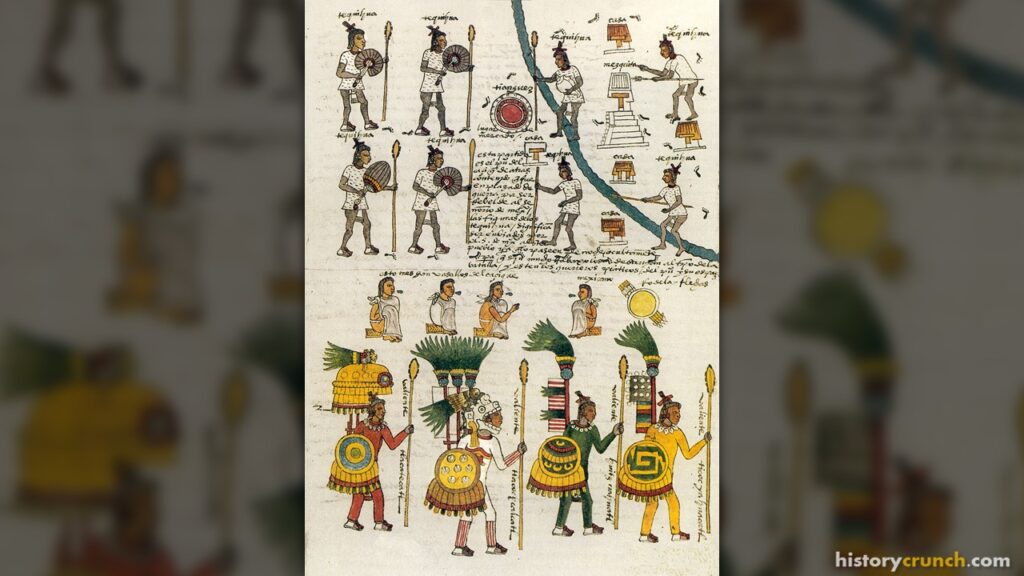
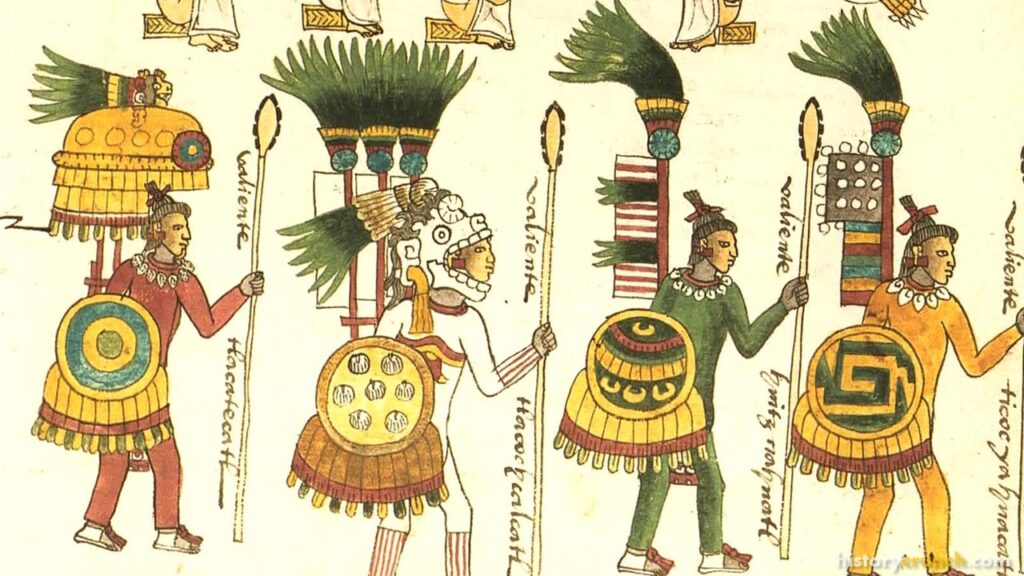
In terms of ranking within the Aztec military, the warriors were generally placed based on the class in society, age and skill as a warrior. For example, the commoners (or lowest classes) made up most of the Aztec military, but the higher ranks were usually held by warriors of noble birth. Some commoners could reach higher ranks based on their ability on the battlefield and how many enemies they captured. However, the noble warriors made up most of the higher ranked warriors and belonged to a series of ‘warrior societies’. These were groups of warriors that were ranked based on the number of prisoners they had captured in battle. Each warrior society had different outfits, armor, and accessories that made them stand out from each other.
Aztec warriors were honored and celebrated in Aztec culture. With that said, the warriors were most celebrated for their skill and abilities in battle. For instance, the ultimate skill of the Aztec warrior was to capture a prisoner. Taking a prisoner was valued over killing the enemy, because it allowed the Aztec to capture slaves and victims for ritual human sacrifice. From the perspective of the Aztec, sacrifice was necessary to ensure the survival of life. For instance, in Aztec religion, the world was created from the sacrifice of the gods. As such, they viewed sacrifice as necessary to repay their debts to the gods. Aztec warriors increased in rank and prestige in society as they captured more prisoners.
As stated above, the Aztec military was made up on several different warrior societies. The first of these was the ‘tlamanih’. Tlamanih translates to ‘captive’ and refers to commoners in the Aztec military which taken a prisoner in battle. The next was ‘cuextecatl’ which was for warriors that had captured two prisoners in battle. They were known to wear red and black tlahuiztli in battle. Third was ‘papalotl’ which translates to ‘butterfly’ and was for warriors who had taken three prisoners. These warriors wore a butterfly design on their back. Another warrior society was the ‘otomies’. They were an elite mercenary force that was allied with the Aztec Empire and fought alongside them in battle. The most honored of the warrior societies was the ‘cuachicqueh’ or ‘Shorn Ones’. They were named for their hair, which was shaved expect for a long braid by their left ear. As well, they were known to wear yellow tlahuiztli and paint their faces in blue, red and yellow. To achieve this rank, warriors had to capture more than six prisoners on the battlefield. As such, they were some of the most feared Aztec warriors.
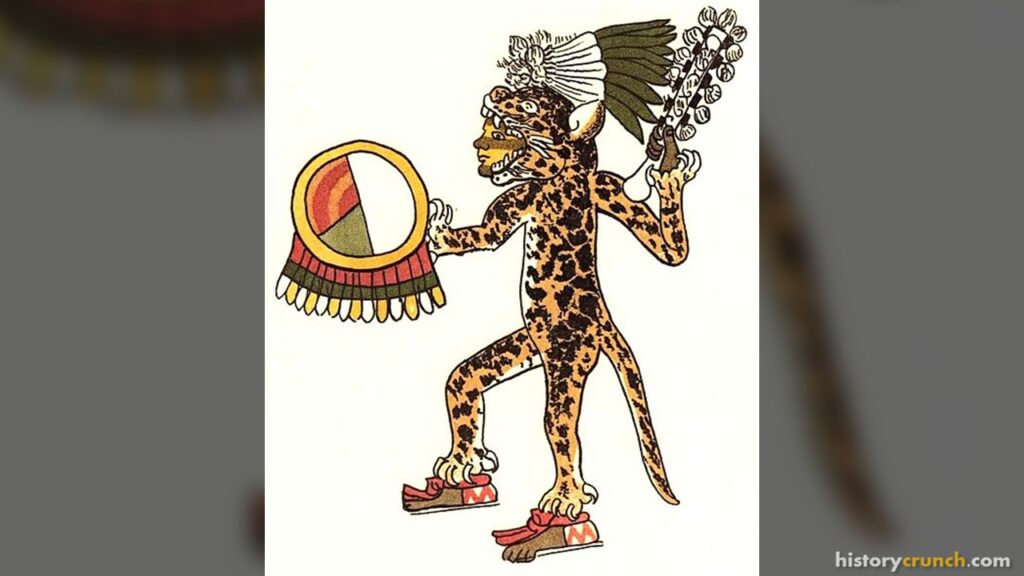
Beyond the warrior societies listed above, some of the most prestigious warriors in Aztec culture were the Eagle warriors and the Jaguar warriors. Both the Eagle and Jaguar warriors were referred to as ‘cuāuhocēlōtl’ and were the two most elite types of warriors in the Aztec military. The warriors that earned these designations were regarded as the best for their ability to capture prisoners in battle, which was one of the main objectives of the Aztec military. Both sets of these types of warriors wore very distinctive types of outfits that were separate from the rest of the Aztec warriors. For instance, the Eagle warriors were known to wear helmets and suits decorated with eagle feathers. As well, they would usually have an eagle head on their head, with their face showing out of the open beak. Whereas, the Jaguar warriors wore the hide or skin of a jaguar which usually covered their entire bodies. They had their faces showing out of the open jaguar mouth. Jaguar warriors wore this in belief that they gained the strength of the animal in battle. Both Eagle warriors and Jaguar warriors went into battle with a weapon called a macuahuitl, which was a type of wooden club that had very sharp obsidian blades attached to its edges. Obsidian is a volcanic glass that when cut can produce extremely sharp blades. Both types of warriors also fought using spears, clubs and shields. Supposedly, a warrior had to capture at least four prisoners in battle to achieve the rank of Eagle or Jaguar warrior.
AZTEC WARRIORS – AZTEC WEAPONS
Weapons were an important part of the Aztec military. In general, the Aztec military made use of several different types of weapons, including: projectiles and melee. The first projectile weapon was the ahtlatl which was a weapon that launched darts called tlacochtli. The darts were usually tipped with obsidian, fish bones or copper. Next was the tlahhuītōlli which was an Aztec version of a bow, and was used to launch arrows referred to as yāōmītl. They also used slings, called tēmātlatl, to launch rocks or obsidian flakes. As for melee weapons (hand-to-hand combat) the Aztec had several options. First and foremost was a weapon called a macuahuitl, which was a type of wooden club that had very sharp obsidian blades attached to its edges. Obsidian is a volcanic glass that when cut can produce extremely sharp blades. The macuahuitl was the standard weapon among the Aztec warriors. Another weapon of choice was the tepoztopilli which was a type of long spear that had a sharp obsidian blade on the end. Other melee-type weapons included different varieties of clubs, daggers and axes.
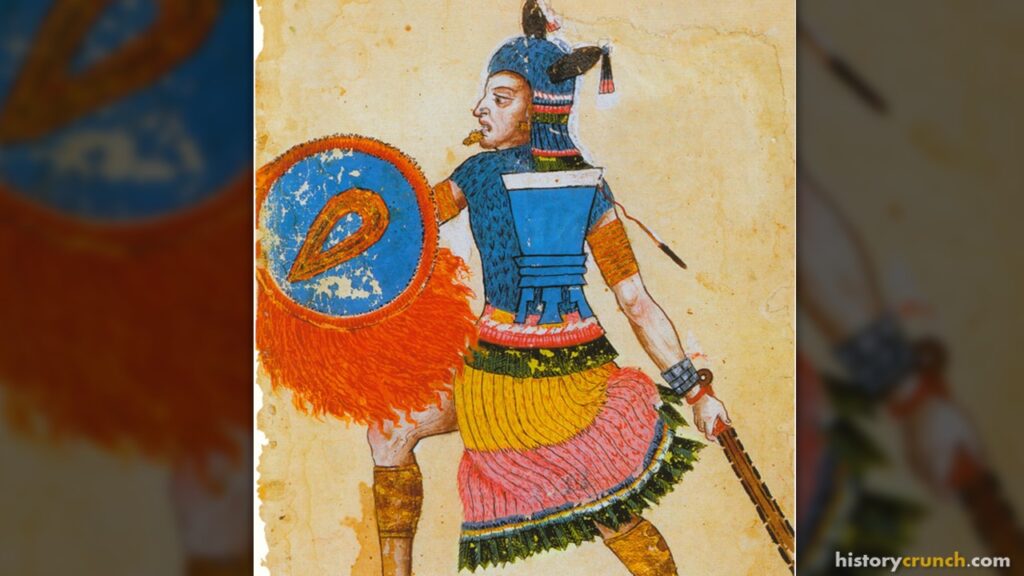
High-ranking warriors were distinguished by their clothing and armor. More specifically, the maxtlatl (loincloth) was worn by all warriors, along with a form of armor called ichcahuipilli. The ichcahuipilli was an outfit made of thick layers of cotton that was worn as a jacket and offered the warrior protection from sharp weapons. Additionally, Aztec warriors were often rewarded for their actions in battle with different types of jewelry made out of shells and glass beads. A high-ranking warrior or one who was born into the noble class might wear addition protection in an outfit called ‘tlahuiztli’. These outfits were decorated more ornately to distinguish the warrior and offered more protection because they covered the arms, legs and torso. The tlahuiztli were generally made out of cotton and leather.