
Middle Ages

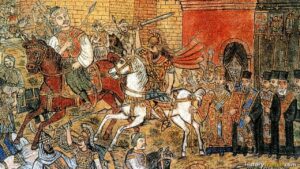
Fall of Constantinople

Fall of Constantinople: A Detailed Summary

The Fall of Constantinople took place on May 29th, 1453, when the Ottoman army under Sultan Mehmed II captured the city after a 53-day siege. The fall of the city brought an end to the Byzantine Empire and is widely considered by historians to mark the end of the Middle Ages. This article details the history and significance of the Fall of Constantinople.

Clothing in the Middle Ages: A Detailed Summary

Clothing in the Middle Ages varied greatly depending on social class and was an important communicator of wealth, status and identity in medieval European society. This article details the history and significance of clothing in the Middle Ages.

Life of a Medieval Knight: A Detailed Summary

Knights were one of the most important groups of people in medieval European society, playing a central role in the feudal system and the major events of the Middle Ages. This article details the life and significance of a medieval knight.

End of the Middle Ages: A Detailed Summary

The end of the Middle Ages was caused by several factors that transformed European society, including the Black Death, the decline of feudalism, the fall of Constantinople and the start of the Renaissance. This article details the history and significance of the end of the Middle Ages.

How Did the Middle Ages Begin?: A Detailed Summary

The Middle Ages began with the fall of the Western Roman Empire in 476 CE, which caused major changes in the political, social and religious life of people across Europe. This article details how the Middle Ages began.

Life of a Medieval Noble: A Detailed Summary

The life of a medieval noble was one of privilege, power, and responsibility. Nobles occupied the second highest position in the feudal system, just below the king, and controlled vast areas of land, large numbers of peasants, and significant military forces. This article details the history and significance of the life of a medieval noble, including their role in the feudal system, daily life in castles and manor houses, food, military obligations, and their importance to medieval society.

Life of a Medieval Peasant: A Detailed Summary

Medieval peasants made up the vast majority of the population during the Middle Ages, yet had the least power and wealth of anyone in the feudal system. Their lives were shaped by farming, heavy obligations to their lords and the Church, and a deep religious faith that gave structure and meaning to an often difficult existence. This article details the history and significance of the life of a medieval peasant.

Plague of Justinian: A Detailed Summary

The Plague of Justinian was a devastating pandemic that struck the Byzantine Empire and much of the known world beginning in 541 CE. It is considered to be the first clearly recorded outbreak of bubonic plague in history and one of the deadliest pandemics ever to affect humanity. This article details the history and significance of the Plague of Justinian.

Wars of the Roses: A Detailed Summary

The Wars of the Roses were a series of civil wars fought in England between 1455 and 1487, pitting the red rose of the House of Lancaster against the white rose of the House of York in a bitter struggle for the English throne. The conflict ended with the Battle of Bosworth Field in 1485 and the rise of the Tudor dynasty under Henry VII. This article details the history and significance of the Wars of the Roses.

Medieval Towns and Cities: A Detailed Summary

Medieval towns and cities grew rapidly during the High Middle Ages, becoming important centers of trade, craftsmanship, and community life across Europe. Surrounded by defensive walls and organized around markets, guilds, and churches, these towns offered ordinary people opportunities that were not available to them in the feudal countryside. This article details the history and significance of medieval towns and cities.