The Plague of Justinian was a devastating pandemic that struck the Byzantine Empire and much of the known world beginning in 541 CE. It is considered to be the first clearly recorded outbreak of bubonic plague in history and one of the deadliest pandemics ever to affect humanity. The plague is named after the Byzantine Emperor Justinian I, who ruled the empire at the time and who himself contracted the disease, though he survived.
What Was the Byzantine Empire?
The Byzantine Empire, also known as the Eastern Roman Empire, was the continuation of the Roman Empire in the eastern part of Europe and the Middle East after the fall of the Western Roman Empire in 476 CE. Its capital was the city of Constantinople, which is known today as Istanbul in modern-day Turkey. The Byzantine Empire was one of the most powerful and wealthy states in the world during the Early Middle Ages and served as an important center of Christian civilization, trade, and culture for many centuries. In fact, at the time of the Plague of Justinian, Constantinople was the largest and most important city in the Mediterranean world. The emperor ruling the Byzantine Empire at the time of the plague was Justinian I, who reigned from 527 to 565 CE and had ambitious plans to reunite the old Roman Empire under his rule. As such, the Plague of Justinian struck at a particularly important moment in the history of the Byzantine Empire and the broader world.
What Was the Plague of Justinian?
The Plague of Justinian was a pandemic caused by the bacterium Yersinia pestis, which is the same bacterium responsible for the Black Death that devastated Europe in the 14th century. A pandemic is the term used to describe the spread of an infectious disease over a very wide area, often affecting the entire known world. In general, historians consider the Plague of Justinian to be the first pandemic in recorded history. The plague caused bubonic plague, which was a horrifying and extremely deadly disease that caused swollen lymph nodes, fever, chills, and disorientation in those who contracted it. Without modern medicines such as antibiotics, bubonic plague killed the majority of the people it infected, with some estimates suggesting a mortality rate of between 60 and 80 percent for those who became sick.
For many centuries historians were uncertain exactly what disease caused the Plague of Justinian. In reality, it was not until 2013 that scientists were able to use DNA analysis of ancient human remains from burial sites across the former Byzantine Empire to confirm that the plague was indeed caused by Yersinia pestis. This discovery was important because it confirmed the connection between the Plague of Justinian and the later Black Death, showing that both pandemics were caused by the same disease.
Origins and Spread of the Plague
Historians believe the Plague of Justinian likely originated in Central Asia, possibly in the region of the Tian Shan mountains on the borders of modern-day Kyrgyzstan, Kazakhstan, and China. From there, the disease traveled along trade routes to reach Egypt, which was at the time the main supplier of grain to the Byzantine Empire. The first recorded outbreak of the plague occurred in the port city of Pelusium in Egypt in 541 CE. From Egypt, the plague spread rapidly through the trade networks of the Byzantine Empire, carried primarily by black rats that traveled aboard the grain ships that constantly moved food and goods around the Mediterranean Sea. For example, rats were attracted to the vast grain stores kept in the warehouses of Constantinople and other major port cities, and the fleas that lived on these rats carried the bacteria responsible for the plague.
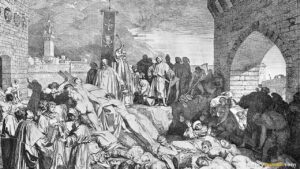
The plague reached Constantinople itself in 542 CE and hit the city with devastating force. The Byzantine historian Procopius, who lived in Constantinople during the outbreak, recorded that at the peak of the epidemic the city was losing thousands of people every single day. So many people died so quickly that the bodies could not be buried fast enough. As well, burial sites filled up, workers tasked with moving the dead died themselves on the job, and Emperor Justinian was forced to order mass graves to be dug outside the city walls. The markets, courts, schools, and workshops of Constantinople came to a complete standstill. For instance, modern historians estimate that the plague killed somewhere between 20 and 40 percent of the population of Constantinople during the initial outbreak. In all, the plague spread from Constantinople across the entire Mediterranean world, reaching as far north as Britain and Denmark and as far east as the Arabian Peninsula.
Impact of the Plague on the Byzantine Empire
The impact of the Plague of Justinian on the Byzantine Empire was enormous and far-reaching. For example, one of the most immediate effects was the devastating loss of life among the farming population. The Byzantine economy was heavily dependent on agriculture and taxation, and with so many farmers dead, fields were left empty and food production collapsed. As a result, famines followed the plague in 542 and again in 545 and 546 CE, making an already terrible situation even worse. At the same time, the loss of so many taxpayers caused the government’s income to collapse, making it impossible for Justinian to fund his ambitious military campaigns and building projects.
In fact, the plague struck the Byzantine Empire at one of the most critical moments in its history. At the time the plague first appeared, Justinian’s armies had already successfully recaptured much of Italy and North Africa and were very close to reuniting the core of the old Roman Empire under Byzantine rule. With that said, the plague killed enormous numbers of soldiers and disrupted the supply lines that kept the armies fed and equipped. As such, the military campaigns that had seemed on the verge of success were badly set back, and many of the territories that Justinian had worked so hard to recapture were eventually lost again in the decades that followed.
The plague did not disappear after the first outbreak. In reality, it returned in waves repeatedly for more than two centuries, continuing to strike different parts of the Byzantine Empire and the surrounding world until approximately 750 CE. Each new wave of the disease killed more people and made it harder for the empire to recover its strength. For instance, historians believe that the long-term weakening of the Byzantine Empire caused by the repeated outbreaks of plague was an important factor in explaining why the empire was unable to resist the rapid expansion of Arab Muslim forces in the 7th century, which resulted in the loss of Egypt, Syria, and other major territories.
Significance of the Plague of Justinian
The Plague of Justinian is one of the most significant events of the Early Middle Ages and one of the most devastating pandemics in all of human history. Historians estimate that the total death toll from the plague and its recurring waves may have reached as high as 25 to 50 million people across Europe, the Middle East, and North Africa, though the exact figures are debated. In general, the plague is considered to have permanently reduced the population of the eastern Mediterranean world for generations.
Furthermore, some historians consider the Plague of Justinian to be a dividing line between the ancient world and the beginning of the Middle Ages, as it helped bring the era of late antiquity to a close by weakening the Byzantine Empire’s ability to maintain the traditions and institutions of the old Roman world. As stated above, the same bacterium that caused the Plague of Justinian also caused the Black Death in the 14th century, making these two catastrophic pandemics deeply connected events in history. As such, the Plague of Justinian is a vital event for students to understand not only because of the enormous suffering it caused at the time, but also because of the long shadow it cast over the history of the Middle Ages and beyond.