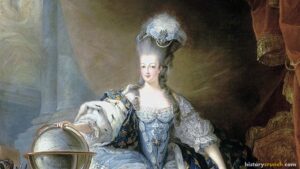
Catherine the Great, also known as Catherine II, was the Empress of Russia from 1762 to 1796. Her 34-year reign is considered one of the most successful in Russian history, marked by significant territorial expansion, administrative reform, and strong patronage of the arts and Enlightenment ideas. She is remembered as an example of enlightened absolutism, combining genuine intellectual curiosity and a reforming spirit with the firm exercise of absolute power. Catherine was not born Russian and did not come to the throne through inheritance. Instead, she seized power through a coup against her own husband, and went on to become the longest-ruling female leader in Russian history.
Catherine the Great – Early Life
Catherine the Great was born Sophie Friederike Auguste von Anhalt-Zerbst on May 2nd, 1729, in Stettin, Prussia, which is now the city of Szczecin in modern-day Poland. Her father was Christian August, Prince of Anhalt-Zerbst, a minor Prussian noble who served as a general in the Prussian army. Her mother, Princess Johanna Elisabeth of Holstein-Gottorp, was socially ambitious and eager to secure advantageous connections for her daughter. Although the family was noble, they were not wealthy.
Sophie received a good education for the time, with tutors instructing her in French, German, religion, and history. She was a bright and curious child who showed an early love of reading and ideas. Her mother’s social ambitions proved decisive in shaping her future. In early 1744, when Sophie was just 14 years old, she and her mother received an invitation to travel to Russia at the request of Empress Elizabeth, who was looking for a suitable bride for her nephew and chosen heir, the Grand Duke Peter.
Sophie charmed Empress Elizabeth almost immediately upon her arrival. She threw herself into learning the Russian language and the customs of the Russian Orthodox Church with a determination that impressed everyone around her. In 1744 she converted to Russian Orthodoxy and took the name Catherine Alekseyevna. The following year, on August 21st, 1745, she married the Grand Duke Peter. She was 16 years old.
Catherine the Great – Marriage and Life at the Russian Court
The marriage between Catherine and Peter was deeply unhappy almost from the start. Peter was eccentric, immature, and showed little interest in his wife. He was openly obsessed with the Prussian military, spent his time drilling toy soldiers, and made no secret of his admiration for Frederick the Great of Prussia. The couple’s relationship was cold and distant, and it became clear early on that Peter had little respect for Catherine and no intention of involving her in any affairs of state.
Catherine responded by educating herself. During the long years of her marriage, she read, working through the major texts of the European Enlightenment. She read the works of philosophers such as Voltaire, Montesquieu, and Denis Diderot, all of whom she later corresponded with personally. She also mastered the Russian language completely, studied Russian history and politics, and worked carefully to build relationships with influential figures at court, in the military, and within the Russian Orthodox Church. In reality, Catherine spent her years as Grand Duchess preparing herself for power, whether she consciously intended it or not.
The marriage produced a son, Paul, who was born in 1754. Empress Elizabeth took the child away immediately after birth to raise him herself, leaving Catherine with little contact with her own son. The isolation deepened Catherine’s determination to secure her own position independently of her husband and of the court around her.
Catherine the Great – The Coup of 1762
Empress Elizabeth died on January 5th, 1762, and Peter became Emperor Peter III. From the outset of his reign, he made a series of decisions that alienated the Russian nobility, the military, and the Church. Most damaging of all was his decision to pull Russia out of the Seven Years’ War, in which Russia had been fighting against Prussia alongside Austria and France. Russian troops had occupied Berlin in 1761, and the war was going well for Russia. Peter’s sudden withdrawal threw away all of these gains and concluded a treaty with Frederick the Great of Prussia, whom Peter openly idolized. The Russian military in particular viewed this as a humiliating betrayal.
Peter also made clear that he intended to rid himself of Catherine entirely. He had a mistress and was openly discussing plans to remove his wife from the throne. Catherine understood that her position, and possibly her life, were in danger. She moved quickly. With the support of her close ally and lover Grigory Orlov, and his brother Alexei Orlov, she began organizing a coup among the elite regiments of the Russian military. On July 9th, 1762, word reached Catherine that one of her co-conspirators had been arrested and that the plot was at risk of being discovered. She acted immediately.
Catherine rode out to the Izmailovsky Regiment, one of the most powerful military units in Russia, and appealed to them personally. They pledged their loyalty on the spot. One by one, the other elite regiments of the Russian army followed. Within hours, Catherine had secured the support of the military and was proclaimed Empress of Russia. Peter III, faced with the complete collapse of his authority, abdicated without resistance. He was placed under guard and died eight days later under circumstances that remain unclear, though it is widely believed he was killed by Alexei Orlov. Catherine did not order his death directly, but she did not prevent it either, and she benefited enormously from the result. On September 22nd, 1762, she was formally crowned Empress of Russia in Moscow.
Catherine the Great – Enlightenment Ideas and Domestic Reforms
From the earliest years of her reign, Catherine presented herself as an enlightened ruler who governed by reason and wished to improve the lives of her subjects. She corresponded regularly with leading Enlightenment philosophers, including Voltaire, Diderot, and the mathematician d’Alembert. She invited Diderot to St. Petersburg and held long conversations with him about philosophy and government. She purchased Voltaire’s personal library after his death and had it shipped to Russia. These relationships were genuine, though they also served a clear political purpose, enhancing Catherine’s reputation across Europe as a cultured and progressive ruler.
In 1767, Catherine convened a Legislative Commission, a large assembly of representatives from across Russian society, to consider new laws for the empire. She prepared an extensive document to guide the commission’s work, known as the Nakaz, or Instruction, which drew heavily on Enlightenment ideas about natural law, individual rights, and rational government. The commission met for more than a year before being dissolved without producing a new legal code. In reality, Catherine’s reforming ambitions consistently ran up against the realities of Russian society. Her power depended on the support of the Russian nobility, and she could not afford to push reforms that would threaten their interests.
Catherine did introduce important administrative changes. In 1775 she enacted a major Provincial Reform that reorganized Russia’s local government into a more rational and efficient structure. In 1785 she issued charters to both the nobility and the towns that formally defined their rights and privileges for the first time. She promoted education, founding schools and expanding the existing system of educational institutions. She also established the Russian Academy of Sciences and took a strong personal interest in the arts, founding the Hermitage Museum in St. Petersburg to house her vast collection of European paintings and sculptures. The collection she assembled became one of the greatest art collections in the world.
Catherine the Great – The Pugachev Rebellion
Despite her reputation as an enlightened ruler, Catherine’s reign was built on a deeply unequal social foundation. The vast majority of Russia’s population were serfs, essentially enslaved agricultural workers who were legally bound to the land and to the noble families who owned it. Catherine’s reforms did little to improve their condition, and in many respects their situation became worse during her reign as the demands placed on them increased.
In 1773, a massive and violent uprising broke out in the eastern regions of the Russian Empire. It was led by Yemelyan Pugachev, a former officer of the Don Cossacks who claimed to be the dead Emperor Peter III. Pugachev attracted a huge following of serfs, Cossacks, and workers who were drawn by his promises to end serfdom, redistribute land, and reduce the power of the nobility. His forces captured the city of Kazan and threatened to spread the rebellion across a wider area of the empire.
Catherine responded with military force. Her army eventually suppressed the rebellion, and Pugachev was captured by his own followers in September 1774, brought to Moscow, and publicly executed in January 1775. The rebellion deeply shook Catherine and had lasting consequences for her domestic policy. After Pugachev, she became far more conservative in her approach to social reform and more committed than ever to preserving the power of the nobility that formed the backbone of her regime. The condition of the serfs did not improve and in some respects worsened in the years that followed.
Catherine the Great – Wars and Territorial Expansion
Catherine oversaw a dramatic expansion of the Russian Empire during her reign, primarily at the expense of the Ottoman Empire and Poland. She fought two major wars against the Ottoman Turks. The first, from 1768 to 1774, ended with the Treaty of Kuchuk Kainarji, which gave Russia access to the Black Sea for the first time and significantly expanded Russian influence in the region. The second, from 1787 to 1792, ended with the Treaty of Jassy, which confirmed Russia’s control over the Crimea, which had been annexed in 1783, and extended Russian territory further into the Caucasus region. Together, these wars transformed Russia into the dominant power in the Black Sea region and opened up important new trade routes.
Catherine also participated in the partition of Poland alongside Prussia and Austria. Three partitions took place during her reign, in 1772, 1793, and 1795. By the end of the third partition, Poland had been completely divided among the three powers and ceased to exist as an independent state. Russia gained enormous stretches of territory in eastern and central Europe as a result. The partitions of Poland significantly extended Russia’s western borders and greatly increased the empire’s population and resources.
Throughout these military campaigns, Catherine relied heavily on talented commanders and advisors, most notably her close ally and long-time favorite Grigory Potemkin, who served as both a military commander and a key administrator of Russia’s newly acquired southern territories. Potemkin oversaw the development and settlement of the lands around the Black Sea and was largely responsible for the construction of the naval base at Sevastopol in the Crimea.
Catherine the Great – Death
Catherine the Great died on November 17th, 1796, in Tsarskoye Selo, near St. Petersburg. She was 67 years old. She had suffered a stroke earlier that day and never regained consciousness. She was succeeded by her son Paul I, who had a difficult and resentful relationship with his mother and reversed a number of her policies after taking the throne. Catherine was buried at the Peter and Paul Cathedral in St. Petersburg alongside the other Russian emperors and empresses.
Catherine the Great – Significance
The significance of Catherine the Great in the history of Russia and Europe is considerable. During her 34-year reign, she expanded the Russian Empire significantly, secured access to the Black Sea, and extended Russian power deep into central Europe through the partition of Poland. These territorial gains transformed Russia’s geopolitical position and laid the groundwork for its role as a dominant European power in the 19th century.
Her patronage of the arts and sciences and her engagement with Enlightenment ideas left a lasting cultural legacy. The Hermitage Museum she founded in St. Petersburg became one of the great cultural institutions of the world. Furthermore, her reign is often referred to as the Golden Age of the Russian Empire, a period of cultural flourishing and imperial grandeur that left a deep mark on Russian national identity.
At the same time, Catherine’s legacy is complex and in some ways contradictory. She embraced Enlightenment ideas in theory while maintaining absolute power in practice. She presented herself as a reformer while depending on serfdom and leaving the condition of the vast majority of Russia’s population essentially unchanged or worsened. As such, Catherine the Great stands as one of the most consequential and complex rulers in the history of the modern world, a figure whose achievements were real but whose contradictions were equally significant.