The Habsburg Dynasty was one of the most influential and enduring royal families in the history of Europe. The Habsburgs were a royal family of German origin whose members ruled over an extraordinarily diverse collection of territories across Europe for more than six centuries. At the height of their power in the 16th century, the Habsburg Empire stretched from Spain and its vast overseas colonies in the Americas to Austria, the Netherlands, large parts of Italy, Hungary, Bohemia, and much of the Holy Roman Empire. No other dynasty in modern European history governed such a wide spread of peoples, languages, and cultures simultaneously. The Habsburgs achieved this dominance primarily through a deliberate and highly successful policy of strategic marriage alliances rather than purely through military conquest, a strategy summarized in the Latin phrase often attributed to them: “Let others wage war; you, happy Austria, marry.” The dynasty produced some of the most important rulers in European history, including the Holy Roman Emperors Charles V and Ferdinand I, the reforming empress Maria Theresa, and the enlightened despot Joseph II.
What Was the Age of Absolutism?
The Age of Absolutism was a period in European history lasting roughly from the early 17th century to the late 18th century during which monarchs across Europe claimed total and unchecked authority over their kingdoms. Rulers justified their power through the idea of the divine right of kings, which held that God had appointed them to rule and that no earthly power had the right to challenge their authority. The Habsburgs were among the most important participants in this era, governing their vast Central European empire through an increasingly centralized and bureaucratic system while simultaneously engaging with the Enlightenment ideas that challenged the traditional foundations of absolute rule. However, the dynasty’s roots stretched back far earlier, into the medieval period, when its members first began their remarkable accumulation of power and territory.
Habsburg Dynasty – Origins and Rise in the Middle Ages
The Habsburgs took their name from a castle known as the Habichtsburg, meaning Hawk’s Castle, built around 1020 in what is now the canton of Aargau in modern Switzerland. The family rose gradually through the ranks of the German-speaking nobility during the 11th and 12th centuries, accumulating lands and influence in the region of Swabia in southwestern Germany.
The dynasty’s first great leap to prominence came in 1273 when Rudolf of Habsburg was elected King of Germany and, shortly afterward, recognized as Holy Roman Emperor as Rudolf I. The Holy Roman Empire was a vast and loosely organized confederation of German-speaking states and territories, and its emperor was elected by a group of powerful German princes rather than inheriting the title by hereditary right. Rudolf’s election was something of a surprise, as the German princes chose him precisely because they believed him to be relatively weak and unlikely to threaten their own independence. In this judgment they were badly mistaken.
Rudolf used his position as emperor to significantly expand Habsburg power. Most importantly, in 1282 he seized the Duchy of Austria from a rival family and granted it to his own sons, establishing Habsburg rule over Austria that would last, in various forms, until 1918. Austria became the territorial heartland of the Habsburg dynasty, and it is from the Latin name for Austria, Österreich, that the dynasty’s other common designation, the House of Austria, derives.
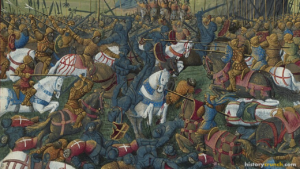
During the 14th century the Habsburgs experienced both expansion and setback. They added new territories in the region of modern-day Switzerland and southwestern Germany but suffered a significant defeat at the Battle of Morgarten in 1315, where Swiss peasant forces defeated a Habsburg army and began the long process by which the Swiss Confederation gradually won its independence from Habsburg rule. The dynasty also lost control of the imperial title for several decades, as rival families successfully contested it. However, in 1438, Albert II of Habsburg was elected Holy Roman Emperor, and from that point the imperial title remained in Habsburg hands, with only one brief interruption, until the Holy Roman Empire itself was dissolved in 1806.
Habsburg Dynasty – Maximilian I and the Marriage Strategy
The figure most responsible for transforming the Habsburgs from a powerful German family into a truly European dynasty was Emperor Maximilian I, who ruled from 1486 to 1519. Maximilian was a skilled diplomat and a firm believer in the power of marriage alliances to expand Habsburg power without the expense and risk of military conquest.
In 1477, Maximilian married Mary of Burgundy, the heir to the Duchy of Burgundy, which controlled a rich collection of territories including the Netherlands and parts of modern-day Belgium and northeastern France. This single marriage brought the wealthy and commercially important Netherlands under Habsburg control and dramatically expanded the dynasty’s wealth and western European influence. When Mary died in 1482, Maximilian ruled the Burgundian territories as regent for their son Philip.
Maximilian continued the marriage strategy by arranging the marriage of his son Philip to Joanna, heir to the thrones of Castile and Aragon, which together made up the kingdom of Spain. This was perhaps the most consequential dynastic marriage in European history. Their son, born in 1500, would inherit not only Spain and the Netherlands from his parents but also the Habsburg territories in Austria and the Holy Roman Empire from his grandfather Maximilian, creating the largest European empire since Charlemagne.
Habsburg Dynasty – Charles V and the Height of Habsburg Power
That son was Charles V, who became the most powerful ruler in Europe and arguably in the world during the first half of the 16th century. By the time he reached adulthood, Charles controlled Spain and its enormous colonial empire in the Americas, the Netherlands, large parts of Italy, Austria, Bohemia, Hungary, and the title of Holy Roman Emperor, which he was elected to in 1519. His territories were so vast and so geographically dispersed that he spent much of his reign traveling between them, and it was said that the sun never set on his empire.
Charles V’s reign coincided with two of the most important developments of the 16th century: the Protestant Reformation and the dramatic expansion of European power in the Americas. The Reformation, launched by Martin Luther in 1517, threatened to tear the Holy Roman Empire apart along religious lines. As a devout Catholic and the leading Christian monarch in Europe, Charles saw himself as the defender of the faith and worked throughout his reign to suppress Protestantism and restore religious unity. He was only partially successful. The Peace of Augsburg in 1555 effectively acknowledged the permanent division of the Holy Roman Empire between Catholic and Protestant states, a compromise that Charles found deeply unsatisfying.
Exhausted by decades of warfare against France, the Ottoman Empire, and German Protestant princes, and disappointed by his failure to reunite Christendom, Charles abdicated in 1556 in a remarkable act without precedent among European monarchs. He divided his vast inheritance between his son Philip II, who received Spain, the Netherlands, and the Italian territories, and his brother Ferdinand I, who received Austria, Bohemia, Hungary, and the imperial title. This division created two separate branches of the Habsburg dynasty, the Spanish Habsburgs and the Austrian Habsburgs, which would follow increasingly divergent paths.
Habsburg Dynasty – The Spanish Habsburgs
The Spanish branch of the Habsburg dynasty, ruling from 1516 to 1700, presided over Spain at the height of its global power. Philip II, who ruled from 1556 to 1598, was the most powerful monarch of the later 16th century, governing an empire that included not only Spain and its enormous colonial possessions in the Americas but also Portugal and its empire after 1580, the Netherlands, large parts of Italy, and the Philippines. His reign saw the defeat of the French Huguenots, the battle against the Protestant Dutch in the long and costly Eighty Years’ War, and the famous defeat of the Spanish Armada by England in 1588.
The Spanish Habsburgs benefited enormously from the vast quantities of gold and silver extracted from the Americas, which funded their wars and court but also contributed to severe inflation across Europe. Over the course of the 17th century, the strain of constant warfare, economic mismanagement, and increasingly weak rulers gradually eroded Spanish power. The last Spanish Habsburg, Charles II, was physically and mentally incapacitated by the effects of generations of inbreeding within the dynasty and died in 1700 without an heir. His death triggered the War of the Spanish Succession, in which the major European powers fought over who would inherit the Spanish throne, and ultimately resulted in the Spanish crown passing to the French Bourbon dynasty.
Habsburg Dynasty – The Austrian Habsburgs and the Age of Absolutism
The Austrian branch of the Habsburg dynasty continued to govern a vast Central European empire throughout the Age of Absolutism, holding the title of Holy Roman Emperor and ruling over Austria, Bohemia, Hungary, and a range of other territories. The 17th century brought enormous challenges, most notably the Thirty Years’ War from 1618 to 1648, which devastated much of Central Europe and ended with the Peace of Westphalia, which significantly limited the Emperor’s authority within the Holy Roman Empire and permanently established the principle of religious toleration among its member states.
The most significant rulers of the Austrian Habsburg line during the absolutist period were the Empress Maria Theresa and her son Joseph II, whose reigns brought the dynasty to its reforming peak in the 18th century. Maria Theresa, who ruled from 1740 to 1780, was the only female ruler in Habsburg history and proved one of the dynasty’s most capable members. She reorganized the Habsburg army and administration following the loss of Silesia to Frederick the Great of Prussia, introduced major educational reforms, and governed her diverse empire with a combination of pragmatism and genuine concern for her subjects’ welfare.
Joseph II, who ruled as sole emperor from 1780 to 1790, was the most radical reformer in Habsburg history, abolishing serfdom, introducing religious tolerance, and attempting to modernize virtually every institution in his empire. His sweeping reforms proved too ambitious and too rapid to succeed fully, and many were reversed after his death, but they demonstrated the extent to which Enlightenment ideas had penetrated even the most traditional of European dynasties.
Habsburg Dynasty – Decline and End
The 19th century brought mounting challenges to Habsburg power. The Napoleonic Wars temporarily dismantled the old Habsburg position in European politics: Napoleon forced the dissolution of the Holy Roman Empire in 1806, ending an institution with which the Habsburgs had been identified for more than three centuries. The Habsburg ruler Francis II simply renamed himself Emperor of Austria, creating the Austrian Empire as a new political framework for his territories, but the symbolic blow of losing the imperial title was significant.
More serious was the challenge of nationalism. The Habsburg Empire was a profoundly multi-ethnic state, containing Germans, Hungarians, Czechs, Poles, Slovaks, Croatians, Slovenes, Italians, and many other peoples within its borders. As the 19th century progressed and nationalist movements demanded that each people should govern themselves in their own state, the Habsburg Empire’s very existence became a target. The Revolutions of 1848 shook the empire severely, and only military force allowed the Habsburgs to restore their authority.
A significant compromise was reached in 1867 when the empire was reorganized as the Austro-Hungarian Empire, a dual monarchy in which Austria and Hungary each had their own parliament and government while sharing a common ruler, foreign policy, and military. This arrangement gave Hungary a degree of self-government but satisfied neither the Hungarians fully nor the other nationalities within the empire, who received no comparable recognition.
The assassination of Archduke Franz Ferdinand, heir to the Austro-Hungarian throne, in Sarajevo on June 28th, 1914, triggered the chain of events that led to World War I. The war proved catastrophic for the dynasty. Austria-Hungary was on the losing side, and when the war ended in 1918, the empire collapsed entirely. The last Habsburg emperor, Charles I, abdicated in November 1918, and the Habsburg territories broke up into a series of independent national states including Austria, Hungary, Czechoslovakia, and Yugoslavia.
Habsburg Dynasty – Significance
The significance of the Habsburg Dynasty in European history is immense. For more than six centuries the Habsburgs stood at the center of European politics, and their decisions shaped the lives of tens of millions of people across the continent. Their policy of strategic marriage alliances transformed the political map of Europe more effectively than any comparable military strategy, demonstrating how dynastic connections could build empires that military conquest alone could never have created.
The Habsburgs also played a central role in some of the most important events in European history, from the Protestant Reformation and the Thirty Years’ War to the Age of Absolutism, the Enlightenment reforms of Maria Theresa and Joseph II, and the complex multi-ethnic politics of the 19th century that culminated in World War I. Their empire was in many respects a prototype of the kind of multi-ethnic, multi-lingual political organization that later generations would struggle to create through international institutions. Its collapse in 1918, and the fragmentation of Central Europe into competing nation-states, contributed directly to the instability that produced World War II a generation later. As such, the Habsburg Dynasty remains one of the most consequential and instructive chapters in the entire history of European civilization.