The Great Terror was the most violent phase of the Reign of Terror during the French Revolution. It took place in the summer of 1794 and saw executions reach their highest levels as Maximilien Robespierre and the Committee of Public Safety moved against anyone they believed was a threat to the revolution. The Great Terror lasted only a matter of weeks but resulted in the deaths of hundreds of people and ended only with the arrest and execution of Robespierre himself.
What Was the Reign of Terror?
The Great Terror was the final and most extreme phase of the broader period known as the Reign of Terror, which lasted from September 1793 to July 1794. The Reign of Terror was a time of extreme violence and paranoia during the French Revolution in which the radical Jacobins, led by Robespierre and the Committee of Public Safety, worked to eliminate anyone they considered an enemy of the revolution. During this period, thousands of people were arrested and executed by guillotine, including nobles, clergy, and ordinary citizens. Fear and suspicion spread throughout French society as accusations of treason could come from anyone and result in swift execution. The Great Terror refers specifically to the final weeks of this period, beginning in June of 1794, when the pace of executions increased dramatically and even powerful revolutionary leaders were not safe from the guillotine.
Great Terror – Background and Causes
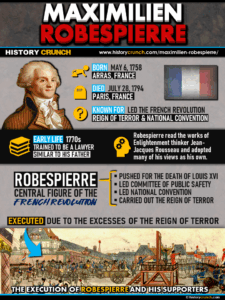
By the spring of 1794, Robespierre had become the dominant figure within the National Convention and the Committee of Public Safety. He had used the Reign of Terror to eliminate his political rivals one by one, including the moderate Girondins and later even fellow Jacobins who called for an end to the violence. When Georges Danton, one of the most prominent figures of the revolution, publicly argued that the killings had gone too far, Robespierre had him arrested and executed in April of 1794. The message was clear: no one was safe from accusation, no matter how committed they were to the revolution. As Robespierre’s power grew, so did the paranoia that drove it. By June of 1794, the pace of trials and executions in Paris began to accelerate sharply, marking the beginning of what historians call the Great Terror.
Great Terror – The Law of 22 Prairial
The event that directly triggered the Great Terror was the passing of the Law of 22 Prairial on June 10th, 1794. This new law, pushed through the National Convention by Robespierre and his allies, dramatically changed how trials were conducted during the revolution. Under the new law, accused persons were denied the right to a defense lawyer and could no longer call witnesses on their behalf. The only verdict available to the Revolutionary Tribunal was either acquittal or death. There was no longer any middle ground. The law also expanded the definition of who could be considered an enemy of the revolution to include an extremely broad range of behaviors, making it possible to accuse almost anyone of treason. The result was a sharp increase in executions in Paris. In the six weeks following the passing of the law, the Revolutionary Tribunal sentenced over 1,300 people to death in Paris alone, compared to roughly 1,200 in the entire preceding year of the Reign of Terror.
Great Terror – Robespierre’s Fall
As the summer of 1794 progressed, Robespierre’s behavior became increasingly erratic and his grip on power became more extreme. In June, he introduced a new state religion known as the Cult of the Supreme Being and oversaw a large festival in Paris to celebrate it. Many members of the National Convention found this deeply troubling and saw it as a sign that Robespierre was becoming a dictator. At the same time, Robespierre made a speech in the National Convention in which he suggested he had a list of enemies within the government itself. Without naming anyone specifically, his words created widespread panic among the members of the convention, as no one knew whether their own name was on the list. Fearing that they would be the next to face the guillotine, a group of convention members began working together in secret to bring Robespierre down before he could act against them.
Great Terror – End of the Great Terror
On July 27th, 1794, known in the French revolutionary calendar as 9 Thermidor, members of the National Convention moved against Robespierre. During a session of the convention, he was shouted down when he tried to speak and was formally arrested along with his closest allies. As soldiers arrived to take him into custody, Robespierre attempted to shoot himself in the head but only succeeded in shattering his jaw. He was held captive for the remainder of the day and executed by guillotine the following afternoon on July 28th, 1794, without a trial. The fall of Robespierre brought the Great Terror and the broader Reign of Terror to an immediate end. The period that followed, known as the Thermidorian Reaction, saw the new government move quickly to dismantle the machinery of the Terror, close the Jacobin clubs, and release thousands of political prisoners.
Significance of the Great Terror
The Great Terror remains one of the most studied and debated episodes of the French Revolution. It is often used by historians to illustrate how a revolution built on ideals of liberty and equality can turn into a system of oppression and fear. In total, over 40,000 people are estimated to have been killed during the entire Reign of Terror, with the Great Terror accounting for a significant portion of those deaths in a very short period of time. The Great Terror showed that the revolution had lost sight of the very principles it was founded on and that unchecked political power, even in the name of protecting the people, could lead to devastating consequences. The end of the Great Terror and the fall of Robespierre marked a major turning point in the French Revolution, paving the way for more moderate government and eventually the rise of Napoleon Bonaparte.