The Jacobins were the most influential and radical political group of the French Revolution and became closely associated with the Revolution’s most violent phase. Formed in 1789, the Jacobin Club grew from a political discussion group of deputies into a powerful nationwide movement that helped shape the fall of the monarchy, the rise of the republic, and the Reign of Terror from 1793 to 1794.
JACOBINS – ORIGINS
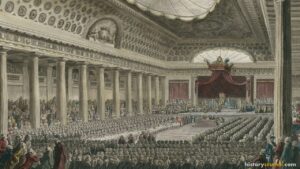
The Jacobins began in 1789 during the early stage of the French Revolution. At first, they were a group of deputies from Brittany, France, who met at Versailles, France, around the time of the Estates-General. This early group was often called the Breton Club. Later, after the National Assembly moved to Paris, France, the group reorganized as the Society of the Friends of the Constitution. However, people commonly called them the Jacobins because they met in a former Dominican convent on the Rue Saint-Honoré in Paris, France, and Dominicans in Paris were often known as Jacobins.
At first, the club was not made up only of extreme revolutionaries. In fact, it included a mix of people who supported reform and wanted to protect the gains of the Revolution. Over time, though, the club grew larger, admitted nondeputies, and built affiliated clubs across France. This was important because the Jacobins became more than just one meeting group in Paris, France. They became part of a national political network that could spread ideas, influence opinion, and pressure governments.
JACOBINS – RISE DURING THE FRENCH REVOLUTION
The Jacobins became more important as the French Revolution grew more serious and more divided. In 1791, many moderate members left after the crisis caused by Louis XVI’s failed attempt to flee France. After that split, more radical figures such as Maximilien Robespierre became more central inside the club. Therefore, the Jacobins increasingly came to represent the more intense and uncompromising side of the Revolution.
This shift matters for students because the French Revolution did not stay the same from beginning to end. In 1789, many revolutionaries still hoped to reform the monarchy. By 1791 and 1792, however, growing fear, war, and distrust pushed politics in a more radical direction. The Legislative Assembly, which ruled from October of 1791 to September of 1792, included many members connected to the Jacobin Club, and it faced economic crisis, conflict with the king, and rising pressure from war. As such, the Jacobins grew stronger during a time when moderate solutions were failing.
JACOBINS – VERSUS THE GIRONDINS
A major turning point came in August of 1792, when the monarchy was overthrown. Soon afterward, in September of 1792, France became a republic. The Jacobin Club then entered a new phase and took on an even more openly radical identity. It even changed its formal name to the Society of the Jacobins, Friends of Liberty and Equality, which means a political society devoted to liberty and equality. During this stage, the club became closely linked to the Montagnards, or “the Mountain,” who were the more radical deputies in the National Convention.
The Jacobins also became closely tied to the struggle against the Girondins, who were a more moderate republican faction. Early in the life of the republic, France was under enormous pressure. The country was at war with foreign monarchies, the economy remained unstable, and many revolutionaries believed that enemies inside France wanted to destroy the new republic. In that setting, the Jacobins pushed for stronger and harsher action. They supported the execution of Louis XVI in January of 1793 and later helped remove the Girondins from power in June of 1793. This was significant because it marked the victory of the more radical revolutionaries inside the government.
JACOBINS – THE REIGN OF TERROR
The Jacobins are most closely remembered for their connection to the Reign of Terror. The Reign of Terror lasted from September of 1793 until July of 1794 and was a period of extreme violence, fear, and political repression. During this time, Jacobin leaders believed that the Revolution faced deadly threats from foreign armies, domestic rebellion, and suspected traitors. Therefore, they supported the use of emergency powers, revolutionary courts, and executions to defend the republic.
The Committee of Public Safety, created in April of 1793, became the main executive body of revolutionary France, and Robespierre became its most famous leader. Under Jacobin influence, the government centralized power, raised armies, monitored local officials, and tried to crush opposition. This period saw the execution of tens of thousands of people across France, many by guillotine. For high school students, this is one of the clearest examples of how revolutions can become more extreme when leaders believe they are surrounded by danger and betrayal.
At the same time, the Jacobins were not simply violent for no reason. They believed they were saving the Revolution in a moment of national emergency. France was fighting wars, facing uprisings, and struggling to hold the republic together. Even so, the methods they used made the Jacobins a symbol of revolutionary excess. In fact, the club became so closely tied to terror and dictatorship that its name later carried a strongly negative meaning for many people.
JACOBINS – DECLINE AND SIGNIFICANCE
The power of the Jacobins collapsed after the fall of Robespierre in July of 1794, an event often called the Thermidorian Reaction. Once Robespierre and his allies were overthrown and executed, the Paris club was first shut down temporarily and then permanently closed in November of 1794. Across France, many affiliated Jacobin clubs were also closed soon afterward. This was important because it showed that the Revolution was moving away from the Terror and away from Jacobin dominance.
The Jacobins were significant because they helped push the French Revolution from reform to radical republic. They influenced the fall of the monarchy, the defeat of the Girondins, and the creation of a government willing to use extreme force in the name of defending liberty and equality. At the same time, they remain one of the most debated groups in modern history. Some people see them as defenders of the Revolution in a moment of crisis, while others remember them mainly for the violence of the Reign of Terror. Regardless, the Jacobins are essential to understanding why the French Revolution became both so transformative and so deadly.