Italy’s participation in World War I was one of the most unusual and consequential of any nation involved in the conflict. Despite being a member of the Triple Alliance with Germany and Austria-Hungary before the war, Italy declared neutrality when the fighting began in 1914 and then switched sides entirely, joining the Allied Powers in May 1915. The Italian Front that followed became one of the most brutal and costly theaters of the war, fought in the rugged alpine terrain along the border between Italy and Austria-Hungary. Over 600,000 Italian soldiers died in the conflict. This infographic was designed for students to visually summarize Italy’s role in World War I and is based on the History Crunch articles on Italy in World War I.
Italy in World War I – Infographic
About This Infographic
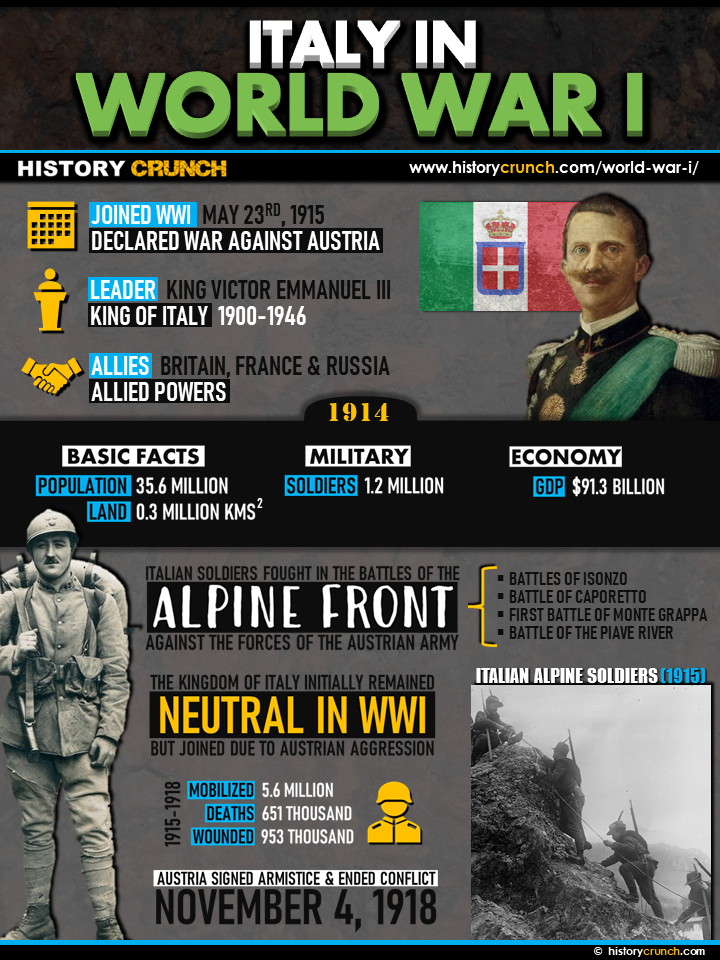
This Italy in World War I infographic was created by the History Crunch team to help students and teachers quickly understand the significance of Italy’s role in the First World War. It is designed as a visual learning and study tool, summarizing the essential information covered in our full article on Italy in World War I. Teachers may use it as a classroom display, a discussion prompt, or a study aid for students preparing for assessments.
What This Infographic Covers
The infographic begins with Italy’s unusual path into the war. Before the war, Italy was a member of the Triple Alliance alongside Germany and Austria-Hungary. When the war began in 1914, Italy declared itself neutral rather than joining its alliance partners. This was because Italy viewed Austria-Hungary as the aggressor in the events that triggered the war, particularly in its aggressive actions against Serbia following the assassination of Franz Ferdinand. Both the Allied Powers and the Central Powers competed to bring Italy into the war on their side. Italy ultimately chose the Allied Powers, signing the secret Treaty of London in April 1915 in exchange for promises of territorial gains in the region. Italy officially left the Triple Alliance on May 3rd, 1915 and declared war against Austria-Hungary, joining Britain, France and Russia as an Allied Power.
The infographic covers the Italian Front, also known as the Alpine Front, which developed along the northern border between Italy and Austria-Hungary. The terrain was extraordinarily difficult, with much of the fighting taking place in mountainous alpine regions and along the valleys of the Isonzo River. Chief of Staff of the Italian Army Luigi Cadorna devised a strategy of successive offensive attacks against Austro-Hungarian defensive positions, with the ultimate aim of breaking through to the Austrian capital of Vienna. The plan led to 12 major battles along the Isonzo River between 1915 and 1917, known collectively as the Battles of the Isonzo. Throughout these 12 battles the two sides went back and forth in the difficult terrain, with the Italian Army suffering over 950,000 casualties and approximately 300,000 deaths, while Austro-Hungarian forces suffered approximately 520,000 casualties. The battles gained Italy less than seven miles of ground, making them a characteristic example of the costly stalemate that defined World War I.
The infographic covers the Battle of Caporetto in October and November 1917, the most devastating Italian defeat of the war. Austro-Hungarian forces supported by German units launched a surprise assault using poison gas attacks and stormtrooper infiltration tactics against the Italian lines near the town of Caporetto. The Italian Army was routed and forced to retreat 93 miles. In total Italy suffered approximately 13,000 dead, 30,000 wounded and nearly 275,000 captured. Luigi Cadorna was replaced as Chief of Staff by Armando Diaz. The Battle of Caporetto became a symbol of Italian military failure and anti-war sentiment in Italy.
The infographic concludes with Italy’s final victory at the Battle of Vittorio Veneto from October 24th to November 3rd, 1918, which ended the war on the Italian Front. Under new command and supported by British, French and American forces, the Italian Army launched a decisive offensive against the weakened Austro-Hungarian forces. The battle coincided with the internal collapse of the Austro-Hungarian Empire, which dissolved during the fighting. Austria-Hungary signed the Armistice of Villa Giusti on November 3rd, 1918, ending the war on the Italian Front.
How to Use This Infographic in the Classroom
This infographic works well as a visual introduction to Italy in World War I before students read the full article. It can also be used as a discussion prompt asking students to consider why Italy switched sides from the Triple Alliance to the Allied Powers in 1915, and what this tells us about how national interest influenced military alliances during the war. Teachers may also use it alongside the Austria-Hungary in World War I infographic to give students both perspectives on the fighting along the Italian Front.
Related Articles
To learn more about the topics covered in this infographic, visit the following History Crunch articles: