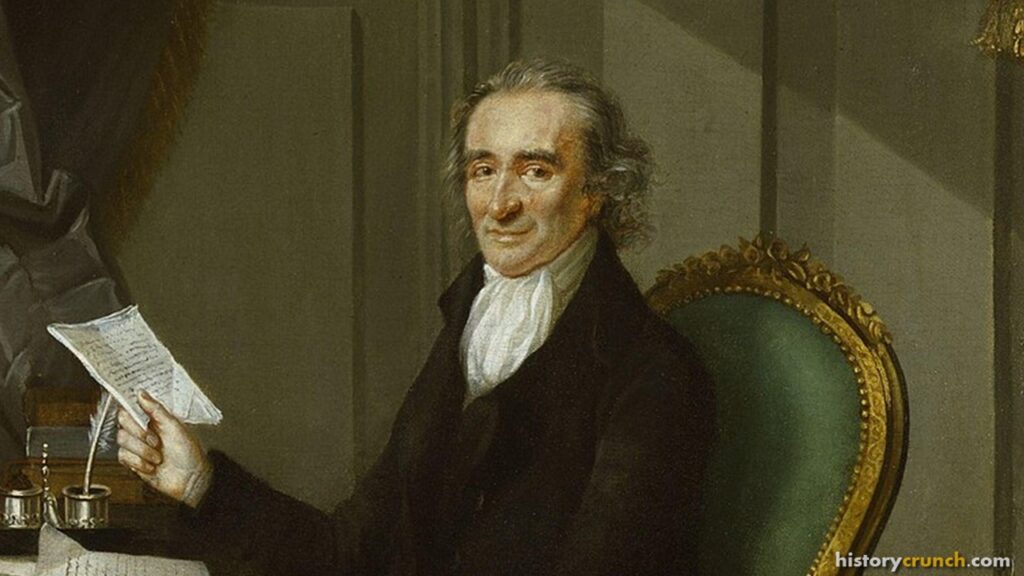
Thomas Paine was an English-born American writer, political thinker, and revolutionary who played a remarkable role in the major political upheavals of his era. He was born on February 9th, 1737, and died on June 8th, 1809. He arrived in America at the age of 37 with few prospects and almost immediately became one of the most important voices of the American Revolution through his pamphlet Common Sense, published in January of 1776. He later participated in the French Revolution and wrote two other major works, The Rights of Man and The Age of Reason, that made him one of the most widely read and controversial political writers in the English-speaking world. His ability to express complex political ideas in clear and simple language that ordinary people could understand made him unique among the thinkers of his age.
Early Life of Thomas Paine
Thomas Paine was born on February 9th, 1737, in the small town of Thetford in Norfolk, England. He was the son of Joseph Pain, a Quaker corset maker, and Frances Cocke, who was an Anglican. The family was of modest means and Paine’s formal education was limited. He attended the local grammar school until the age of thirteen, where he learned to read, write, and do basic arithmetic. He then left school to work as an apprentice to his father.
As a young man Paine tried his hand at a number of different occupations without great success. He briefly served as a sailor on a privateer ship at the age of twenty, worked as a corset maker, attempted to start his own business, and eventually became an excise tax collector for the British government. He was dismissed from this job twice. During his second period as an excise officer, he wrote a political pamphlet arguing that excise workers deserved better wages and distributed it to members of Parliament. The campaign failed and Paine lost his job. He was left deeply in debt, his marriage had ended, and he had no clear future in England.
In 1774, at the age of 37, Paine met Benjamin Franklin in London. Franklin was in England representing the interests of the American colonies and recognized something in Paine that he thought might be useful. He gave Paine a letter of recommendation and encouraged him to emigrate to America. Paine arrived in Philadelphia in November of 1774, just months before the outbreak of the American Revolution.
Thomas Paine – Common Sense and the American Revolution
In Philadelphia, Paine found work as a journalist and editor at the Pennsylvania Magazine. He quickly developed a reputation in political circles as a sharp and energetic writer. As tensions between the American colonies and Britain escalated in 1775, Paine began working on a pamphlet arguing the case for American independence. He discussed his ideas with Benjamin Rush, Benjamin Franklin, and Samuel Adams, and it was Rush who suggested the title Common Sense.
Common Sense was published anonymously on January 10th, 1776. It was a 47-page pamphlet written in plain, direct language aimed at ordinary readers rather than political elites. In it, Paine argued that monarchy was a corrupt and irrational form of government, that hereditary rule made no sense, and that the American colonies had no good reason to remain tied to Britain. In fact, he argued that the entire British system of government was fundamentally built on injustice and tyranny. He called for complete and immediate independence and for the establishment of a democratic republic with a written constitution.
The pamphlet was an immediate sensation. In proportion to the population of the colonies at the time, it had the largest sale and circulation of any book published in American history. Copies were passed around, read aloud in taverns and meeting places, and distributed to soldiers. George Washington ordered it read to his troops. One estimate suggests approximately 500,000 copies circulated among a colonial population of around 2.5 million people. Common Sense transformed public opinion by giving ordinary Americans the arguments they needed to justify a complete break from Britain rather than simply seeking a reform of their relationship with the Crown. As stated above, John Adams later wrote that without the pen of the author of Common Sense, the sword of Washington would have been raised in vain.
Paine continued to support the revolutionary cause through a series of pamphlets published between 1776 and 1783 collectively known as The American Crisis. The first of these, published in December of 1776 when Washington’s army was on the verge of collapse after a series of defeats, opened with the famous words these are the times that try men’s souls. Washington ordered it read aloud to his troops, and it is credited with helping to restore morale at one of the lowest points of the war. Paine served as a volunteer aide to generals during the war but his greatest contribution was always with his pen rather than his sword.
Thomas Paine – The French Revolution and The Rights of Man
After the American Revolution ended, Paine returned to Europe in 1787. He spent time in both Britain and France, where the political atmosphere was rapidly approaching crisis. When the French Revolution broke out in 1789, Paine was deeply sympathetic to its ideals. He became one of the most visible defenders of the revolution in the English-speaking world.
In 1790, the British politician Edmund Burke published a famous criticism of the French Revolution, arguing that it was a dangerous and destructive assault on tradition and order. Paine responded with The Rights of Man, published in two parts in 1791 and 1792. The work was a comprehensive defense of the principles of the French Revolution and a sweeping argument against monarchy, aristocracy, and hereditary privilege. Paine argued that all governments existed to serve the rights of the people and that any government that failed to do so had no legitimate authority. He also proposed what would today be recognized as early social welfare policies, including state provision of education and support for the poor and elderly.
The Rights of Man was enormously popular among ordinary readers in Britain and was seen by the government as a dangerous threat to public order. Paine was charged with seditious libel and indicted for treason. He escaped to France just before he would have been arrested, and was subsequently convicted in absentia in Britain and effectively outlawed.
Thomas Paine – France and The Age of Reason
In France, Paine was received as a hero of the revolution and was elected as a member of the National Convention, the revolutionary legislature, despite speaking almost no French. However, he quickly fell into political difficulty. When the revolution moved into its most radical phase under Robespierre, Paine argued against the execution of King Louis XVI, believing that killing the king would damage the cause of republicanism internationally. This position made him deeply unpopular with the radical faction. In December of 1793, he was arrested and imprisoned in the Luxembourg Prison in Paris, where he narrowly escaped execution during the Reign of Terror. He was released in November of 1794 after the American ambassador James Monroe intervened on his behalf.
During his imprisonment, Paine began writing his most controversial work, The Age of Reason, which was published in two parts in 1794 and 1796. The book was a defense of Deism, the belief in a rational God who created the universe but did not intervene in human affairs. Paine rejected organized religion, challenged the literal truth of the Bible, and attacked the institutional power of the Church. The Age of Reason was deeply influential among freethinkers but caused enormous outrage among religious believers. In fact, it damaged his reputation in the United States so severely that when he returned to America in 1802, invited by President Thomas Jefferson, he was largely shunned by the public that had once celebrated him.
Later Years and Death of Thomas Paine
Paine spent his final years in the United States in increasingly difficult circumstances. His criticism of organized religion had made him a hated figure among devout Americans, and his earlier published attacks on George Washington and John Adams had alienated him from the Federalist political establishment. He continued to write and publish until the end of his life but attracted little of the public attention he had once commanded.
Thomas Paine died on June 8th, 1809, in New York City at the age of 72. His funeral was poorly attended. Only a handful of people gathered at his grave in New Rochelle, New York. A contemporary newspaper described his life as having done some good and much harm. However, his influence grew enormously after his death, and his ideas inspired generations of reformers, abolitionists, and democratic activists around the world.
Significance of Thomas Paine
The significance of Thomas Paine in the history of the Enlightenment and the democratic revolutions of the 18th century is considerable. Common Sense was arguably the single most important piece of political writing produced during the American Revolution. It transformed public opinion at a critical moment and gave the revolutionary cause the popular energy it needed to succeed.
His broader contribution was to demonstrate that Enlightenment ideas about natural rights, democratic government, and human equality could be expressed in language accessible to ordinary people rather than only to educated elites. In fact, more than any other political writer of his age, Paine brought the ideas of the Enlightenment to the common reader and showed that political philosophy did not have to be the exclusive property of the wealthy and the learned.
His influence extended far beyond his own lifetime. His arguments for democratic government, freedom of religion, social welfare, and the abolition of hereditary privilege anticipated many of the reforms that would be achieved in the 19th and 20th centuries. Abraham Lincoln, Theodore Roosevelt, and many other later leaders acknowledged Paine’s influence on their thinking. As such, Thomas Paine stands as one of the most important and consequential political writers in the history of the modern world.