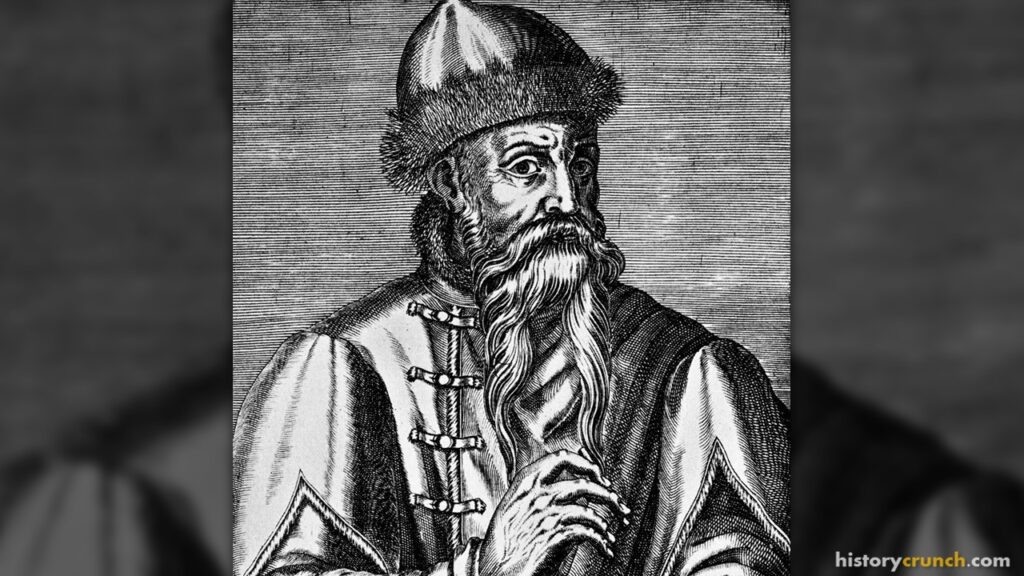
Johannes Gutenberg was a German blacksmith, goldsmith and printer who is best remembered today for his development of the first printing press in the mid-1400s. His invention of the printing press is considered to be one of the most transformative inventions in history and had a profound impact on historical movements such as the Renaissance and Age of Enlightenment.
JOHANNES GUTENBERG – EARLY LIFE
Gutenberg was born in Mainz, Germany around the year 1400. His exact date of birth is not known but historians estimate that he born within a range around the year 1400. It is believed that he grew up learning to be a goldsmith because his father worked as a merchant and Goldsmith at the time. Little is known about his early life but it is believed that he and his family moved from Mainz to Strasbourg for political reasons. As well, there is some evidence that he may have attended the University of Erfut in the year 1418. In the years that follow there is little record of his life, but historians have suggested that he was likely working as a goldsmith.
JOHANNES GUTENBERG – PRINTING PRESS
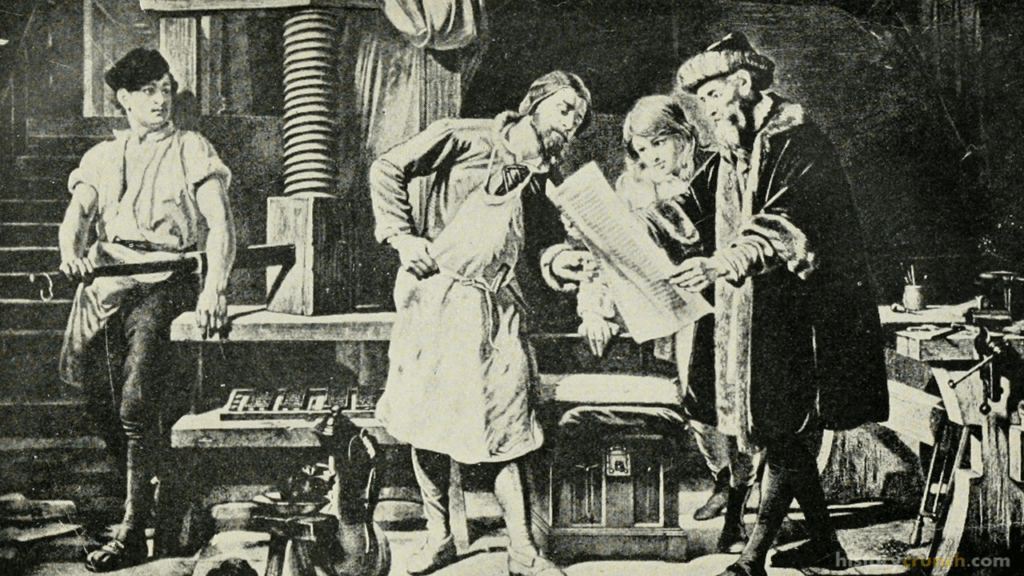
Historians have not identified an exact date for the invention of the printing press, as little records have survived from the time period. As such, it is generally accepted the first printing press was developed in the mid-1400s. Prior to the printing press, books and other literature were created through a varied assortment of methods (woodblock press, etc.) which were all labor intensive and slow. Gutenberg’s invention was the development of a hand mold that allowed for precise movable type. This meant that he perfected the process of making movable type pieces for easily and quickly constructing type-font documents. This sped up the printing process and made it extremely affordable, which allowed for an explosion in the publishing and printing of books. For example, the Gutenberg Bible was the first book to be mass produced on the Gutenberg printing press. At the time, Gutenberg used a series of loans to establish his own workshop with his printing press. He used this workshop as a business in which he developed printed works for customers as well as for the church.
The invention and use of the printing press in Europe was important for the Renaissance because it allowed new ideas and worldviews to spread across the continent more easily. At its core, the Renaissance was about new ideas (such as humanism) overthrowing old views and customs (such as religious beliefs and practices and feudal traditions). Therefore, the invention of the printing press allowed these new ideas to spread and further enhance the overall Renaissance.
JOHANNES GUTENBERG – DEATH AND SIGNIFICANCE
Gutenberg continued to travel and move around Germany until he died on February 3rd, 1468. He was buried on the grounds of a church in Mainz. The church was later destroyed and Gutenberg’s grave has been lost to history. When he died, his contributions to the printing press were largely unknown. It was not until decades after that he was credited by historians with the invention. Today, his invention is credited with transforming life for people at the time.