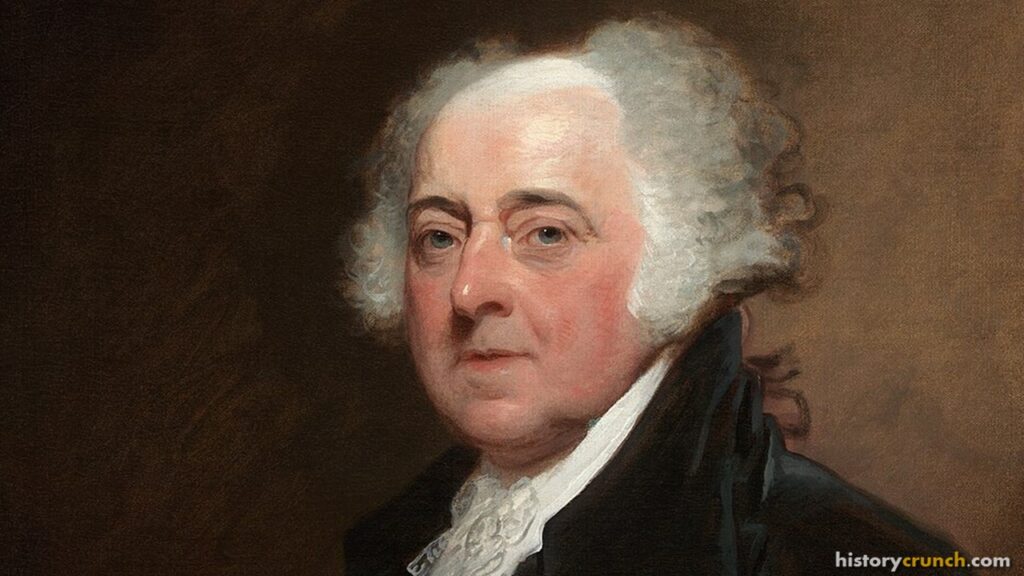
John Adams was a lawyer, statesman, and Founding Father who played a central role in the American Revolution and served as the second President of the United States. Born on October 30th, 1735, in Braintree, Massachusetts, and dying on July 4th, 1826, Adams spent decades in public service, working as a delegate to the Continental Congress, a diplomat in Europe, the first Vice President, and finally as president from 1797 to 1801. He was blunt, deeply principled, and often unpopular, but his contributions to American independence and government rank among the most important of any Founding Father.
John Adams – Early Life and Education
John Adams was born on October 30th, 1735, in Braintree, in the British colony of Massachusetts. His father was a farmer and shoemaker who served as a deacon in the local church and was well respected in the community. As a boy, Adams loved the outdoors and often skipped school to hunt and fish. His father pushed him toward a formal education, hoping he would become a minister. Adams entered Harvard College at age fifteen and graduated in 1755.
After graduating, Adams spent several years teaching school while he studied law. He was admitted to the bar in 1758 and began building a legal career in Boston. He quickly proved himself to be one of the sharpest legal minds in the colony. In 1764, he married Abigail Smith, the daughter of a minister from nearby Weymouth. The marriage proved to be one of the great partnerships in American history. Abigail was highly intelligent, well-read, and deeply engaged in politics. The two exchanged hundreds of letters during the long periods Adams spent away from home, and those letters remain one of the most detailed records of the revolutionary era.
John Adams – Growing Opposition to British Rule
Adams became involved in colonial politics in the mid-1760s as British tax policies sparked growing anger in Massachusetts. He was an early critic of the Stamp Act of 1765, writing essays under a pen name arguing that Parliament had no right to tax the colonies. He spoke out again against the Townshend Acts of 1767. But his most striking act of principle in these years came in 1770, when he agreed to defend the British soldiers charged with murder in the Boston Massacre.
Adams believed every accused person deserved a fair trial, even unpopular defendants. He argued successfully that the soldiers had fired in fear for their lives after being surrounded and attacked by an angry crowd. Six of the eight soldiers were found not guilty. The two who had clearly fired into the crowd were convicted of manslaughter and received lighter sentences. The decision outraged many Bostonians, but Adams later called it one of the best things he ever did. His willingness to stand by principle when it was costly became one of the most consistent features of his character.
John Adams – The Continental Congress and Independence
Adams served as a Massachusetts delegate to the First Continental Congress in Philadelphia in 1774 and was reelected to the Second Continental Congress in 1775. He quickly emerged as one of the most active and forceful members. When Congress created the Continental Army in June of 1775, it was Adams who nominated George Washington to serve as Commander-in-Chief, arguing that a Virginian in the role would help unite the colonies behind the common cause.
In the spring of 1776, Adams became the leading voice in Congress pushing for independence. When Virginia delegate Richard Henry Lee formally proposed independence in June of 1776, Adams seconded the motion and spent the following weeks arguing for it with energy and determination. He was appointed to the Committee of Five to draft a declaration and pushed Thomas Jefferson to write the document, recognizing Jefferson’s exceptional skill as a writer. When Jefferson’s draft came before Congress, Adams defended it fiercely against critics. He signed the Declaration of Independence on August 2nd, 1776.
John Adams – Diplomat in Europe
In 1778, Congress sent Adams to France to help Benjamin Franklin secure French support for the American cause. He found France frustrating, feeling that Franklin received all the credit while he did much of the practical work. He returned briefly to Massachusetts in 1779, during which time he drafted the Massachusetts Constitution, the oldest surviving written state constitution in the United States. He then returned to Europe, traveling to the Netherlands, where he successfully negotiated a crucial loan for the American government and opened trade relations, a diplomatic achievement of real importance that is often overlooked.
In 1781, Adams joined Franklin, John Jay, and Henry Laurens in Paris to negotiate the peace treaty ending the Revolutionary War. The Treaty of Paris, signed in September of 1783, formally recognized American independence and gave the new nation all territory east of the Mississippi River. After the treaty was signed, Adams stayed in Europe and served from 1785 to 1788 as the first American ambassador to Great Britain, working to smooth relations with the country the United States had just defeated in war.
John Adams – Vice President
Adams returned home in 1788 and was elected Vice President under George Washington in 1789, winning the second-highest number of electoral votes. The role proved deeply frustrating for a man who was used to being at the center of important decisions. As president of the Senate, Adams could not take part in debates. Washington relied on his cabinet rather than his vice president, and Adams was largely left out of major decisions. He described the office as the most meaningless position the imagination of man had ever created. He served two full terms as vice president, from 1789 to 1797, casting 31 tie-breaking votes in the Senate, all in support of the Washington administration.
John Adams – The Presidency
Adams was elected president in 1796, winning narrowly over Thomas Jefferson in the first truly contested presidential election in American history. Under the rules at the time, Jefferson, as the runner-up, became vice president, placing two political opponents in the two highest offices in the land.
Adams’s presidency was dominated from start to finish by the threat of war with France. France was angry that the United States had signed the Jay Treaty with Britain in 1794, seeing it as a sign that America was taking Britain’s side in the ongoing war between the two European powers. French warships began seizing American merchant vessels, and the situation grew tense quickly. In 1797, Adams sent three diplomats to France to negotiate a solution. French officials, referred to, in American accounts, only as X, Y, and Z, demanded a large bribe before any talks could begin. When Adams reported the demand to Congress, it caused a national outrage known as the XYZ Affair. Calls for war with France grew loud, particularly from Alexander Hamilton and his supporters within the Federalist Party.
Adams refused to declare war. He believed war with France would be disastrous for the young nation and that the dispute could be settled through negotiation. The undeclared naval conflict that followed, known as the Quasi-War, lasted from 1798 to 1800 and was fought entirely at sea. By 1800, American warships had largely cleared French privateers from major sea routes, and France, exhausted by its own wars in Europe, agreed to negotiate. The Treaty of Mortefontaine, signed in September of 1800, ended the Quasi-War and restored peaceful relations between the two countries.
Keeping the United States out of a full-scale war with France was probably the most important decision Adams made as president. It cost him politically, as Hamilton and his supporters worked against him within the Federalist Party, helping to split the party ahead of the 1800 election. Adams lost his bid for a second term to Thomas Jefferson, receiving fewer electoral votes in a close contest.
Adams also signed the Alien and Sedition Acts in 1798, a set of laws that made it easier to deport foreign nationals and made it a crime to publish harsh criticism of the government. The acts were widely seen as attacks on free speech and press, and they damaged Adams’s reputation and contributed to the Federalists’ defeat in 1800. He later acknowledged that signing them had been a mistake.
Despite losing the election, Adams made one lasting contribution in his final weeks in office. He appointed John Marshall of Virginia as Chief Justice of the Supreme Court, a position Marshall would hold for 34 years. Marshall shaped American constitutional law more than any other justice in history, and his appointment is considered one of the most important acts of Adams’s presidency.
John Adams – Later Life and Death
Adams retired to his farm in Quincy, Massachusetts, in March of 1801 and spent the next 25 years reading, writing, and farming. He was initially bitter about his defeat and did not attend Jefferson’s inauguration. Over time, however, he and Jefferson repaired their friendship through a remarkable series of letters that stretched from 1812 until their deaths. The correspondence between the two old rivals has become one of the most celebrated exchanges in American history.
Adams lived to see his son, John Quincy Adams, win the presidential election of 1824, one of the greatest joys of his final years. He died on July 4th, 1826, the fiftieth anniversary of the adoption of the Declaration of Independence, at his home in Quincy at the age of ninety. His last words were reported to be “Thomas Jefferson survives.” He did not know that Jefferson had died at Monticello earlier that same afternoon.
Significance of John Adams
John Adams holds an important place in American history that is not always fully recognized. He was one of the most active and determined voices for independence in the Continental Congress, playing a key role in pushing the Declaration through at a moment when hesitation could have delayed or prevented it. His diplomatic work in Europe, including securing loans from the Netherlands and helping negotiate the Treaty of Paris, helped keep the Revolution alive and brought it to a successful conclusion.
As president, his refusal to take the country into a full-scale war with France, despite enormous pressure to do so, was an act of real courage that likely saved the young republic from a conflict it was not ready for. Adams was one of the few Founding Fathers who never owned enslaved people, a fact that sets him apart from many of his contemporaries. He was difficult, proud, and easy to underestimate, but the American republic owes more to his stubbornness and his principles than most history books have acknowledged.