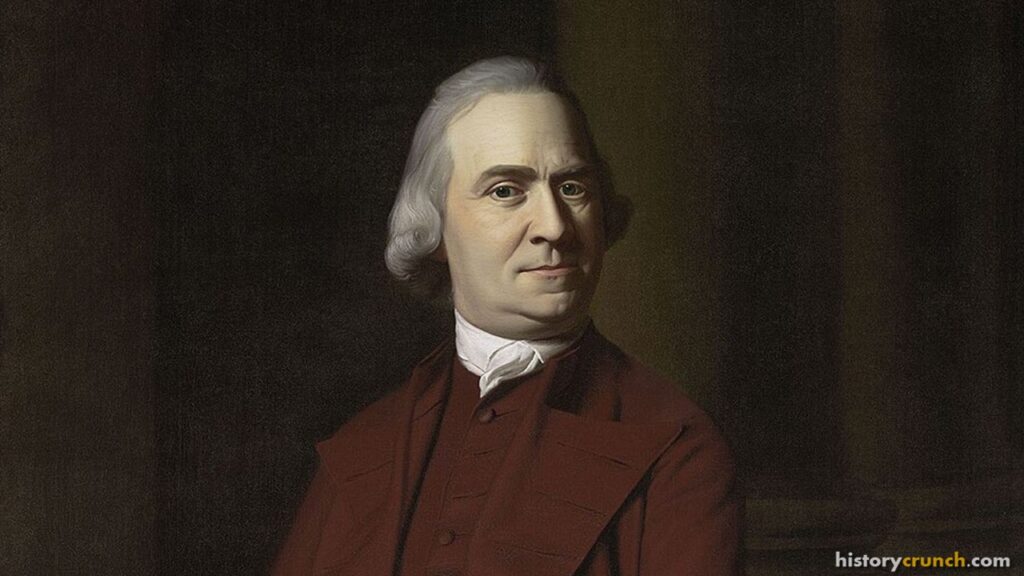
Samuel Adams was a Boston politician, writer, and organizer who became one of the most important leaders of the American independence movement. Born on September 27th, 1722, in Boston, Massachusetts, and dying on October 2nd, 1803, Adams spent most of his adult life working to build resistance to British rule in the colonies. He helped found the Sons of Liberty, organized the Committees of Correspondence, played a central role in the Boston Tea Party, and signed the Declaration of Independence. More than almost anyone else, it was Samuel Adams who turned the anger of ordinary Bostonians into a coordinated political movement that helped start the American Revolution.
Samuel Adams – Early Life and Education
Samuel Adams was born on September 27th, 1722, in Boston, in the British colony of Massachusetts. His father, also named Samuel, was a successful businessman, a brewer, and a deacon in the local church. The family had deep Puritan roots, and religion played a central role in Adams’s upbringing. He attended the Boston Latin School as a boy and entered Harvard College at the age of fourteen, graduating in 1740. He returned for a master’s degree in 1743. For his thesis he argued that it was lawful for citizens to resist a government that violated their rights, a question that would define his entire life.
After graduating, Adams had little success in business or any of the other jobs he tried. His father gave him money to start a business, and Adams promptly lent half of it to a friend and lost the rest. He later worked as a tax collector for the city of Boston but proved so poor at actually collecting taxes that he ended up owing the city a large sum of money. John Hancock eventually paid the debt to keep Adams out of trouble. Adams had almost no interest in making money. His only real passion was politics.
Samuel Adams – Growing Opposition to British Rule
Adams became deeply involved in colonial politics in the 1760s as British taxation policies began to generate serious anger in Massachusetts. He was elected to the Massachusetts House of Representatives in 1765, the same year the Stamp Act was passed, and quickly established himself as one of the most vocal opponents of British authority. He wrote pamphlets, newspaper articles, and public letters arguing that Parliament had no right to tax the colonies, and he organized town meetings in Boston to build opposition to the new taxes.
Adams was not a natural public speaker. He had a shaky hand and an unsteady voice that made public speaking difficult for him. Instead, he worked through writing and through behind-the-scenes organizing. He wrote under pen names in newspapers including the Boston Gazette, publishing article after article criticizing British policy and pushing Boston’s citizens to resist. He let more gifted speakers like James Otis and Joseph Warren deliver the speeches while he shaped strategy and built networks. By the late 1760s, Adams was the most influential political figure among Boston’s working people.
Samuel Adams – The Sons of Liberty
Adams played a central role in organizing the Sons of Liberty, the group that led direct resistance to British tax policies in Boston and across the colonies. The Sons of Liberty grew out of earlier groups that had formed to protest the Stamp Act in 1765, and under Adams’s guidance they became a disciplined and wide-reaching organization. Members included tradespeople, artisans, merchants, and lawyers, and the group eventually spread to every colony.
The Sons of Liberty used a range of tactics to resist British authority, from organized boycotts of British goods to public demonstrations and, on occasion, direct action such as destroying the property of tax collectors and customs officials. Adams generally stayed in the background during the more disruptive actions, but everyone in Boston understood that he was the organizing force behind them. British officials, including Governor Thomas Hutchinson, identified Adams and John Hancock as the two men most responsible for driving the resistance movement in Massachusetts.
Samuel Adams – The Committees of Correspondence
One of Adams’s most important contributions to the American Revolution was the creation of the Boston Committee of Correspondence in November of 1772. Adams proposed the committee at a Boston town meeting, arguing that the colonies needed a reliable way to share information about British policies and coordinate their responses. The committee was quickly established with 21 members and began producing documents outlining colonial rights and the ways Britain had violated them. Within months, roughly 80 towns across Massachusetts had set up their own local committees in response.
Adams pushed the idea outward from Massachusetts, and by 1773 most of the other colonies had established their own committees as well. The network the committees created allowed news of events in Boston to reach the other colonies quickly, built a sense of shared cause across a wide geography, and laid the groundwork for the organized response to the Intolerable Acts in 1774. Without the communications system Adams built through the committees, the colonial resistance movement would have been far slower and less effective.
Samuel Adams – The Boston Massacre and Its Aftermath
When British soldiers fired into a crowd on King Street in Boston on March 5th, 1770, killing five colonists in what became known as the Boston Massacre, Adams moved immediately to use the event to build opposition to British rule. He organized a large public funeral for the victims that drew thousands of people through the streets of Boston, turning the procession into a powerful statement against the British military presence in the city. He pushed for the removal of British troops from Boston and worked closely with Paul Revere, whose engraving of the massacre was distributed widely across the colonies to build outrage.
Adams also wrote extensive accounts of the event for newspapers and used the Committees of Correspondence to ensure that the Patriot version of what had happened reached every colony. His skill at shaping public understanding of events was one of his greatest strengths, and the Boston Massacre gave him material that he used for years to keep anti-British feeling alive in Massachusetts and beyond.
Samuel Adams – The Boston Tea Party
The Boston Tea Party of December 16th, 1773, was one of the most important acts of colonial resistance before the Revolutionary War, and Adams was at the center of it. When Parliament passed the Tea Act of 1773, giving the British East India Company a monopoly on tea sales in the colonies while keeping the Townshend tea tax in place, Adams organized Boston’s response. He chaired a series of town meetings at the Old South Meeting House that drew thousands of people and attempted to force the British-appointed governor to send the tea ships back to England without unloading.
When Governor Hutchinson refused on the evening of December 16th, Adams reportedly told the crowd that he could think of nothing more that could be done to save the country. Many in the room took this as a signal. That night, members of the Sons of Liberty, dressed in rough imitations of Mohawk warriors, boarded three ships in Boston Harbor and dumped 342 chests of tea into the water. Adams publicly defended the action as a necessary protest against unjust taxation. He later called it the greatest event that had happened since the dispute with Britain began.
Samuel Adams – The Continental Congress and Independence
Adams was selected as a Massachusetts delegate to the First Continental Congress in September of 1774 and served in the Continental Congress until 1781. He was one of the earliest and most determined voices for independence within the Congress. While many delegates still hoped for reconciliation with Britain in 1774 and into 1775, Adams had concluded by at least 1774 that independence was the only real solution. He worked quietly behind the scenes to move other delegates in that direction.
Adams was staying in Lexington with John Hancock when British troops marched out of Boston on the night of April 18th, 1775. Paul Revere’s midnight ride warned them that British soldiers were coming, and they escaped just ahead of the soldiers who had been ordered to arrest them. The battles that followed at Lexington and Concord the next morning launched the Revolutionary War. Adams signed the Declaration of Independence on August 2nd, 1776, a document he had long believed was necessary and inevitable.
Samuel Adams – Later Life
After the Revolutionary War ended, Adams returned to Massachusetts and continued his work in state politics. He helped write the Massachusetts state constitution in 1780 and was initially opposed to the United States Constitution of 1787, fearing it gave too much power to the central government. He changed his position after Federalists promised to add a bill of rights, and he argued for ratification in Massachusetts.
Adams served as lieutenant governor of Massachusetts from 1789 to 1793 under John Hancock and became governor after Hancock’s death, serving until 1797. His time as governor was generally quiet compared to his earlier years. He was less comfortable in the formal structures of peacetime government than he had been organizing resistance movements in the streets and back rooms of colonial Boston. He retired from public life in 1797 and died on October 2nd, 1803, at the age of eighty-one. He was buried at the Granary Burying Ground in Boston, near the graves of Paul Revere, John Hancock, and the victims of the Boston Massacre.
Significance of Samuel Adams
Samuel Adams’s place in the American Revolution is not always fully understood, partly because he worked so often in the background and left so little obvious trace of his influence on events. But most historians agree that without him, the colonial resistance movement in Massachusetts would have been slower to develop, less organized, and less effective. He was the person who turned scattered anger at British taxation into a coordinated political movement, who built the networks of communication and organization that made collective action possible, and who kept pushing toward independence at a time when many others were still hoping for compromise.
He was not perfect. His newspaper writing was sometimes unfair and one-sided, and some of the tactics used by the Sons of Liberty crossed the line into intimidation and violence that went beyond political protest. But his commitment to the idea that people have the right to resist a government that violates their freedoms was genuine and deeply held, and it shaped the Revolution in ways that outlasted his own time in the spotlight.